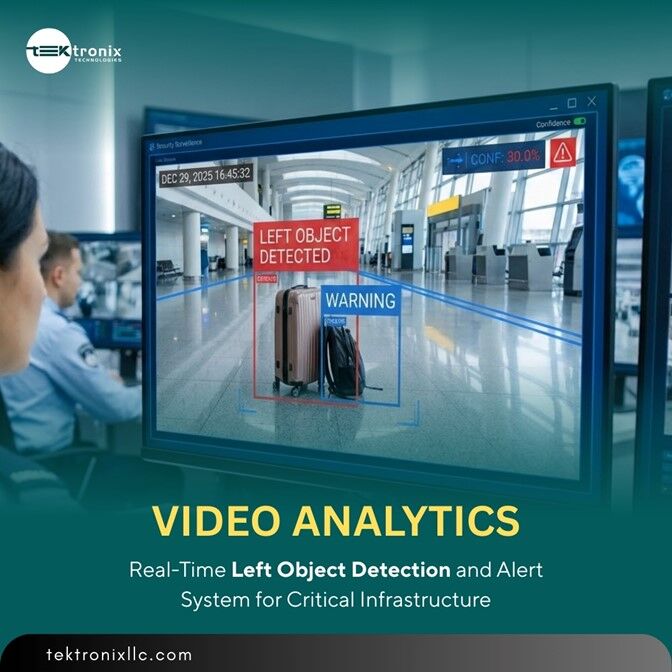
Understanding Left Object Detection in Modern Video Analytics
At its core, left object detection is a specialized capability within Video Analytics that uses computer vision and deep learning to recognize when an item — a bag, box, or package — has been placed in a monitored area and left unattended beyond a defined time threshold. Unlike traditional CCTV, which simply records footage for later review, modern analytics engines continuously interpret every frame, distinguishing between a person briefly setting down luggage and a genuinely abandoned object that warrants investigation.
This capability sits alongside object tracking, motion analytics, perimeter intrusion detection, and forensic video search within a broader smart surveillance ecosystem. Together, these tools give security operators a single, intelligent layer of visibility across sprawling facilities that would otherwise require dozens of human eyes watching hundreds of screens.
Why Oman and the GCC Need Smarter Surveillance
The Gulf region is undergoing rapid infrastructure expansion — new airport terminals, metro systems, logistics corridors, tourism developments, and giga-projects tied to national visions such as Oman Vision 2040. This growth brings larger crowds, higher-value assets, and more complex security perimeters, all of which increase the operational burden on traditional monitoring teams. Video Analytics Oman deployments are increasingly viewed as essential infrastructure rather than optional add-ons, particularly for transport hubs, oil and gas sites, and government buildings that cannot afford a delayed response to an unattended item or a security breach.
Across the wider region, Video Analytics GCC adoption is accelerating as regulators, airport authorities, and enterprise security teams recognize that manual CCTV monitoring simply cannot scale to match the pace of urban and economic growth. Intelligent analytics platforms close that gap by giving every camera the ability to think, flag, and alert — not just record.
How AI-Powered Video Analytics Solutions Work
A modern AI-Powered Video Analytics pipeline begins with live camera feeds, which are processed through trained neural networks capable of recognizing objects, behaviours, and anomalies. When the system identifies an unattended item, a loitering pattern, or a restricted-zone breach, it instantly generates a prioritized alert for the operator, complete with a snapshot, timestamp, and camera location. This is the essence of well-engineered Video Analytics Solutions: turning raw footage into actionable intelligence within seconds rather than minutes.
Real-Time Hazard Detection
Because the analytics engine runs continuously against live streams, Real-Time Hazard Detection is possible the moment an object is dropped, a vehicle is parked in a restricted zone, or a crowd begins to gather unusually. Operators are alerted while the situation is still developing, not after reviewing footage hours later.
Testing, Handover, and Ongoing Support
Before go-live, detection models are validated against real operating conditions and shift patterns. After handover, ongoing tuning and support ensure accuracy holds up as seasons, crowd patterns, and site layouts change over time.
The Future of Left Object Detection Video Analytics in the Region
Looking ahead, expect tighter integration between analytics platforms, edge-AI cameras, drones, and city-wide command centers, allowing alerts to move seamlessly from a single camera to a coordinated citywide response. As 5G connectivity and edge processing mature across Oman and the Gulf, detection latency will continue to shrink, and predictive models will begin flagging risk patterns before an incident even occurs — pushing regional security operations from reactive monitoring toward genuinely proactive protection.
Facilities that begin building this intelligent layer today — starting with high-value use cases like left object detection — will find it far easier to extend into predictive, city-scale analytics tomorrow, rather than retrofitting legacy CCTV networks under pressure after an incident has already occurred.
Conclusion
Video Analytics has moved from a nice-to-have to a frontline necessity for organizations across Oman and the Gulf. AI-Powered Video Analytics platforms now detect unattended objects, unusual behaviour, and emerging hazards the instant they occur, giving control rooms the gift of time. Investing in proven Video Analytics Software and Video Analytics Solutions delivers measurable Real-Time Hazard Detection, faster Automated Emergency Response, Reduced False Alarms, and Detailed Incident Reporting that together strengthen safety outcomes. As Video Analytics Oman and Video Analytics GCC deployments continue to expand, organizations that adopt intelligent detection today will be far better positioned to protect people, property, and reputation tomorrow.
For more information contact us on:
Tektronix Technology Systems Dubai-Head Office
[email protected]
+971 55 232 2390
Office No.1E1 Hamarain Center 132 Abu Baker Al Siddique Rd – Deira – Dubai P.O. Box 85955