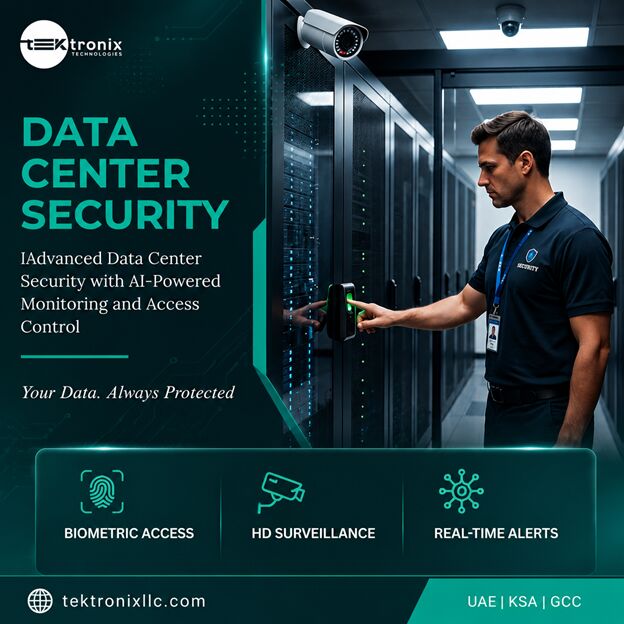
Why Data Center Security KSA Programs Are Now a Boardroom Priority
Saudi Arabia's Vision 2030 agenda has accelerated cloud adoption, smart-city rollouts, and fintech expansion at a pace few regions can match. That growth has placed enormous pressure on facility operators to align with the National Cybersecurity Authority's Essential Cybersecurity Controls, SAMA's regulatory framework for financial institutions, and sector-specific data residency rules. For a Riyadh-based bank or a Jeddah logistics hub, non-compliance is not merely a fine — it is a direct threat to the license to operate.
Giga-projects such as NEOM, expanding hyperscale investment from global cloud providers, and the growth of the Tadawul-listed enterprise sector have all pushed data infrastructure to the top of the national agenda. As more workloads move from legacy on-premise server rooms into purpose-built facilities, boards are asking a very direct question: can our facility withstand a targeted attack and still meet its uptime commitments? That question rarely has a confident answer without an independent security assessment.
Facility operators across the Kingdom are moving away from single-point defences (a firewall here, a badge reader there) toward integrated architectures. This shift is exactly what informs Tektronix's six-layered data center security framework, built specifically for organizations that must satisfy both regional regulators and international auditors simultaneously.
Cybersecurity for Data Center Operations Across the GCC
Beyond the Kingdom, Data Center Security GCC requirements differ subtly from country to country. The UAE's NESA framework, Qatar's National Information Assurance Policy, and Bahrain's Central Bank guidelines each add their own layer of obligation on top of common Gulf Cooperation Council data-sovereignty expectations. Enterprises running regional operations across Riyadh, Dubai, Doha, and Manama increasingly need one security posture that can flex to meet each jurisdiction without being rebuilt from scratch.
A regional threat landscape shaped by geopolitical tension, high-value financial targets, and critical national infrastructure means Gulf data centers are targeted more frequently — and more sophisticatedly — than the global average. Ransomware groups, state-linked actors, and insider threats all feature in recent regional incident reports, which is why forward-looking operators budget for security as a continuous program rather than a one-time deployment.
Cross-border operations add a further layer of complexity. A group headquartered in Riyadh with a disaster-recovery site in Dubai or a colocation footprint in Manama must reconcile several regulators at once, each with its own audit cadence and reporting obligations. Building a security architecture that is documented once and mapped to each jurisdiction's requirements — rather than rebuilt per country — is what allows regional enterprises to scale without multiplying their compliance overhead.
A Six-Layered Framework Built for Regional Compliance
No single control — encryption, a firewall, or a camera system — is sufficient on its own. What distinguishes a genuinely resilient facility is the way these controls are engineered to work together, with overlapping coverage so that a failure in one layer is caught by the next. Tektronix's data center security services in Saudi Arabia bring together perimeter Défense, access governance, surveillance, network security, encryption, and continuous monitoring into a single, auditable framework designed around NCA, SAMA, and broader GCC regulatory expectations.
Organizations evaluating their current posture can review the complete methodology on the six-layered security framework page, which breaks down each layer and how it maps to regional compliance obligations.
A Checklist for Evaluating Your Facility's Security Posture
Whether you operate a private enterprise facility or lease space within a colocation environment, the following questions offer a practical starting point before your next audit cycle:
● Can you produce evidence of encryption key-management procedures on demand?
● Are firewall rule sets reviewed on a fixed schedule, not only after an incident?
● Is access revoked automatically the moment an employee or vendor engagement ends?
● Does video retention meet the minimum period required by your regulator?
● Can your SIEM correlate physical and network events into a single incident timeline?
● Has your architecture been mapped explicitly against NCA, SAMA, or NESA controls?
A confident 'yes' to all six typically indicates a mature, integrated security program. Gaps in two or more areas usually signal that controls exist in isolation rather than as part of a coordinated framework — the exact problem a layered architecture is designed to solve.
Why Regional Enterprises Trust This Approach
Tektronix has spent over a decade delivering security and infrastructure projects for banks, government entities, and enterprise data centers across Saudi Arabia and the GCC. That experience translates into designs informed by real regional audits, not generic global templates — every recommendation in this guide reflects controls that have been implemented and validated in live Gulf facilities.
● Local engineering teams with direct experience across NCA, SAMA, and NESA audits
● Vendor-certified integrations with leading firewall, surveillance, and access-control platforms
● A track record of deployments across banking, government, and enterprise colocation facilities
● Ongoing monitoring and support rather than a one-time installation
Enterprises that want a structured starting point can request a facility assessment mapped directly to the Tektronix six-layered methodology, giving stakeholders a clear, documented view of where their current controls stand against regional regulatory expectations.
Conclusion
Data Center Security now sits at the center of every serious infrastructure conversation in Saudi Arabia and the GCC. Cybersecurity for Data Center operations depends on layered controls working in concert, from Data Center Encryption and Data Center Firewalls to Data Center Access Control and Data Center Surveillance. Early warning comes from disciplined Data Center Intrusion Detection and continuous Data Center Threat Detection, not from chance. Together, these controls define what credible Data Center Security KSA and Data Center Security GCC programs look like today. Enterprises that treat security as an integrated framework, rather than isolated tools, are the ones best positioned to protect their operations and their customers.
For more information contact us on: