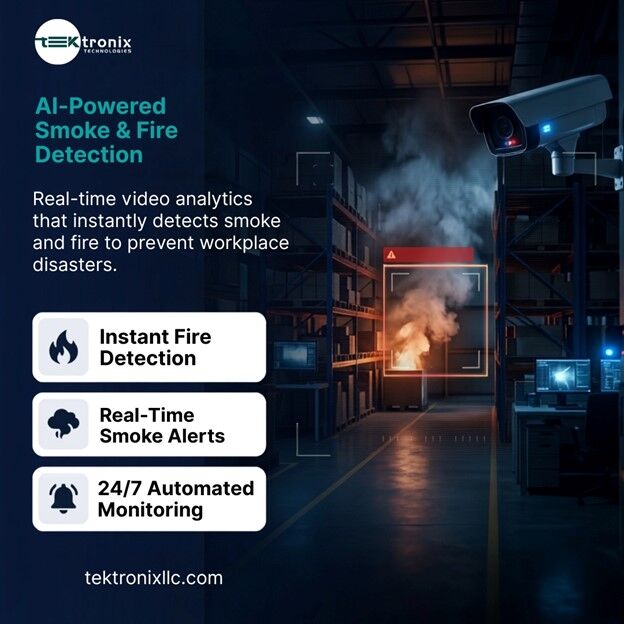
This shift is not a passing trend — it is a structural change in how fire risk is managed. Vision-based intelligence, powered by machine learning and computer vision, is quietly becoming the backbone of next-generation fire protection strategy across the Kingdom and the Gulf Cooperation Council states.
Organizations exploring this shift can review Tektronix's AI-powered video analytics services to understand how intelligent monitoring fits into a modern fire and safety strategy.
For safety directors and facility managers, the appeal of intelligent monitoring lies not just in speed, but in visibility. A well-configured system turns every camera on a property into a potential early-warning sensor, giving operations teams a live, unified view of risk across an entire site — something a scattered network of point sensors was never designed to provide.
The Growing Need for Intelligent Fire Protection in KSA & GCC
The GCC region is undergoing one of the most ambitious infrastructure expansions in the world. Giga-projects such as new economic cities, logistics hubs, entertainment districts, and industrial corridors are being built at a pace that outstrips the capabilities of legacy fire detection hardware. Heat-based sensors and smoke detectors, while still useful, are inherently reactive — they respond only after a fire has already produced sufficient heat, smoke, or particulate concentration.
In large warehouses, oil and gas facilities, shopping malls, transportation hubs, and mixed-use towers common across Riyadh, Jeddah, Dubai, Abu Dhabi, Doha, and Manama, this delay can be costly. Fire doubles in size roughly every minute in the early stages, meaning a one- or two-minute detection lag can be the difference between a contained incident and a catastrophic loss. This is precisely the gap that camera-based, AI-driven monitoring is designed to close.
This exposure is compounded by workforce density. Malls, transit stations, and lab or accommodation facilities across the region host large numbers of people at any given time, and evacuation windows shrink dramatically once smoke begins to spread through corridors and stairwells. Facility planners are increasingly asked to prove — not just assume — that a site's fire strategy can detect and respond within seconds rather than minutes, which is driving direct interest in vision-based systems as a complement to, rather than a replacement for, existing detection hardware.
Implementation Best Practices for Facility Owners
Organizations planning a rollout typically move through a structured process: a site risk assessment to identify high-priority zones, a camera and sensor gap analysis against existing infrastructure, a pilot deployment in one or two critical areas, and a phased expansion once detection accuracy and response workflows are validated. This staged approach limits disruption, controls cost, and allows safety teams to build confidence in the system before scaling site-wide.
● Prioritize high-risk zones first — server rooms, chemical storage, loading docks, and confined spaces.
● Integrate with existing fire alarm control panels rather than running a parallel, disconnected system.
● Define clear escalation workflows so automated alerts translate into predictable human action.
● Review incident logs monthly to refine detection thresholds and reduce nuisance alerts over time.
For a deeper walkthrough of this process, connect with the Tektronix video analytics team to scope a site-specific rollout plan.
Conclusion
Video Analytics is fast becoming the backbone of intelligent fire protection across Saudi Arabia and the GCC, replacing slow, reactive detection with proactive, visually verified safety. By combining Real-Time Hazard Detection, Automated Emergency Response, Reduced False Alarms, and Detailed Incident Reporting, modern Video Analytics Solutions give facility owners a measurable edge in protecting people, assets, and operations. As Video Analytics KSA and Video Analytics GCC adoption accelerates alongside regional giga-projects and smart-city initiatives, organizations that invest early in reliable Video Analytics Software and AI-Powered Video Analytics are positioning themselves ahead of both regulatory expectations and preventable loss. The result is a safer, smarter, and more resilient built environment across the region.
For more information contact us on:
Tektronix Technology Systems Dubai-Head Office
[email protected]
+971 55 232 2390
Office No.1E1 Hamarain Center 132 Abu Baker Al Siddique Rd – Deira – Dubai P.O. Box 85955