Introduction
In commercial building automation, unmanaged lighting and HVAC systems represent a major operational expense. Facility directors and electrical consultants historically installed standard motion detectors to control power usage. However, traditional motion hardware frequently creates operational headaches: when employees sit quietly at office desks typing, reading documents, or leading video calls, basic detectors assume the space is unoccupied and turn off the lights.
Understanding the distinction between a human presence sensor and a human detection sensor is essential for designing modern, friction-free smart buildings. By shifting from crude movement tracking to high-precision 24 GHz FMCW radar, true presence technology continuously monitors biological presence, eliminating false shut-offs entirely. Discover the complete range of indigenous sensing hardware on the official TRUEiSENSE True Presence Sensors.
Core Differences: Human Presence Sensor vs. Human Detection Sensor
Primary Detection Target:
(i) Human Detection Sensor: Tracks gross body movements such as walking, pacing, or waving arms.
(ii) Human Presence Sensor: Tracks biological micro-vibrations, including human respiration, heartbeats, and minor chest shifts.
Sensing Technology:
(i) Human Detection Sensor: Employs Passive Infrared (PIR) heat differentials or basic 5.8 GHz microwave signals.
(ii) Human Presence Sensor: Utilizes high-frequency 24 GHz FMCW millimeter-wave (mmWave) radar.
Seated & Stationary Performance:
(i) Human Detection Sensor: Exhibits high failure rates in stationary environments, triggering frequent false light shut-offs.
(ii) Human Presence Sensor: Delivers 100% continuous accuracy with zero "false-off" switch events.
Core Question Answered:
(i) Human Detection Sensor: "Did a body physically move across the line of sight?"
(ii) Human Presence Sensor: "Is a living occupant physically inside this room right now?"
Optimal Installation Zones:
(i) Human Detection Sensor: Fast-transit zones such as corridors, stairwells, and storage rooms.
(ii) Human Presence Sensor: Seated zones such as workstation desks, boardrooms, hospital rooms, and executive cabins.
Energy Savings Potential:
(i) Human Detection Sensor: Moderate energy savings (20% to 40%) due to extended off-delay timers needed to prevent sudden shut-offs.
(ii) Human Presence Sensor: Maximum energy savings (40% to 80%) by allowing tight, real-time off-delay timers without risk of false shut-offs.
How a Human Presence Sensor Eliminates False Switch-Offs
(i) 24 GHz FMCW Radar Micro-Sensing: Emits high-frequency radio waves that reflect off subtle biological targets, establishing an active detection field unaffected by thermal changes or ambient light.
(ii) Respiration & Chest Expansion Tracking: A true human presence sensor detects tiny sub-millimeter chest movements caused by breathing, ensuring continuous occupancy verification even when occupants sit still for hours.
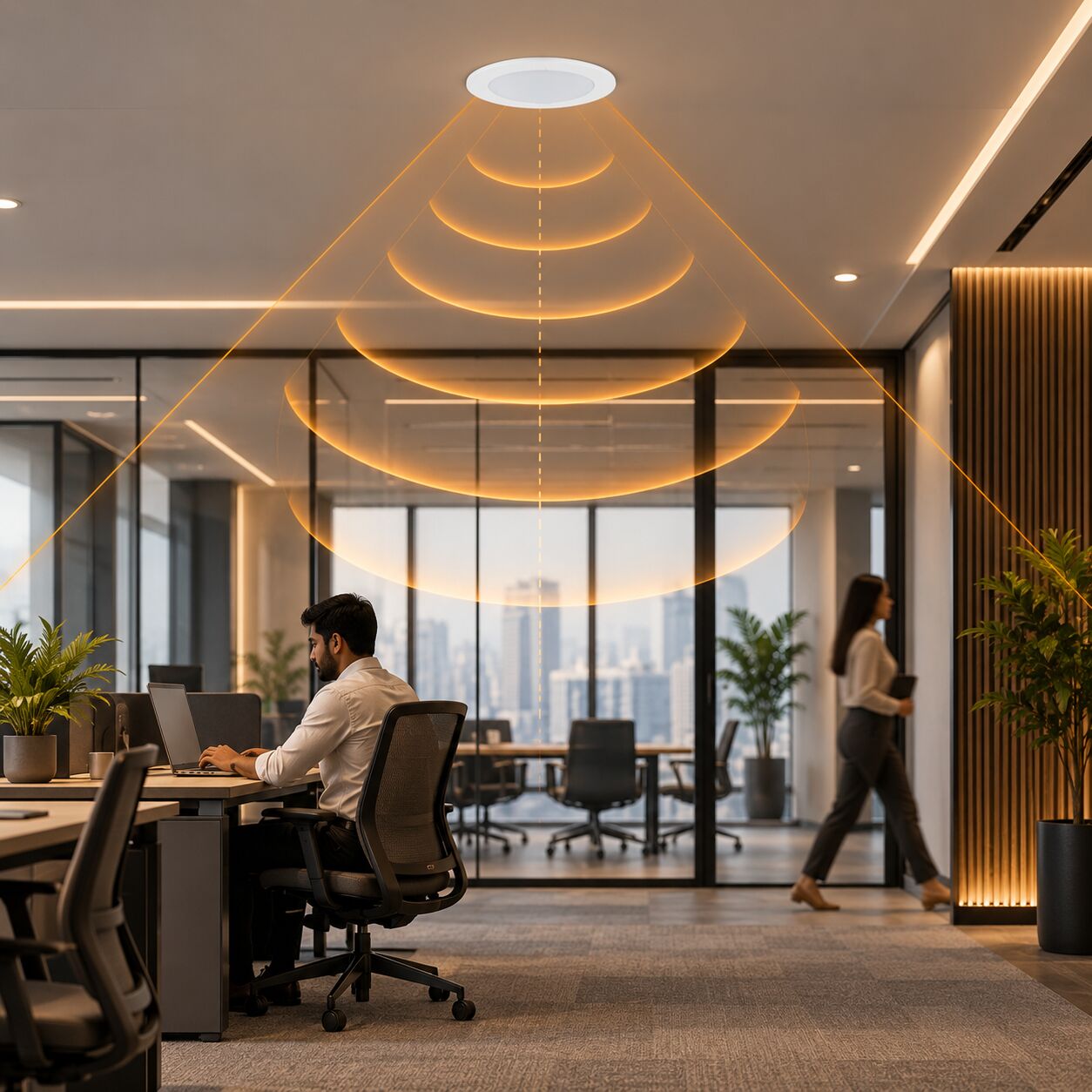
(iii) 3-Tiered Spatial Coverage: Multi-zone sensors manage distinct operational radii: wide motion detection (up to 10m), seated presence tracking (up to 5m), and absolute breathing presence (up to 3m).
(iv) 100% Non-Invasive Privacy: Operates strictly using non-optical radio frequency radar without camera lenses, making it fully privacy-compliant for executive cabins, hospital ICUs, and private restrooms.
(v) Industrial Grid Protection: Hardware features wide input voltage tolerance (120V–290V AC) and built-in surge suppression engineered to withstand unstable commercial power lines.
Key Applications Across Facilities
(i) Executive Cabins & Desk Workstations: Mount a 24 GHz human presence sensor above seating zones to maintain steady lighting while occupants sit stationary reading or typing.
(ii) Conference Rooms & Boardrooms: Keep overhead lighting, climate control, and AV displays active throughout multi-hour presentations without manual button overrides.
(iii) Hospitals & Patient Wards: Monitor patient room occupancy continuously without privacy-violating camera optics.
(iv) Libraries & Study Halls: Automate illumination across large reading zones where students sit motionless for long study sessions.
Buying Guide: Choosing Between Presence and Detection Sensing
Step 1 — Differentiate Space Usage: Deploy a basic human detection sensor in fast-transit corridors and stairwells; specify a human presence sensor for seated workspaces and private cabins.
Step 2 — Verify Radar Operating Frequency: Confirm that high-precision zones utilize authentic 24 GHz FMCW mmWave radar hardware rather than legacy 5.8 GHz microwave modules.
Step 3 — Inspect BMS Protocols: Ensure the hardware supports dry-contact relays, 0–10V dimming, or DALI protocols to integrate into central smart building management portals.
Step 4 — Schedule a Facility Audit: Connect with TRUEiSENSE application engineers to conduct an on-site audit, identify energy wastage zones, and project payback timelines.
FAQ
Q: Can a human detection sensor tell if someone is sitting still in an office chair?
A: No. A standard human detection sensor (PIR) requires physical movement across optical zones; when an occupant sits still, PIR sensors trigger false light shut-offs.
Q: How does a human presence sensor detect a person who is sleeping or meditating?
A: A modern human presence sensor (like the TRUEiSENSE Real Presence Sensor) uses 24 GHz FMCW mmWave radar to track sub-millimeter chest vibrations caused by respiration, keeping lights active even when the person is motionless.
Q: Do radar presence sensors emit harmful radiation or record visual footage?
A: No. High-frequency 24 GHz radar modules emit extremely low-power radio signals (far below standard Wi-Fi router emissions) and operate without cameras, ensuring complete safety and privacy.
People Also Ask
Q: What is the primary difference between a human presence sensor and a motion sensor?
A: Motion sensors detect active body movements (walking or waving), while a human presence sensor detects stationary human existence by tracking subtle biological signals like breathing.
Q: How much electricity can an office building save by switching to presence sensors?
A: Enterprise facilities typically achieve a 40% to 80% reduction in lighting and H