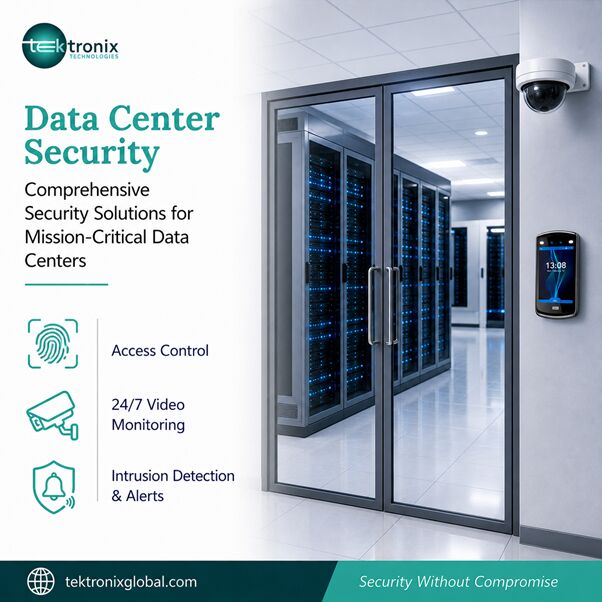
As UAE enterprises accelerate hybrid cloud adoption — moving workloads between on-premises facilities, private cloud environments hosted in UAE colocation sites, and public cloud regions in Dubai and Abu Dhabi — the physical security of the facilities anchoring that hybrid architecture becomes more strategically important, not less. Tektronix LLC has spent more than two decades delivering physical security infrastructure across the Gulf, and its data center security work is built specifically around the shared-responsibility reality of modern hybrid and cloud environments.
Why Cloud and Hybrid Environments Create New Physical Security Demands
The shared responsibility model of cloud computing distributes security obligations between cloud providers and their customers, but it never transfers physical security responsibility away from the operator of the Data Center facility that houses the underlying hardware. Major public cloud regions in Dubai and Abu Dhabi operate within physical facilities that must satisfy the same rigorous physical security requirements as any enterprise-owned site, and the colocation operators housing UAE enterprise private cloud hardware carry the same contractual and regulatory responsibility for the access control, surveillance, and intrusion detection systems protecting each server cage.
For UAE enterprises running hybrid architectures, where sensitive data moves between on-premises servers and cloud-hosted workloads, the physical security of every node in that chain is a potential attack vector. UAE cybersecurity frameworks for critical information infrastructure explicitly include physical security requirements alongside cyber controls, recognising that the strongest network encryption is worthless if an attacker can physically remove a storage drive from an insufficiently secured cabinet.
Data Center Solutions Built Around a Layered Security Architecture
Comprehensive Data Center Solutions for cloud and hybrid environments combine several distinct layers into one coordinated architecture rather than treating each as a standalone purchase: converged network defence, encryption across every data state, identity-verified access control, continuous surveillance, layered intrusion detection, and a unified threat detection capability that correlates events across the physical and cloud domains simultaneously.
Data Center Perimeter Security: The First and Most Critical Boundary
A Data Center Perimeter Security programme establishes the outermost layer of defence before an individual ever reaches a building entrance — fencing, vehicle barriers, perimeter lighting, and camera coverage designed to detect an approach long before it becomes an access attempt. For UAE facilities, this typically includes under-vehicle inspection at delivery and staff vehicle entry points and standoff distance planning that accounts for the specific threat profile of the site.
Conclusion
Securing cloud and hybrid infrastructure in the UAE requires an architecture that protects both the physical and digital layers of the hybrid stack without compromise. A converged approach — combining zero-trust cybersecurity design, encryption across on-premises and cloud domains, consistent firewall policy spanning both environments, identity-verified access control at every physical and logical boundary, full-coverage surveillance retained to regulatory standards, layered intrusion detection across physical and network domains, and threat detection that correlates events across both — gives facility operators genuine confidence that the physical layer their entire digital stack depends on is being protected with the same seriousness as the network above it. As hybrid adoption accelerates across Dubai, Abu Dhabi, and Sharjah, operators who invest in this full architecture now are positioning their infrastructure ahead of a compliance and threat landscape that keeps rising in complexity.
For more information contact us on:
Tektronix Technology Systems Dubai-Head Office
[email protected]
+971 50 814 4086
+971 55 232 2390
Office No.1E1 Hamarain Center 132 Abu Baker Al Siddique Rd – Deira – Dubai P.O. Box 85955