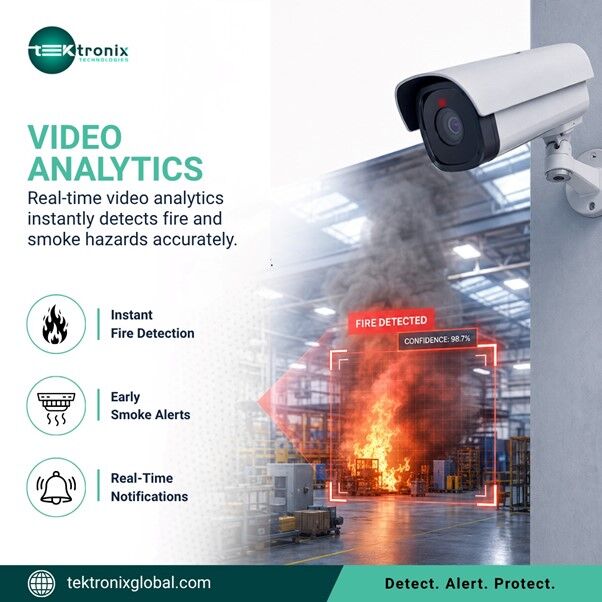
UAE facilities — from oil and gas processing plants and high-bay logistics warehouses to high-rise towers and data centres — face a fire detection challenge shaped by exactly the conditions where traditional sensors struggle most: extreme ceiling heights, strong ventilation, open-sided structures, and outdoor exposure. Local fire codes require detection systems matched to the specific geometry and hazard profile of each space, and camera-based detection has become the practical way to meet that requirement in environments where point detectors simply cannot provide adequate coverage.
Why Traditional Fire Detection Falls Short in UAE Environments
Conventional point-type smoke and heat detectors are designed for enclosed spaces with modest ceiling heights, where combustion products accumulate rapidly at sensor level. They perform poorly, or not at all, in the large-volume spaces that dominate UAE industrial and infrastructure environments: aircraft hangars where ceiling heights exceed thirty metres and high air velocity dilutes combustion particles before they reach a sensor; open-sided logistics sheds where natural ventilation prevents product accumulation; outdoor refineries and petrochemical areas where wind dispersal renders point-detector thresholds largely irrelevant; and road tunnels where detection geometry demands a fundamentally different approach altogether.
In these environments, which represent a significant share of the UAE's highest-consequence fire risk locations, AI-Powered Video Analytics provides a detection capability that conventional systems cannot. Camera-based detection analyses the visual characteristics of fire and smoke as they develop — the distinctive pixel-level patterns of flame flicker, smoke plume expansion, and colour temperature shift — at detection distances of fifty metres or more, across open areas that no realistic quantity of point detectors could adequately cover.
Smart Video Analytics: From Passive Recording to Active Hazard Recognition
Older CCTV networks simply record footage for someone to review after the fact. Smart Video Analytics flips that model, running continuous computer-vision analysis on every camera feed so the system itself recognises a hazard signature in real time rather than waiting for a person to notice it on a monitor wall.
A complete Video Analytics Solution for fire safety combines this recognition layer with the physical camera network, the analytics processing hardware, and the integration links to a facility's existing fire alarm and building management infrastructure — the software alone is only useful once it is genuinely wired into the systems that need to act on what it sees.
At the core of that stack sits the Video Analytics Software, which runs the detection algorithms frame by frame, and the broader Video Analytics System architecture that manages camera health, processing load distribution across a large multi-camera site, and the alerting pipeline that turns a detection event into an action a human or another system can respond to.
Why UAE Fire Safety Managers Choose Tektronix
Tektronix LLC holds active SIRA licensure and maintains certified integration partnerships with Axis Communications, Hikvision, Genetec Security Center, Milestone XProtect, and Dahua — the platforms whose AI analytics engines power its fire and smoke detection deployments. With more than 500 surveillance and analytics installations across the UAE and GCC spanning industrial, critical infrastructure, transport, and government environments, the engineering team carries formal training in analytics platform configuration, fire and smoke detection algorithm calibration, building management and fire alarm panel integration, and civil defence technical approval documentation preparation.
Target false-alarm performance is documented in the project specification and formally validated during site acceptance testing before handover to a client's fire safety team, ensuring the deployed system performs to its commissioned standard from day one rather than requiring extended tuning after go-live.
Conclusion
Camera-based fire and smoke detection has become the most effective option for the large-volume, high-consequence environments that define UAE fire risk across industrial, logistics, transport, and critical infrastructure sectors. Built on analytics engines that identify fire and smoke signatures in seconds, triggering automated response sequences across integrated building and safety systems, cutting nuisance alarms through scene-specific calibration, and generating incident records that satisfy civil defence and insurance documentation requirements, a well-implemented video analytics platform protects both lives and assets in a way conventional point detectors were never designed to across the environments where UAE fire risk is highest.
For more information contact us on:
Tektronix Technology Systems Dubai-Head Office
[email protected]
+971 50 814 4086
+971 55 232 2390
Office No.1E1 Hamarain Center 132 Abu Baker Al Siddique Rd – Deira – Dubai P.O. Box 85955