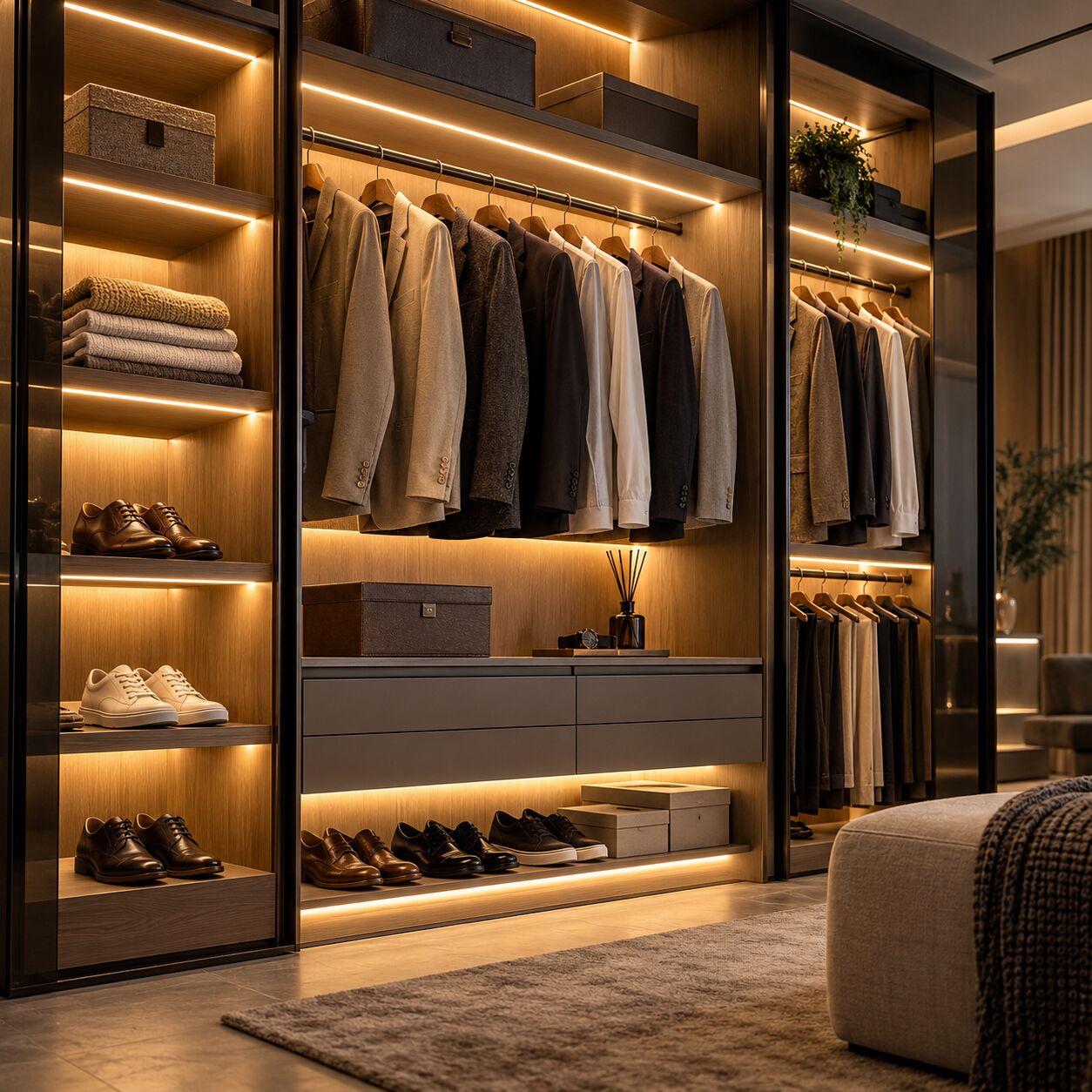
Product Overview
(i) Esysense Low-Voltage IR Proximity Sensors: Precision single and dual-probe infrared sensors (such as the ESY-M22 and ESY-M23) designed for seamless, flush-mounted installation inside modern wardrobe carcasses.
(ii) Esysense Heavy-Duty Push Door Switches: Direct 110V–270V AC mechanical plunger switches (like the ESY-TC36) engineered for reliable, driver-free cabinet door activation.
(iii) Esysense Smart Touch & Gesture Sensors: Versatile wave and touch dimming modules (like the ESY-M40) ideal for glass display wardrobes and open dressing bays.
(iv) Recessed LED Channel Profiles: Ultra-slim aluminum profile tracks that house high-CRI LED strip lights for elegant, shadow-free wardrobe lighting.
A Guide to Automatic Lighting for Modern Wardrobes
A modern bedroom wardrobe is more than just storage; it is an essential part of your daily routine. Deep closets, corner shelves, and unlit clothing bays make finding garments or distinguishing subtle color shades frustrating under distant bedroom ceiling lights. Installing an integrated wardrobe automatic light system elevates both functional convenience and interior aesthetics.
1. Choosing the Right Sensor Technology for Your Wardrobe
Selecting the best wardrobe sensor light switch depends on your cabinet door layout and furniture
design:
(i) Infrared (IR) Proximity Sensors: Installed inside the cabinet carcass to monitor shutter position within a 5 cm detection range. Opening the door breaks the reflected IR beam to turn lights ON instantly. Available in single-probe options for individual doors or dual-probe configurations for double doors.
(ii) Passive Infrared (PIR) Motion Sensors: Detects thermal movement across an open space. These work best in walk-in closets, open dressing bays, and sliding wardrobe setups where physical door proximity triggers are impractical.
(iii) Mechanical Push Switches: Heavy-duty plunger switches mounted on the cabinet frame. Opening the shutter releases a spring plunger to complete the circuit, offering direct AC power compatibility without requiring external DC drivers.
(iv) Touch & Gesture Wave Sensors: Mounted along glass display shelves or vanity bays, allowing you to turn lights on or dim them with a light touch or hand wave.
2. Matching Lighting Output & Color Temperature
(i) Warm White (3000K): Delivers a cozy, luxury hotel atmosphere ideal for natural dark wood, walnut, or warm laminate wardrobes.
(ii) Neutral White (4000K): Provides crisp, daylight-accurate illumination. High Color Rendering Index (CRI 90+) LEDs ensure you can accurately tell navy blue from black garments.
(iii) LED Profile Channel Selection: Housing flexible LED strips inside recessed aluminum profiles with opaque diffusers softens harsh glare and provides smooth, linear light across shelves.
3. Power Delivery: Hardwired vs. Wireless
(i) Hardwired Systems (12V / 24V DC): Connects directly to house power via a concealed LED driver. Offers continuous power, higher brightness (500–1000+ lumens), and zero battery recharging maintenance.
(ii) Direct AC Switches (110V–270V AC): Connects directly into standard mains electrical lines, simplifying wiring for mechanical switches without requiring separate power transformers.
(iii) Wireless Battery Units: Uses magnetic mounts for quick stick-on installation, making them suitable for rental homes or retrofitting finished cabinets.
Key Sensor Options for Modern Wardrobe Automation
Single-Door IR Proximity Sensor Features:
(i) Sensor Type: Active Infrared Break-Beam.
(ii) Detection Range: 5–6 cm proximity distance from the shutter.
(iii) Voltage: 12V–24V DC low-voltage system.
(iv) Best For: Single hinged shutters, overhead lofts, and pull-out drawers.
Double-Door Dual-Probe IR Sensor Features:
(i) Sensor Type: Dual IR Sensing Heads connected to a Master Controller.
(ii) Control Logic: OR-Logic Circuit (opening either left or right shutter triggers lights ON).
(iii) Voltage: 12V–24V DC low-voltage system.
(iv) Best For: Master double-leaf wardrobes and large armories.
Mechanical Push-Button Switch Features:
(i) Sensor Type: Spring-Loaded Plunger Switch.
(ii) Voltage Support: Direct 110V–270V AC mains compatibility.
(iii) Best For: Heavy wooden shutters and driver-free cabinet installations.
PIR Motion Sensor Module Features:
(i) Sensor Type: Passive Thermal Infrared Motion Detector.
(ii) Coverage: Wide angle motion detection.
(iii) Best For: Walk-in closets, sliding doors, and open clothes racks.
Step-by-Step Plan to Upgrade Your Wardrobe Lighting
(i) Map Out Wardrobe Sections: Identify whether your closet uses single doors, double doors, or sliding panels to select matching sensor types.
(ii) Select Sensor & Control Mechanisms: Choose dual IR probes for double doors, single IR probes for single doors, or PIR sensors for walk-ins.
(iii) Plan Power Supply Placement: Reserve space in an upper loft or behind top paneling to house low-voltage 12V DC power drivers cleanly.
(iv) Install Recessed LED Profiles: Cut shallow channel grooves into shelf undersides to embed aluminum tracks for glare-free lighting.
(v) Connect and Calibrate: Mount sensor probes within 5 cm of closed door panels to ensure reliable automatic activation.
People Also Ask
Q: How does a wardrobe automatic light turn on when the door opens?
A: A wardrobe automatic light uses proximity sensors (active IR beams) or mechanical plunger switches mounted along the cabinet frame. Opening the door breaks the infrared reflection or releases the plunger, completing the circuit to turn on connected LED lights.
Q: Do wardrobe sensor lights waste electricity if left open accidentally?
A: Modern LED wardrobe lighting consumes minimal power (typically 5W to 15W total). While lights remain on while doors are open, closing the doors shuts power down immediately, preventing energy waste compared to ceiling room lights left on continuously.
Q: Can I install a wardrobe sensor light in an existing finished closet?
A: Yes. You can retrofit surface-mounted LED profile channels powered by slim 12V DC transformers, or install wireless battery-powered motion sensor light bars for a tool-free upgrade.
Frequently Asked Questions (FAQ)
Q: What is the difference between an IR sensor and a PIR sensor for wardrobes?
A: An IR proximity sensor measures distance to the cabinet shutter (5 cm range) to trigger lights based strictly on door position. A PIR motion sensor detects thermal body heat movement, making it ideal for walk-in closets or sliding doors.
Q: Where should a wardrobe automatic light sensor probe be mounted?
A: Mount the sensor probe along the top or side inner f