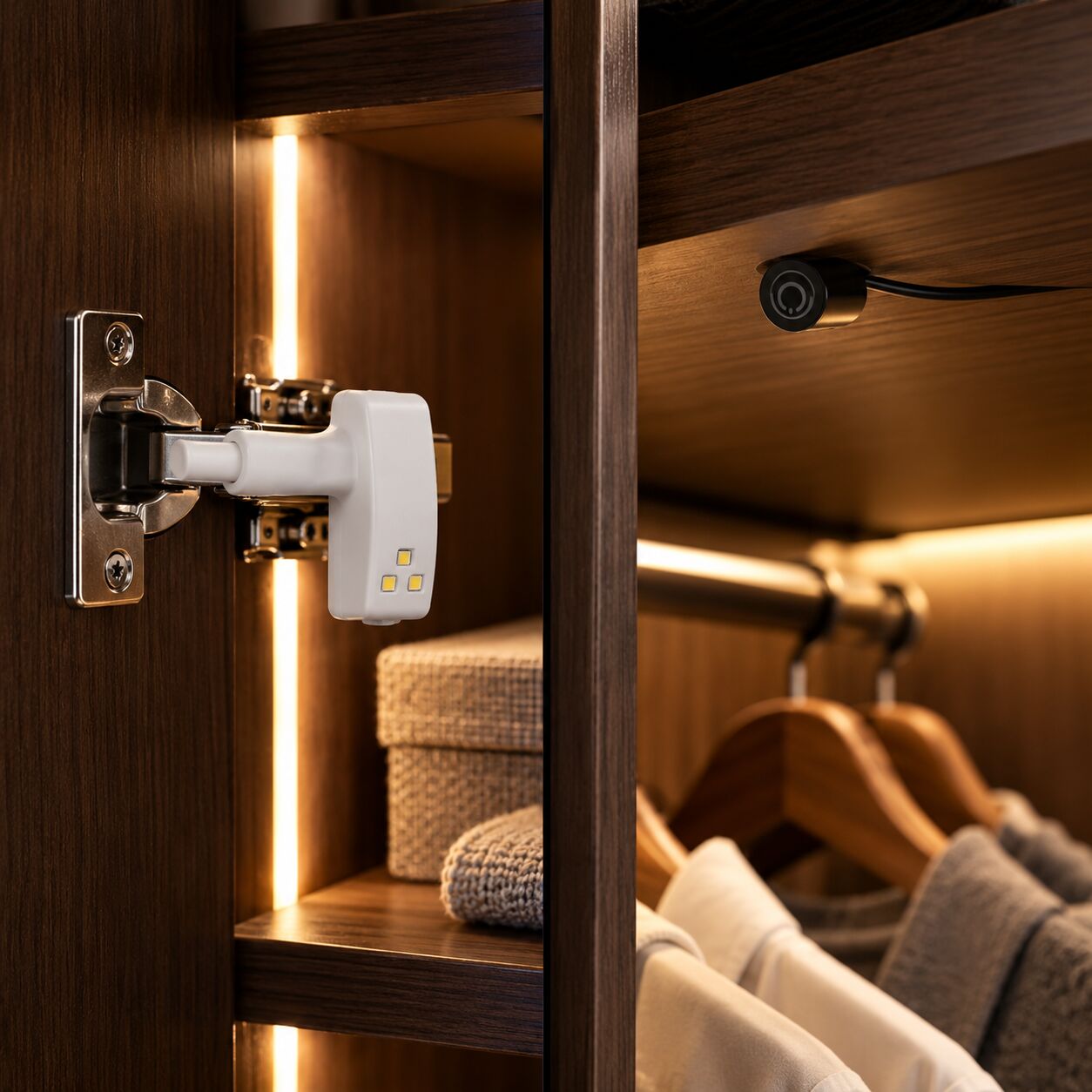
Product Overview
(i) Hinge Light Switch: Battery-powered or low-voltage plunger units that attach directly to standard 35mm concealed European cabinet door hinges.
(ii) Esysense Single & Dual-Probe IR Wardrobe Door Sensors: Independent optical distance sensors (such as ESY-M22 and ESY-M23) flush-mounted along carcass frames to control 12V/24V DC LED lighting zones.
(iii) Esysense ESY-TC36 Direct AC Push Switches: Heavy-duty standalone mechanical door switches that connect straight to 110V–270V AC mains lines.
Hinge-Mounted Sensors vs Separate Door Sensors for Cabinets
Upgrading wardrobes, kitchen pantries, and storage cupboards with automatic interior lighting requires selecting the right trigger mechanism. While both options eliminate dark cabinet corners, understanding the structural differences between a hinge light switch and a standalone wardrobe door sensor ensures optimal performance for your furniture layout.
1. What Is a Hinge Light Switch?
A hinge light switch is integrated directly into or attached alongside the mounting plate of standard 35mm concealed European cabinet hinges.
Mechanism: Operates via a mechanical spring plunger or built-in micro-switch. When the door closes, the hinge plate depresses the plunger to cut power; when opened, the plunger releases to complete the electrical circuit.
Primary Advantage: Extremely compact, budget-friendly, and ideal for quick retrofits on individual cabinet doors without needing extra wire routing along the frame.
2. What Is a Separate Wardrobe Door Sensor?
A separate wardrobe door sensor operates independently of the cabinet's physical hinge hardware.
Mechanism: Uses optical infrared (IR) proximity probes, passive thermal motion sensors (PIR), or standalone frame-mounted plunger switches.
Primary Advantage: Highly adaptable placement. Sensor probes can be recessed flush into top carcass paneling, side walls, or center dividing pillars, providing clean optical triggers for double doors, sliding shutters, and large wardrobes.
Technical Feature Comparison: Hinge Switch vs. Separate Door Sensor
Hinge Light Switch:
(i) Mounting Location: Attached directly to existing 35mm cabinet hinge screws or plates.
(ii) Power Source: Typically powered by replaceable button cell batteries or localized low-voltage leads.
(iii) Trigger Mechanism: Physical mechanical plunger pressure actuated by hinge swing.
(iv) Best Suited For: Single-shutter kitchen cabinets, small cupboards, and quick DIY retrofits.
(v) Limitations: Cannot easily manage unified double-door lighting zones or sliding doors.
Separate Wardrobe Door Sensor:
(i) Mounting Location: Recessed or surface-mounted along the cabinet carcass frame.
(ii) Power Source: Hardwired 12V/24V DC driver systems or direct 110V–270V AC lines.
(iii) Trigger Mechanism: Optical IR proximity beams, thermal PIR motion, or heavy-duty AC switches.
(iv) Best Suited For: Custom modular wardrobes, double-leaf armoires, and multi-tier LED strip channels.
(v) Limitations: Requires planning wire pathways and power driver placement during installation.
How to Choose the Right Setup for Your Cabinets
(i) Evaluate Door Construction: If your wardrobe features double doors that meet at a center seam, choose a separate dual-probe wardrobe door sensor to ensure lights turn on regardless of which shutter opens first.
(ii) Consider Installation Complexity: For existing furniture where running hidden wires is difficult, a battery-powered hinge light switch offers quick, tool-free installation.
(iii) Determine Light Output Needs: For high-brightness COB or SMD LED strip channels running across multiple shelves, a hardwired separate wardrobe door sensor connected to a 12V/24V DC driver delivers continuous power without battery maintenance.
People Also Ask
Q: Can a hinge light switch work on double-door wardrobes?
A: A single hinge light switch only controls lighting for the specific door leaf it is attached to. For a unified double-door closet where opening either door lights up the entire space, a separate dual-probe wardrobe door sensor is recommended.
Q: Do separate wardrobe door sensors require drilling into cabinet wood?
A: Not necessarily. While flush-recessed IR proximity probes use small 10mm drill holes for a built-in finish, surface-mounting clip brackets and adhesive pads allow completely drill-free installation.
Q: How long do battery-powered hinge light switches last?
A: Because the LED beads draw minimal power during brief seconds when cabinet doors remain open, standard button batteries in a hinge light switch typically last between 6 and 12 months depending on daily usage.
Frequently Asked Questions (FAQ)
Q: What is a hinge light switch for cabinets?
A: A hinge light switch is a compact LED lighting module that attaches directly to standard cabinet door hinges, automatically switching lights ON or OFF when the door swings.
Q: Why choose a separate wardrobe door sensor over a hinge-mounted switch?
A: Separate wardrobe door sensors support higher-wattage LED strips, offer touchless optical triggers, and allow multi-door control across wide wardrobes.
Q: Are separate wardrobe door sensors compatible with sliding doors?
A: Yes. Standalone motion sensors (PIR) or top-track sensors work seamlessly on sliding cabinet panels where hinge switches cannot be installed.
Q: Will a hinge light switch fit any type of cabinet hinge?
A: Most hinge light switches are designed specifically for standard 35mm concealed European-style cabinet hinges with removable mounting screws.
Q: Where can I buy reliable wardrobe door sensors and cabinet lighting hardware?
A: Explore single-probe, dual-probe, PIR, and touch sensor controls directly at the Esysense Wardrobe & Cabinet Sensor Lighting.
Recommended Resources & Next Steps
Ready to choose the ideal sensor switch for your home storage? Explore professional single and dual-probe IR proximity sensors, push switches, and profile accessories at the official Esysense Wardrobe & Cabinet Sensor Lighting.
Written from direct product testing and manufacturer specifications by Esysense Tech Innovations Pvt. Ltd., Noida, India. All prices, specs and model references are verified against live product listings at esysense.com. Last updated: September 2026.