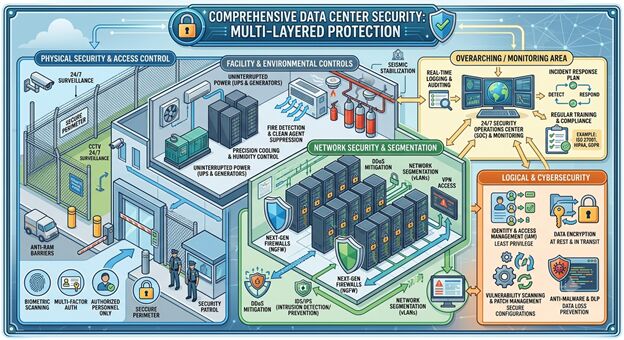
This guide walks through the core pillars of a resilient data center security strategy — encryption, firewalls, access control, surveillance, and intrusion detection — and explains why financial institutions operating in Kuwait and across the GCC need a partner who understands both global best practice and local regulatory expectations.
Why Financial Institutions in Kuwait & GCC Need Robust Data Center Security
Banking, insurance, and payment infrastructure in the Gulf has moved almost entirely online. Mobile banking apps, instant payment rails, and cloud-connected core banking systems mean a single point of failure can disrupt an entire economy's financial flow. Attackers know this, and financial services remain one of the most targeted sectors worldwide, facing everything from ransomware and phishing campaigns to state-sponsored espionage aimed at critical infrastructure.
At the same time, central banks and regulators across the region — including the Central Bank of Kuwait, the Saudi Central Bank, and the UAE's regulatory bodies — have introduced stricter cybersecurity and data residency frameworks. Meeting these obligations starts at the physical and digital core of every institution: the data center itself. A facility engineered around layered defence reduces downtime risk, protects customer confidence, and keeps an institution audit-ready year-round.
Beyond regulation, there is a simple business reality: trust is the product a bank actually sells. A single publicised outage or data breach can undo years of brand-building overnight, driving customers toward competitors and inviting regulatory penalties. Investing in resilient infrastructure — redundant power, environmental controls, and layered security — is therefore as much a commercial decision as a technical one, directly protecting revenue, reputation, and long-term customer retention.
Cybersecurity for Data Center: Building a Resilient First Line of Defence
Cybersecurity for Data Center environments goes beyond antivirus software or a single firewall rule set. It is a coordinated discipline covering network segmentation, continuous patch management, endpoint hardening, and 24/7 security operations center (SOC) monitoring. Every server, switch, and management console inside the facility is treated as a potential entry point and secured accordingly.
● Network segmentation to isolate core banking systems from general IT traffic
● Continuous vulnerability scanning and timely patch deployment
● Hardened server and hypervisor configurations
● Round-the-clock monitoring by a dedicated security operations team
Cybersecurity teams supporting financial institutions also run regular tabletop exercises and penetration tests, simulating real-world attack scenarios so that response playbooks are proven before they are ever needed. Combined with employee awareness training, this reduces the human-error risk that remains one of the leading causes of security incidents in the banking sector.
Why Financial Institutions Trust an Experienced Regional Partner
Securing a financial institution's data center is not a one-time project — it requires engineers who have deployed, monitored, and maintained these systems across real banking and enterprise environments in the region. Tektronix brings hands-on experience delivering layered security infrastructure for enterprise and financial clients across Kuwait and the GCC, backed by certified security professionals, vendor-accredited engineering teams, and a track record of supporting regulated industries through audits and compliance reviews.
This combination of technical depth and regional regulatory familiarity is what allows financial institutions to move from a reactive security posture to a proactive, layered defence strategy that stands up to both attackers and auditors.
Conclusion
Data Center Security and Cybersecurity for Data Center practices together protect Kuwait and GCC financial institutions from an ever-evolving threat landscape.
Strong Data Center Encryption and modern Data Center Firewalls keep sensitive financial data locked away from attackers at every layer.
Strict Data Center Access Control paired with round-the-clock Data Center Surveillance ensures only authorized personnel ever reach critical systems.
Advanced Data Center Intrusion Detection and Data Center Threat Detection capabilities catch risks before they cause real damage.
Choosing a trusted partner for Data Center Security Kuwait and Data Center Security GCC needs is one of the smartest investments a financial institution can make today.