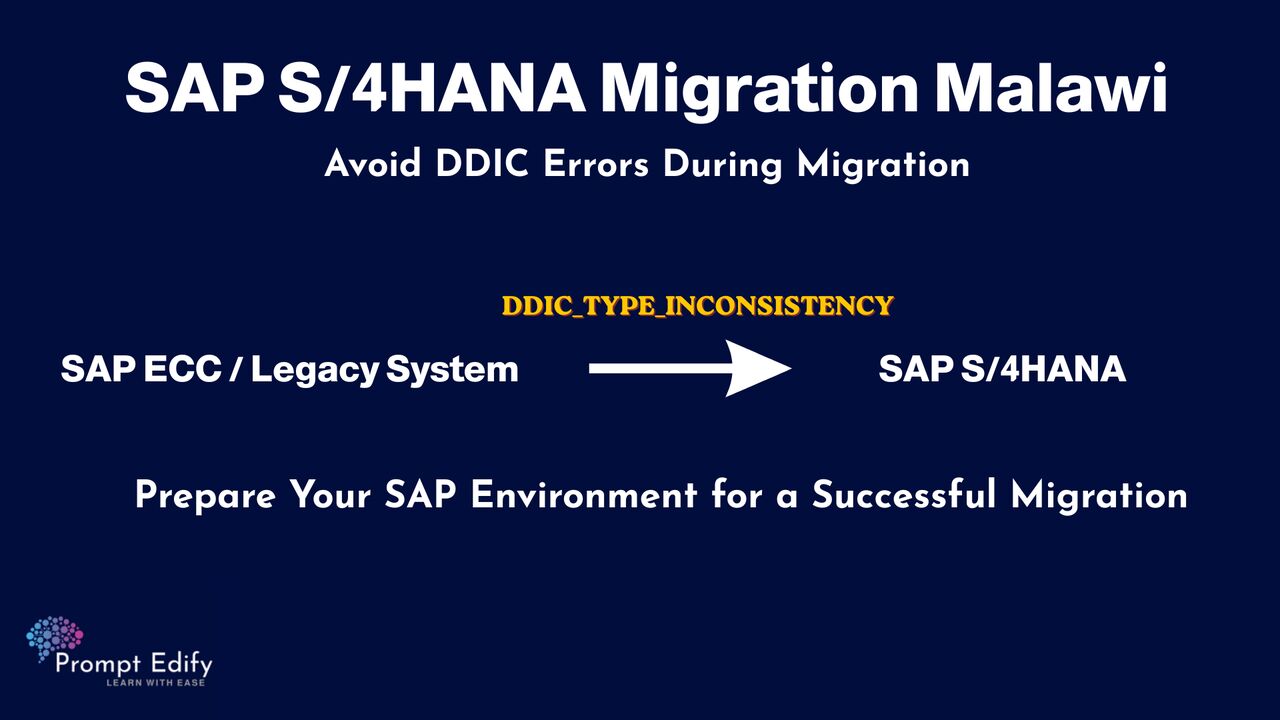
Migration is not only a transfer of information from one platform to another. Companies that have used SAP ECC for many years could have created custom objects, like programs, reports, tables, interfaces, and others, which would be useful for the business at the current moment but would bring technical challenges when migrating to SAP S/4HANA.
One of the main issues during the process of migration may become a DDIC_TYPE_INCONSISTENCY error.
This error can happen during the migration or simulation process due to some incompatibility between a custom conversion object and the SAP ABAP Dictionary. It is very important to identify the error prior to the migration process itself.
What Is DDIC_TYPE_INCONSISTENCY?
DDIC_TYPE_INCONSISTENCY is connected with the SAP ABAP Dictionary or simply DDIC.
SAP ABAP Dictionary (DDIC) is SAP’s central repository for defining tables, fields, data types, and structures.
The problem might arise because of custom Z* developments for an organization's previous SAP system.
For instance, a company might use a conversion program that has been in use for several years now. In the course of an SAP S/4HANA migration, this program interacts with some structure or DDIC object which is inconsistent with the target environment.
As a result, the migration stops or reports an error.
Why Can This Happen During a Legacy System Upgrade?
An Legacy System Upgrade may prove to be much more difficult than expected due to the fact that legacy SAP systems may have accumulated years' worth of customizations.
Some examples of such customizations include:
Custom Z* applications
Custom tables and structures
User Exits
Enhancements
Custom reports
Interfaces
Conversion programs
Custom fields
Some customizations may not even be necessary anymore. Some of them might need to be adapted technically to be able to run on the new platform.
This is why it is important for companies to analyze their customizations before the actual migration takes place.
SAP ECC to S/4HANA Migration: Why Preparation Matters
Migration of SAP ECC to S/4HANA may result in modifications of data structures, processes, integration, and technical elements.
Let's consider an organization from Lilongwe that has used SAP ECC for years. The financial and supply chain departments of this organization may use custom reporting tools and programs that have been tailored specifically for it.
The organization prepares its master data and initiates the migration process. During testing, one of the custom conversion objects generates the following error:
DDIC_TYPE_INCONSISTENCY
Instead of considering that this issue is related to the business data, the technical department needs to check the object that causes the error.
This case proves that the preparatory work for the migration process requires data and custom-code assessments.
SAP offers Custom Code Migration features to analyze custom solutions that may need to be adapted when migrating to SAP S/4HANA.
How SAP S/4HANA Migration Cockpit Helps
The SAP S/4HANA Migration Cockpit assists in transferring business data into SAP S/4HANA. The software offers migration projects and migration objects as well as processes such as simulation and migration monitoring.
The process of simulation is quite helpful since it allows the migration team to identify any possible issues prior to the final data loading.
The migration flow can be described in the following way:
Prepare → Check → Simulate → Identify Errors → Fix → Test Again → Migrate
In case of any DDIC_TYPE_INCONSISTENCY error, which is generated by a custom conversion object during the testing process, the problem can be identified prior to migration.
How to Troubleshoot DDIC_TYPE_INCONSISTENCY
There is no universal solution to all cases of DDIC_TYPE_INCONSISTENCY.
What the right solution is depends on the object where the problem occurs and on its cause.
However, there are some steps an organization may follow to troubleshoot the problem.
1. Determine the Affected Object
To begin with, one should analyze the information about the migration error and find out the custom conversion object or the Z* development that has caused the issue.
This way, it will be much easier to investigate the problem.
2. Review the ABAP Dictionary
Next, one should review the appropriate tables, structures, data elements, and other DDIC objects.
It is necessary to find out if the technical specifications correspond to the requirements of SAP S/4HANA.
3. Analyze Custom Code
One should review the custom code or the conversion object and see whether changes are needed.
Custom code analysis and using ATC checks will help to detect any changes needed in the process of SAP S/4HANA conversion.
4. Fix the Inconsistency
After the source of inconsistency is determined, the technical team may proceed with changes and activate relevant objects.
Then the fix has to be tested.
5. Repeat Simulation
After completing all necessary fixes, one should perform the simulation process once again.
In case of successful migration object processing without errors, the next steps may follow.
Building a Strong SAP S/4HANA Migration Strategy
The ideal SAP S/4HANA Migration Strategy should be carried out even before the actual process of migration begins.
For organizations operating in Malawi, it is vital to have knowledge about their SAP system.
Some of the components of a good strategy are:
Analyzing the current SAP ECC System
Custom programs and developments analysis
Identification of obsolete custom developments
Analysis of data quality
Analysis of interfaces and integration
Changes in business processes
Testing migration objects
Simulation of migration process
Resolution of technical issues
Validation of migrated data
Effective migration process planning
Documentation is also vital. Migration teams should document changes in the system, the need for custom developments, data, testing results, and compliance.
In the event that an organization has complex document and reporting requirements, then the Prompt Edify DRC services should be considered while formulating the SAP Transformation Strategy. DRC services are concerned with the SAP documents and reporting requirements.
Why SAP Community Matters During Migration
Some questions could arise concerning custom code, migration objects, data structure, testing, and features of the SAP S/4HANA system. Learning from other SAP experts will allow obtaining information on how to deal with these aspects.
SAP Community offers opportunities for SAP experts to share their experience, discuss technical problems, and keep up with changes in the SAP environment.
Prompt Edify offers help to SAP learners and professionals via SAP training and the SAP community. Being involved in a professional learning network will allow developin