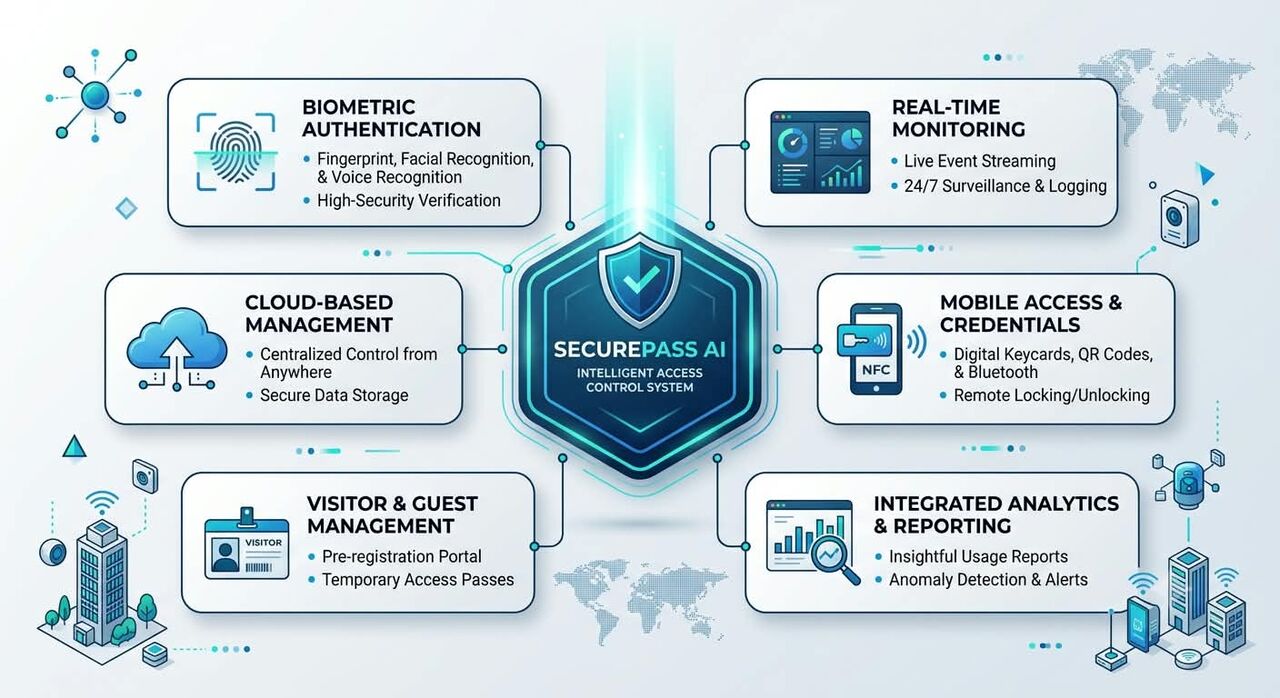
Access Control Solutions
Access Control Solutions include the complete combination of hardware and software required to manage secure entry. These solutions may include card readers, biometric terminals, electronic locks, access controllers, management software, and monitoring tools. For a small business, a basic door access solution may be sufficient, while a large enterprise may require a centralized platform capable of managing multiple buildings, floors, doors, and user groups.
Modern access control solutions can also integrate with CCTV cameras, visitor management systems, time attendance platforms, automatic gates, turnstiles, and other security technologies. This integration allows businesses to create a connected security environment instead of managing different systems separately.
Access Control Device
An Access Control Device is the physical hardware used to identify a person and control entry. Depending on the system, this can be a card reader, fingerprint scanner, facial recognition terminal, PIN reader, mobile credential reader, or other authentication device. The device communicates with the access controller or software to determine whether access should be granted.
For businesses that want convenient and touchless authentication, facial recognition devices are becoming increasingly popular. These devices can identify authorized users quickly without requiring them to carry a physical card. The right access control device should be selected according to the location, expected user volume, environmental conditions, security requirements, and integration needs.
Security Access Control System
A Security Access Control System provides controlled and monitored entry to areas that require additional protection. It is particularly useful for locations such as server rooms, data centers, executive offices, warehouses, laboratories, financial facilities, and restricted government or industrial areas.
Security access control can use multiple authentication methods to strengthen protection. For example, a business may require an employee to use both a card and a PIN before entering a highly restricted area. More advanced systems can combine biometric authentication, CCTV verification, alarms, and real-time monitoring to provide multiple layers of security.
Biometric Access Control
Biometric Access Control uses a person's unique physical characteristics to verify identity. Common biometric technologies include fingerprint recognition and facial recognition. Unlike traditional access cards, biometric credentials are directly linked to the individual, which can help reduce problems associated with lost, stolen, or shared cards.
Facial recognition is particularly useful in modern workplaces where organizations want a fast and touchless entry experience. Biometric Access Control can be deployed at office entrances, restricted departments, data centers, schools, healthcare facilities, residential communities, and other
locations where identity verification is important. Before deployment, organizations should also consider privacy, data protection, system accuracy, and applicable local requirements.
Door Access Control System
A Door Access Control System is designed specifically to manage entry through individual doors. It can be installed on office entrances, meeting rooms, server rooms, storage areas, employee-only zones, and other restricted locations. Depending on the security requirement, a door access system can use RFID cards, PINs, mobile credentials, fingerprints, or facial recognition.
A modern Door Access Control System can also maintain access records, allowing authorized administrators to see when a particular credential was used. This creates greater visibility and accountability while making it easier to deactivate credentials when an employee leaves the organization or when a credential is lost.