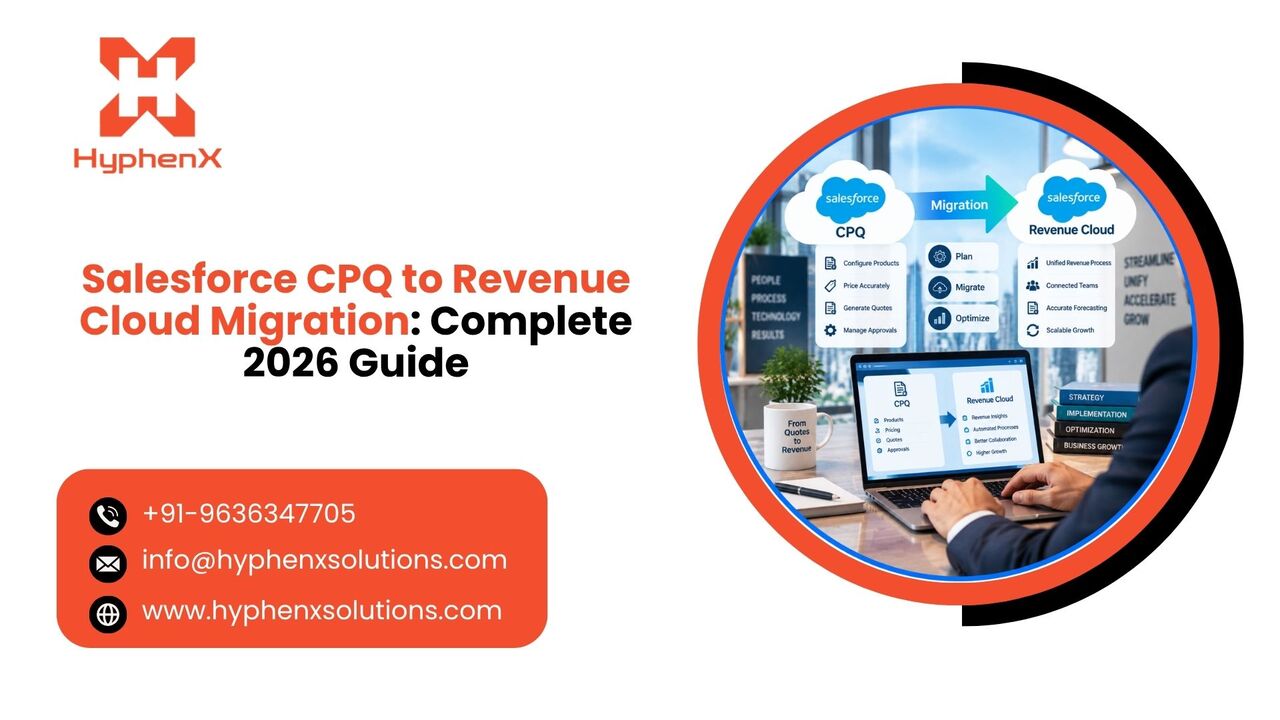
Salesforce now refers to Revenue Cloud as Agentforce Revenue Management in current documentation, while Revenue Cloud Advanced remains the successor product discussed for CPQ customers. A sound migration therefore starts as a redesign exercise rather than a record-copy exercise. The work should protect live quoting and renewals while the new product model, pricing logic, transaction flows, and integrations are prepared.
Step 1: Define the migration case before touching configuration
Start by documenting why the current CPQ setup needs to change and what the new system must support. Record active selling models, quote volumes, approval paths, contract motions, billing handoffs, integrations, custom Apex, plugins, and renewal behavior. Salesforce’s July 10, 2026 CPQ update says CPQ is in maintenance rather than end of life, so teams can plan around business readiness instead of an invented shutdown date. A CPQ migration service should turn the starting inventory into a signed scope, an owner map, and clear acceptance criteria before build work begins.
Step 2: Clean the catalog and decide what deserves to move
The product catalog is the foundation for later configuration, so move only what the business still sells or needs to service. Review duplicate SKUs, inactive bundles, obsolete options, hidden dependencies, and product rules that exist only because of old workarounds. Salesforce lists catalog rationalization as a common migration issue when teams defer cleanup and then recreate unnecessary complexity in the target system. For a Revenue Cloud Advanced migration, each retained product should have a clear commercial purpose, current attributes, and an identified pricing model before it enters the build backlog.
Step 3: Rebuild pricing and configuration against real selling rules
Pricing logic should be translated by business intent rather than copied field for field. Document how list prices, discounts, subscriptions, amendments, renewals, exceptions, and approval thresholds are supposed to behave, then map those outcomes to Revenue Cloud capabilities. Salesforce’s Spring ’26 CPQ Administrator guidance describes 3 foundation stages in sequence: product catalog setup, pricing and pricing models, then sales and contract processes. It also says data volume, custom product structures, legacy systems, integrations, and subject-matter availability can affect migration effort.
A CPQ to RCA migration should include representative quote scenarios before configuration is accepted. Test standard deals, unusual discount requests, amendments, renewals, cancellations, and any usage or subscription cases that matter to the revenue model. The goal is to prove that the new logic produces the expected commercial result before historical transactions are introduced.
Step 4: Map data by business purpose and downstream dependency
Data mapping needs more than a source field and a target field. Define which records must remain operational, which can stay as history, and which should be archived outside the active transaction path. Salesforce documents 4 broad transactional data migration approaches for go-live, with different tradeoffs around simplicity, coexistence work, migration effort, and unified reporting. That choice should be made before extraction because contracts, orders, assets, and billing history can have different downstream requirements.
For a Salesforce CPQ to Revenue Cloud migration, reconciliation rules should be set before the first production load. Compare record counts, key financial fields, asset relationships, renewal dates, and exception reports against approved expectations. A data load is complete only when the migrated records behave correctly in the processes that use them.
Step 5: Rebuild integrations and custom extensions deliberately
Inventory every connection that reads from or writes to CPQ. ERP feeds, tax services, e-signature tools, middleware, custom APIs, quote document logic, and finance exports may rely on package-specific objects or behaviors. Salesforce’s CPQ developer documentation confirms that the managed package remains available for existing customers but no longer receives new feature development. That makes extension discovery important because a hidden plugin, Apex class, or integration assumption can surface late in testing.
Each integration should pass contract tests for payload structure, required fields, error handling, retries, authentication, and downstream reconciliation. Run these checks in a sandbox with realistic transaction paths before cutover. A passing API call is insufficient if the receiving finance or fulfillment process produces the wrong business result.
Step 6: Use staged testing, cutover controls, and post-launch review
User acceptance testing should follow the same revenue paths people handle in production. Give sales operations, finance, admins, and other process owners scenarios with known expected results, then log defects by business impact. Salesforce’s current migration guidance says teams should evaluate rollout, cutover, data migration, technical prerequisites, and integration requirements as connected parts of the transition. Coexistence is also documented for qualifying orgs, which can support a staged move when licensing and architecture allow it.
Go-live approval should require clean reconciliation, passed critical scenarios, trained owners, a rollback decision, and a defined support path. After launch, watch quote errors, approval exceptions, failed integrations, renewal issues, billing mismatches, and manual corrections. Those measures show whether the new process is behaving as designed and where another fix is needed.
Final migration readiness check
The migration is ready when the team can explain what is moving, why each component exists, how every major revenue path was tested, and who owns failures after launch. Product, pricing, contract, asset, and integration results should reconcile against agreed expectations. If the team still depends on undocumented rules or can't reproduce a critical quote scenario, the cutover should stay blocked until that gap is resolved.
Frequently asked questions
Is Salesforce CPQ end of life in 2026?
Salesforce hasn't announced an end-of-life date for CPQ. The company states that CPQ is end of sale, while existing customers can renew licenses, add users, and continue receiving support. That gives current customers room to plan a migration around business readiness instead of an assumed shutdown date.
How long does a CPQ to Revenue Cloud migration take?
Salesforce says a typical migration can run about 3 to 6 months, while complex environments can take longer. Catalog size, custom logic, integration count, data history, testing needs, and internal de