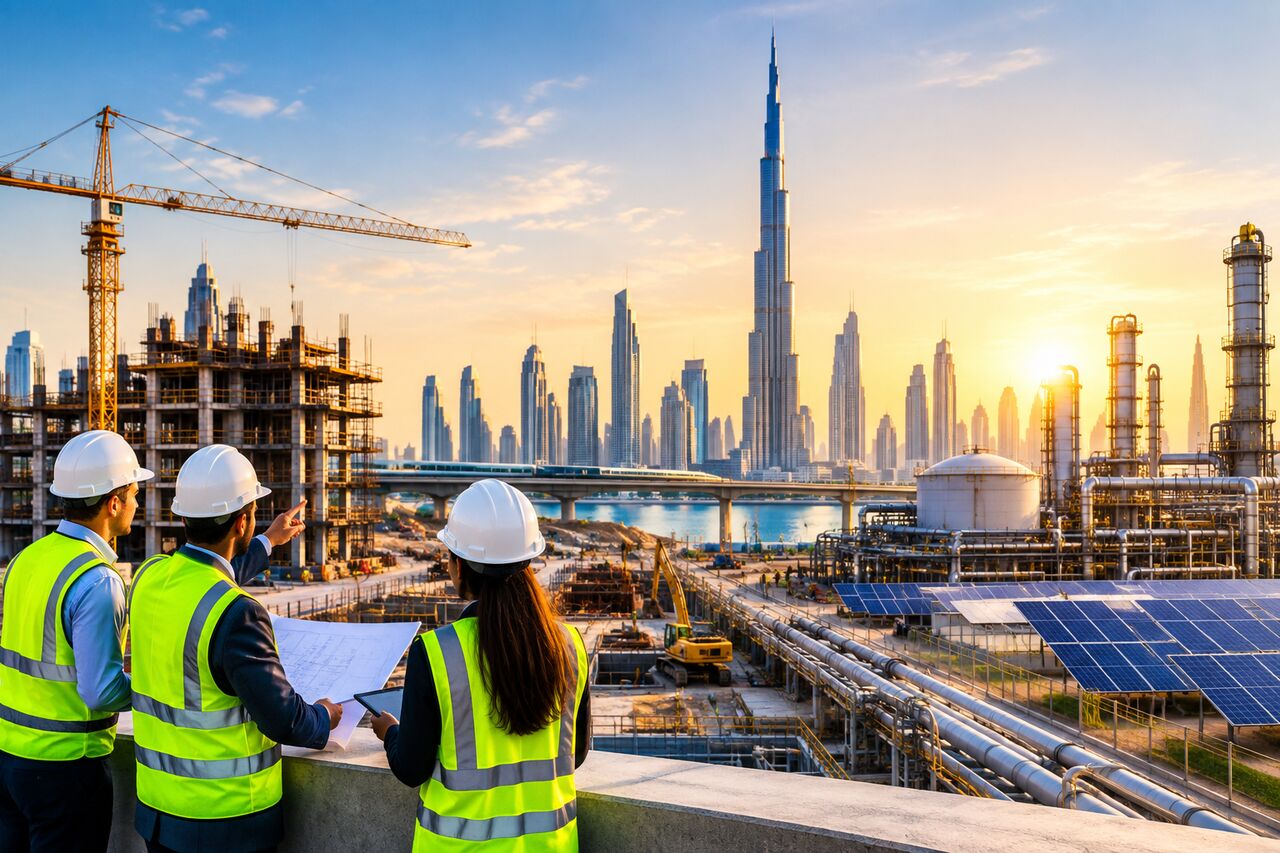
The United Arab Emirates is internationally renowned for its world-class infrastructure, including record-breaking skyscrapers, vast industrial complexes, and cutting-edge alternative energy power plants. Nearly all major projects in the United Arab Emirates are supported by a specialized group of companies known as EPC contractors. Gaining a thorough understanding of the roles these companies play and the distinct dynamics of Dubai’s EPC contractor market is crucial for anyone aiming to gain meaningful insight into the region’s construction industry.
What Does EPC Actually Mean?
EPC is short for Engineering, Procurement, and Construction. EPC is a project delivery model in which one contractor assumes full responsibility for the three key phases of a project—engineering, procurement, and construction. This approach ensures a streamlined process, as the contractor oversees technical design, sources all necessary materials and equipment, and manages the entire construction phase from start to finish.
Under the EPC model, the contractor delivers a fully operational project to the client within a defined timeframe and for a fixed, lump-sum price. This "turnkey" project delivery approach has become popular for large infrastructure, industrial, and energy projects in the Gulf region because it shifts most of the responsibility to the contractor, streamlining project management for clients.
Why the EPC Model Matters in Dubai and the UAE
Over the past two decades, Dubai’s remarkable transformation has been fueled by ambitious megaprojects—ranging from airports and metro rail systems to water treatment facilities, power plants, and solar energy stations. These projects are typically complex, multidisciplinary, and time-sensitive, aligning with national initiatives such as the UAE Energy Strategy 2050 and broader economic diversification goals.
The EPC model would work well in this setting. This model enables government agencies, developers, and private financiers to implement complex projects without having to coordinate the activities of numerous subcontractors and vendors themselves. The process will be easier to control and will ensure cost and schedule certainty.
The Structure of the EPC Industry in the UAE
There is diversity in the EPC business within the UAE, which comprises companies specializing in different sectors:
Oil & gas EPC companies that work on refineries, pipelines, and petrochemical plants, mainly for government-associated bodies like ADNOC.
EPC companies in the power and energy sector specialize in constructing both thermal power plants and renewable energy facilities, such as solar power plants.
EPC contractors in industrial and manufacturing construction deliver manufacturing plants and factories.
Water and wastewater EPC specialists design and construct desalination and treatment facilities, addressing the region's acute freshwater scarcity.
Some EPC contractors specialize in constructing commercial towers, developing transportation infrastructure, and building mixed-use complexes. Most EPC contracting firms in Dubai operate across multiple sectors, though some focus exclusively on a single area of expertise.
What Distinguishes Reputable EPC Companies
In the case of the best EPC companies in the UAE, some features are common among existing players and new entrants:
Engineering expertise: Leading EPC companies maintain in-house engineering teams that can perform front-end, detailed, and value engineering. They achieve cost efficiency without compromising on safety or operational effectiveness.
Experience with large-scale projects: Given the immense scale of Gulf infrastructure developments, proven experience in successfully delivering similar large-scale projects is a critical differentiator for EPC companies.
Health, safety, and environment requirements: Regulatory authorities in the UAE, along with international frameworks such as ISO standards, mandate rigorous safety management systems—particularly for industrial and energy projects.
Strength in supply chain and procurement: As EPC companies take responsibility for sourcing equipment and materials, it may be beneficial to have established relations with dependable suppliers and manufacturers.
Local regulatory know-how: Familiarity with local regulatory authorities is essential for navigating approval processes, free zone regulations, and sector-specific licensing requirements.
Challenges Facing the Sector
Despite the sector’s advanced development, EPC contractors in the UAE continue to face several persistent challenges. Volatile material costs can significantly affect contract pricing and erode profitability, making financial planning increasingly complex. Additionally, the construction sector struggles with a consistent shortage of skilled workers, which can hinder project delivery and compromise quality standards.
Resources for Further Reading
For those seeking a deeper understanding of how EPC services are structured across various industries in Dubai, numerous industry resources are available. For example, Tekzone’s EPC Contractors page outlines the typical scopes of work involved in EPC arrangements.
Frequently Asked Questions
How do an EPC contractor and general contractor differ?
A general contractor mainly focuses on the construction phase and typically becomes involved only after other parties have completed the design work. In contrast, an EPC contractor oversees the entire project lifecycle—encompassing engineering, procurement, and construction—providing a single point of responsibility from start to finish.
Why do major projects in the UAE usually adopt the EPC model?
The EPC model unifies all project responsibilities within a single entity, greatly simplifying project management and enhancing coordination at every stage of the project lifecycle.
Does EPC have a fixed price?
EPC contracts are typically structured as lump-sum or fixed-price agreements; however, variations do exist depending on project complexity, risk allocation, and the specific requirements of the parties involved.
Which industries in Dubai have the highest demand for EPC contractors?
Industries such as energy, oil and gas, water treatment, and large-scale industrial projects are among the most frequent users of EPC contractors in Dubai.
How does one evaluate an EPC contractor's performance?
Evaluation parameters for EPC contractors may include adherence to project timelines, compliance with budget requirements, a strong safety record, and the delivery of high-quality engineering solutions.
Conclusion
EPC contractors play a vital role in transforming the UAE’s infrastructure ambitions into reality by ensuring efficient and reliable execution of construction projects. By uniting engineering, procurement, and construction within a single EPC structure, the UAE has been able to execute complex projects with a level of efficiency and pred