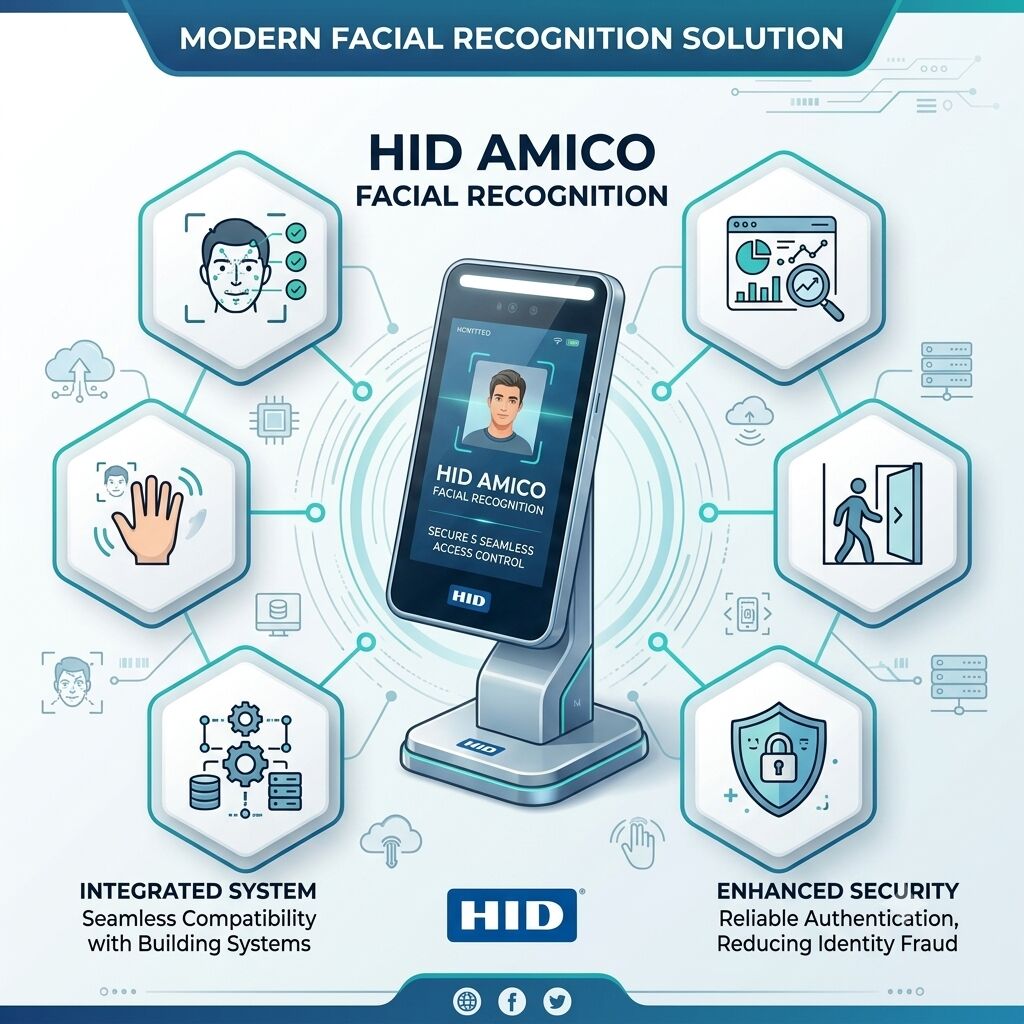
This article looks at the technology inside the device, the controller architecture behind it, where it fits across UAE industries, and how organizations are migrating from card-based systems without disrupting daily operations.
The Shift From Card-Based Access to AI-Driven Verification
Card and fob credentials have a structural weakness: they verify that a badge was presented, not that the right person is standing at the door. Tailgating, badge-sharing, and lost-card fraud remain common failure points in traditional deployments. AI-driven facial verification closes that gap by matching a live face against an enrolled template in real time, removing the credential-sharing problem entirely while speeding up entry at high-traffic doors.
UAE enterprises operating in free zones, government campuses, and mixed-use towers are increasingly replacing aging proximity-card infrastructure with camera-based readers precisely because the verification happens at the person, not at the object they are carrying.
What Makes HID Amico Different From Standard Facial Readers
HID Amico Facial Recognition Accuracy and Speed
The core strength of HID Amico Facial Recognition is sub-second matching under real-world lighting conditions, including the harsh midday glare and low-light lobby entrances common across UAE buildings. The matching engine is tuned to hold accuracy steady across a wide range of skin tones, facial coverings, and eyewear, which matters in a market as demographically diverse as the UAE.
Hardware Design of the HID Amico Facial Recognition Reader
The HID Amico Facial Recognition Reader pairs a wide-angle camera with an infrared depth sensor in a single wall- or turnstile-mounted unit, letting it capture a usable image from multiple approach angles rather than requiring visitors to stand still and centered. The enclosure is built for continuous outdoor-adjacent use at building entrances, a requirement given the UAE's heat and humidity swings between seasons.
AI-Powered Anti-Spoofing and Liveness Detection
A facial reader is only as trustworthy as its ability to reject a fake. AI-Powered Anti-Spoofing analyzes depth, texture, and micro-movement in real time, distinguishing a living face from a printed photo, a video replay, or a 3D mask presented at the camera. This runs alongside Liveness Detection, which prompts subtle cues the system verifies before granting a match, closing off the presentation-attack methods that have embarrassed earlier generations of facial access systems in other markets.
For high-security UAE sites — bank vaults, data centers, and government records rooms — this layered spoof-resistance is frequently the deciding factor between a facial reader that is merely convenient and one that is actually audit-defensible.
HID Aero Controller: The Backbone of Scalable Deployments
Behind every reader sits the HID Aero Controller, the IP-based hardware that manages door logic, credential validation, and event logging independently of the central server. Because decision-making happens at the controller rather than relying on a constant server connection, doors keep functioning correctly even during a network interruption — an important resilience feature for UAE campuses spread across multiple buildings or basement parking structures with inconsistent connectivity.
● Open, standards-based architecture that integrates with existing video management and fire-alarm systems
● Edge-based decision-making that keeps doors operational during a network outage
● Support for hundreds of doors per site without a forklift upgrade of existing cabling
● Detailed event logging for compliance audits and incident investigation
HID Access Control: Integrating Amico Into a Wider Security Ecosystem
Facial readers rarely operate in isolation. A mature HID Access Control deployment ties the reader and controller into visitor management, elevator destination dispatch, building management systems, and video surveillance, so a single verified entry event can simultaneously unlock a turnstile, call an elevator to the correct floor, and log the visit for later review. This kind of integration turns a lobby door into a coordinated part of the building's overall security posture rather than a standalone checkpoint.
HID Mobile Access: Credentials Without the Card
Alongside facial verification, HID Mobile Access lets staff and approved visitors carry their credential on a smartphone, using Bluetooth or NFC to unlock doors without pulling out a physical badge at all. This matters for organizations running a hybrid credential strategy — visitors and contractors enrolled by face, employees using mobile credentials, and legacy card holders phased out over a defined migration window rather than replaced overnight.
HID Amico is moving UAE physical security away from shareable cards and toward identity verified at the person. Its HID Amico Facial Recognition engine and HID Amico Facial Recognition Reader hardware deliver fast, accurate matching, while AI-Powered Anti-Spoofing and Liveness Detection keep presentation attacks out. Backed by the HID Aero Controller for resilient HID Access Control, and complemented by HID Mobile Access for hybrid credentialing, HID Amico UAE deployments are reshaping entry security across HID Amico Dubai towers and HID Amico Abu Dhabi government campuses alike.