Quick Recommendation
(i) Best overall for indoor hallways & staircases: Esysense 10W B22 Motion Sensor Bulb — offers high-lumen illumination, automatic movement detection, and integrated daylight suppression for standard Indian bayonet sockets.
(ii) Best option for decorative indoor sconces & glass diffusers: Esysense 10W E27 Motion Sensor Bulb — features high-sensitivity microwave radar that penetrates glass shades while maintaining a sleek form factor.
(iii) Best choice for compact indoor utility spaces & restrooms: Esysense 7W B22 Motion Sensor Bulb — delivers focused, energy-efficient illumination for smaller rooms where subtle lighting is required.
(iv) Avoid PIR sensor bulbs when: Installing inside opaque globes or thick glass fixtures, as solid barriers block passive infrared heat signals.
Product Overview
A motion sensor dimmable bulb incorporates integrated sensing optics, an internal LED driver, and dual-output micro-controllers inside a standard light bulb casing.
(i) What it is: An all-in-one automated indoor LED bulb featuring motion tracking and stepped/dual-level dimming functionality.
(ii) What it does: Operates at a dimmed background state (or standby mode) when rooms are vacant, boosting instantly to 100% brightness upon occupant movement.
(iii) Who it is intended for: Homeowners, families with children or seniors, renters, and hoteliers seeking comfortable night navigation without manual switch toggling.
(iv) Primary features: Dual-level dimming logic, PIR thermal or microwave radar sensor, integrated LUX photocell daylight sensor, B22 or E27 base fitting.
(v) Key specifications: 7W to 10W active power ratings, 10%–20% standby dim level, 360-degree detection angle, 3 to 9 meter detection range, 60-second hold timer.
(vi) Main use cases: Indoor corridors, stairwells, master bathrooms, nursery rooms, walk-in closets, and foyer entryways.
(vii) Important limitations: Indoor wall switches must remain powered ON continuously; not all internal dimming circuits are compatible with external wall-mounted Triac dimmer switches.
Why This Matters
Abruptly turning on bright 100% overhead lighting in the middle of the night causes visual glare and disturbs sleep cycles. Conversely, leaving hall lights completely off creates tripping hazards on indoor steps. Selecting a motion sensor dimmable bulb solves both issues by maintaining a soft, energy-saving background glow that automatically brightens when you walk past, providing effortless safety and cutting lighting energy consumption.
Understanding Motion Sensor Dimmable Bulbs
A motion sensor dimmable bulb operates through micro-controller logic that adjusts current to the LED chips based on occupancy and ambient daylight.
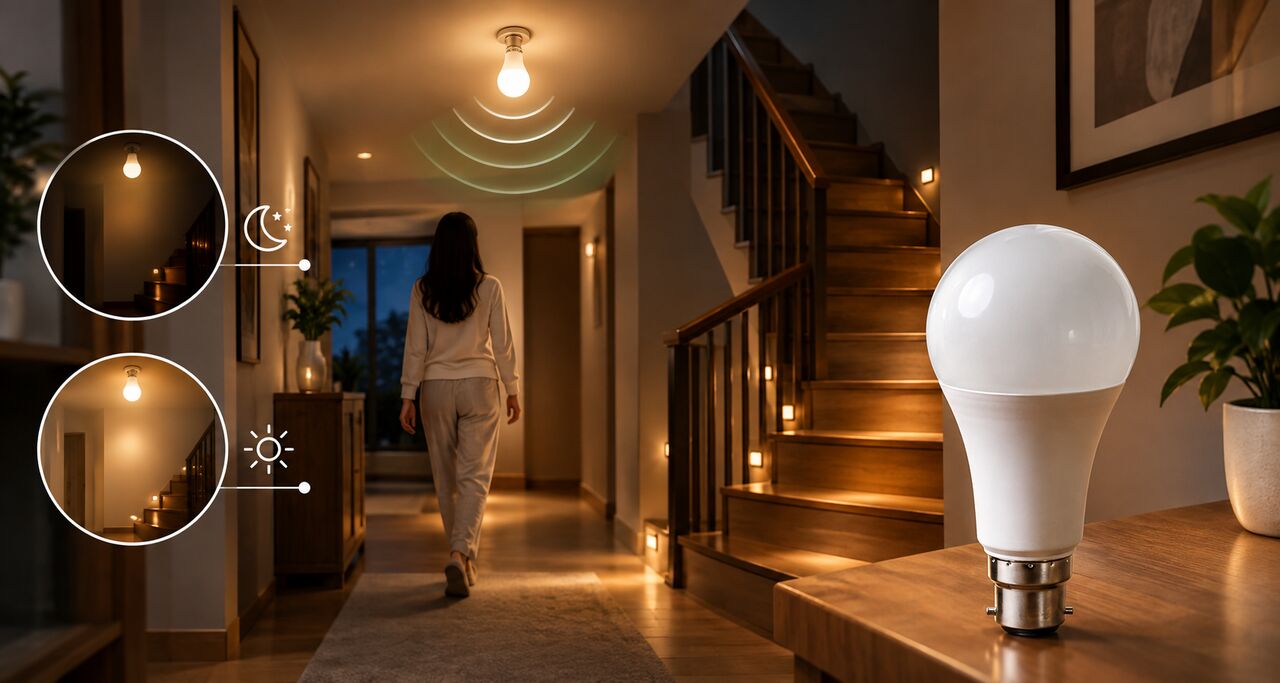
(i) Dimmed Standby State: When the wall switch is turned ON and the room is dark, the bulb runs in a low-power dimmed state (10%–20% brightness).
(ii) Daylight Suppression Check: An internal photodiode measures ambient natural light. If sunlight is sufficient, the bulb remains completely OFF to eliminate daytime energy waste.
(iii) Occupancy Trigger: When a person enters the room, the sensor triggers the internal driver to ramp up power to 100% brightness immediately.
(iv) Auto-Dim / Shutoff Count: After movement stops for approximately 60 seconds, the bulb smoothly transitions back down to its low-power dimmed standby state or full standby mode.
Key Features
(i) Dual-Level Baseline Dimming: Allows the light to stay at 10%–20% output rather than turning pitch dark.
(ii) Indoor Sensor Technology (PIR vs. Radar): Dictates whether the bulb senses thermal body heat signatures or microwave frequency shifts.
(iii) Socket Base Fitting (B22 vs. E27): Ensures a direct fit into standard Indian wall battens (B22) or decorative screw lamps (E27).
(iv) Photocell (LUX) Intelligence: Prevents daytime activation when natural light is adequate.
(v) Hold Delay Duration: Determines how long full 100% brightness persists after movement ceases.
Main Buying Factors
1. Dimming Mechanism & Standby Logic (Dual-Level vs. Complete OFF)
What to look for: Verify whether the bulb features continuous low-level ambient dimming or absolute zero-power shutoff.
Why it matters: Dual-level dimmable bulbs maintain a 10% to 20% background glow, making them suitable for night navigation in hallways without total darkness. Standard motion bulbs turn completely off when unoccupied.
Who benefits: Families with young children or elderly relatives navigating indoor staircases at night.
Practical recommendation: Choose a dual-level motion sensor dimmable bulb for continuous indoor corridor orientation, or a standard auto ON/OFF model for utility rooms where 100% shutoff is preferred.
2. Sensor Technology for Indoor Environments (PIR Infrared vs. Microwave Radar)
What to look for: Select the right sensing mechanism for your room's physical layout.
Why it matters: Passive Infrared (PIR) detects thermal body heat within direct line of sight and cannot penetrate walls or glass diffusers. Microwave Radar emits continuous 5.8GHz waves that pass through glass shades, thin wood, and acrylic covers.
Potential trade-offs: Radar sensors are sensitive and may detect movement through thin partition walls or glass doors if installed too close to adjoining rooms.
Practical recommendation: Use PIR sensor bulbs inside enclosed bedrooms and restrooms to prevent false triggers from adjacent hallways. Use Radar sensor bulbs inside glass diffuser sconces or wide foyers.
3. Fitting Compatibility (B22 Bayonet vs. E27 Screw Base)
What to look for: Check your existing wall batten or lamp fixture socket before ordering.
Why it matters: B22 bayonet pin fittings match standard Indian wall sockets, whereas decorative, imported, or pendant fixtures require E27 Edison screw threads.
Practical recommendation: Select a motion sensor light bulb indoor unit with a B22 base for regular room battens, or choose an E27 model like the Esysense 10W E27 Motion Sensor Bulb for screw-in fixtures.
4. Wattage Rating & Color Temperature
What to look for: Match the bulb wattage to your room dimensions.
Why it matters: 7W bulbs deliver focused lighting for small restrooms and closets, while 10W bulbs provide bright light for long corridors and multi-level stairways.
Practical recommendation: Choose 3000K warm white for bedroom or hallway sconces to maintain a relaxed evening mood, and 6500K cool white for bathrooms and utility closets where higher clarity is needed.
Comparison: Base Fit