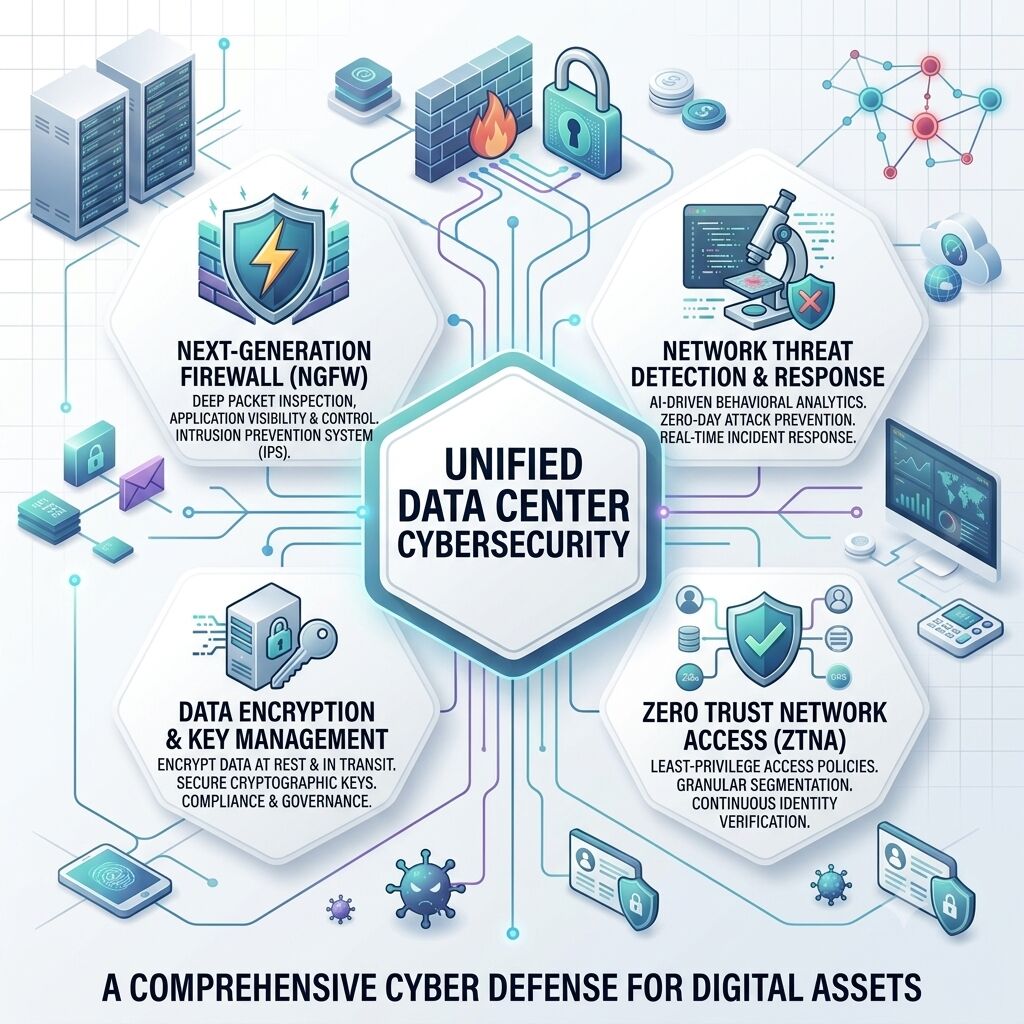
This article walks through the six layers a modern facility needs, how Qatar's regulatory landscape shapes deployment decisions, and what to look for when selecting an integrator for a mission-critical build.
Why Qatar & GCC Data Centers Need a Layered Security Approach
A data center holds a concentration of value — financial records, government systems, telecom backbones, and enterprise workloads — that makes it a target for both physical and digital attackers simultaneously. Relying on a single control point, such as a badge reader at the front door or a firewall at the network edge, leaves the facility exposed the moment that one layer is bypassed or fails.
A layered, defense-in-depth model instead assumes any single control can fail, and builds redundancy so that a breach at one layer is caught by the next. This approach has become the baseline expectation for data centers supporting Qatar's growing digital economy and the GCC's broader push toward regional cloud sovereignty.
The Six Layers of Modern Data Center Security
A well-designed facility stacks physical and digital controls into six coordinated layers, each catching what the previous layer might miss:
Layer 1: Perimeter and Data Center Access Control
The first layer starts at the site boundary — fencing, vehicle barriers, and manned checkpoints — before narrowing down to Data Center Access Control at every internal door: biometric readers at the building entrance, mantraps at the data hall, and cabinet-level locks on individual racks. Each zone requires progressively stronger verification, so a badge that opens the lobby does not automatically open a customer's server cabinet.
Layer 2: Data Center Surveillance
Continuous Data Center Surveillance through high-resolution cameras covering entrances, aisles, and loading docks gives security teams a complete visual record of who moved where and when. Footage retention aligned with local regulatory timelines turns surveillance from a passive deterrent into evidence that can support both incident investigation and compliance audits.
Layer 3: Data Center Intrusion Detection
Beyond cameras, Data Center Intrusion Detection sensors on doors, floor panels, and cabinet enclosures alert security staff the instant an unauthorized opening occurs, even in unmanned sections of the facility overnight. Motion and vibration sensors along the perimeter add an outer ring of detection before an intruder ever reaches the building itself.
Layer 4: Data Center Firewalls
On the network side, Data Center Firewalls segment traffic between tenants, isolate management networks from production workloads, and enforce strict rules on what can communicate with what. Properly segmented firewall zones mean that a compromise in one tenant's environment cannot spread laterally to another customer sharing the same facility.
Layer 5: Data Center Encryption
Physical and network controls protect access to the hardware, but Data Center Encryption protects the data itself, both at rest on storage arrays and in transit between racks and external connections. Even if a storage device were physically removed from the facility, encrypted data on it remains unreadable without the corresponding keys, which are typically managed on separate, hardened key-management infrastructure.
Layer 6: Data Center Threat Detection and Cybersecurity
The final layer ties everything together through continuous Data Center Threat Detection, correlating physical access logs, network traffic anomalies, and system behaviour to spot patterns a single control would miss on its own. This is where broader Cybersecurity for Data Center operations lives — security information and event management (SIEM) tooling, 24/7 monitoring, and incident-response playbooks that turn raw alerts into a coordinated response within minutes rather than hours.
Physical vs. Cyber: Why Data Centers Need Both
It is tempting to treat physical security and cybersecurity as separate budgets managed by separate teams, but a modern facility cannot afford that split. An intruder who defeats a physical control gains a path to plug directly into internal network infrastructure, bypassing perimeter firewalls entirely. Conversely, a cyber attacker who compromises building-management or access-control software can unlock physical doors remotely. Convergence between physical security operations and IT security teams — sharing a single incident-response process and a shared view of alerts — closes that gap.