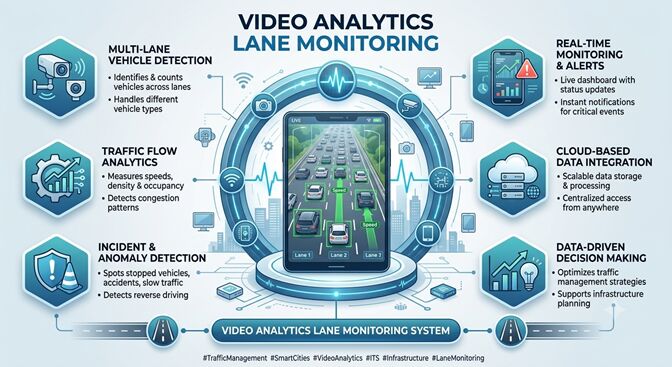
This article looks at how AI-driven lane monitoring works, the core capabilities road authorities should expect from a modern platform, and how the technology is being adapted specifically for Qatar's and the GCC's road-safety priorities.
The Road Safety Challenge Across Qatar & GCC Highways
Rapid urban growth across Qatar and the GCC has brought a corresponding rise in daily traffic volume, particularly around new developments such as Lusail and the corridors feeding Hamad International Airport. Traditional traffic management leans on fixed speed cameras and human control-room operators watching dozens of video feeds at once — an approach that scales poorly as networks grow and makes it nearly impossible to catch every developing hazard before it becomes a collision.
Wrong-way driving, sudden lane changes, debris in the carriageway, and pedestrians crossing outside designated zones are exactly the kind of fast-developing events that a tired or overloaded human operator can miss, but that a purpose-built analytics engine watches for continuously without fatigue.
What Is AI-Powered Video Analytics for Road Safety?
At its core, AI-Powered Video Analytics applies computer-vision models directly to existing camera feeds, turning raw video into structured events: a vehicle entering a restricted lane, a queue forming ahead of a junction, or an object left in the roadway. Instead of a human reviewing footage after an incident is reported, the system raises the alert the moment the pattern is detected, giving control-room staff and field response teams a head start measured in seconds rather than minutes.
Because the analysis runs on camera infrastructure many road authorities already have in place, adoption is usually a software and processing upgrade rather than a full hardware replacement across an entire highway network.
Core Capabilities of Modern Video Analytics Software
Real-Time Tracking for Lane and Vehicle Monitoring
Continuous Real-Time Tracking follows individual vehicles across camera zones, measuring speed, lane position, and following distance without requiring a physical sensor embedded in the road surface. This lets a lane-monitoring deployment flag unsafe lane departure, tailgating, and stopped vehicles in live lanes within moments of them occurring, rather than waiting for a downstream camera or a passing patrol to notice.
Predictive Analytics for Congestion and Incident Forecasting
Beyond reacting to what is happening right now, Predictive Analytics models historical and live traffic-flow data to forecast where congestion is likely to build in the next 15 to 30 minutes, giving control rooms time to adjust variable message signs, retime signals, or dispatch patrol units before a slowdown turns into a queue that stretches back to the previous interchange.
Intrusion Detection for Restricted Lanes and Infrastructure
Bus lanes, emergency shoulders, and tunnel maintenance zones all depend on keeping unauthorized vehicles and pedestrians out. Intrusion Detection tuned for road environments recognizes when a vehicle crosses into a restricted lane or when a person enters a hard shoulder or tunnel walkway, triggering an alert distinct from general traffic monitoring so restricted-area violations are never lost in the noise of routine congestion alerts.
Video Analytics GCC: A Shared Regional Direction
Road authorities across the UAE, Saudi Arabia, Bahrain, Kuwait, and Oman are moving in a broadly similar direction, with agencies such as Dubai's Roads and Transport Authority (RTA) publishing smart-mobility strategies that increasingly reference AI-based incident detection as a core capability rather than an optional add-on. The GCC Standardization Organization (GSO) provides a shared technical reference point that lets a Video Analytics GCC rollout use a broadly consistent architecture across multiple member states, even where local enforcement rules and camera-network ownership differ.
Choosing Video Analytics Solutions for a Road Network
Road authorities evaluating a lane-monitoring platform should look past the marketing demo and ask concrete deployment questions:
● Can the analytics engine run on the existing camera fleet, or does it require new, higher-resolution hardware at every location?
● What is the false-alarm rate for wrong-way and intrusion detection under heavy rain, dust, or nighttime conditions common in the region?
● How quickly can predictive congestion models be retrained after a new interchange or lane configuration opens?
● Does the platform integrate with existing variable message sign and traffic-signal control systems?
● Can alerts be routed automatically to the nearest patrol unit rather than only to a central control room?
● What historical data retention does the system support for post-incident investigation and reporting?
Why a Software-First Approach Matters for Lane Monitoring
Because Video Analytics Software processes existing video streams rather than requiring embedded road sensors, road authorities can extend lane monitoring to new stretches of highway simply by pointing the analytics engine at additional camera feeds. This software-first model also means detection accuracy improves over time through model updates, without technicians needing to revisit every physical camera location on the network.
Why Tektronix Deploys Video Analytics Solutions Across Qatar & GCC
Tektronix integrates Video Analytics Solutions for road authorities and infrastructure operators across Qatar and the wider GCC, configuring lane monitoring, wrong-way detection, and predictive congestion forecasting on top of camera networks already in place, and connecting alerts directly into existing control-room and dispatch workflows.
To review the full lane-monitoring platform and deployment options for your road network, visit the AI-powered lane monitoring solutions page.
Conclusion
Video Analytics is turning existing highway cameras across Qatar and the GCC into an active safety layer rather than passive recording equipment. AI-Powered Video Analytics combined with Real-Time Tracking catches unsafe lane behaviour the instant it happens, while Predictive Analytics and Intrusion Detection get ahead of congestion and restricted-lane violations before they escalate. Purpose-built Video Analytics Software and Video Analytics Solutions are now central to both Video Analytics Qatar and Video Analytics GCC road-safety strategy.