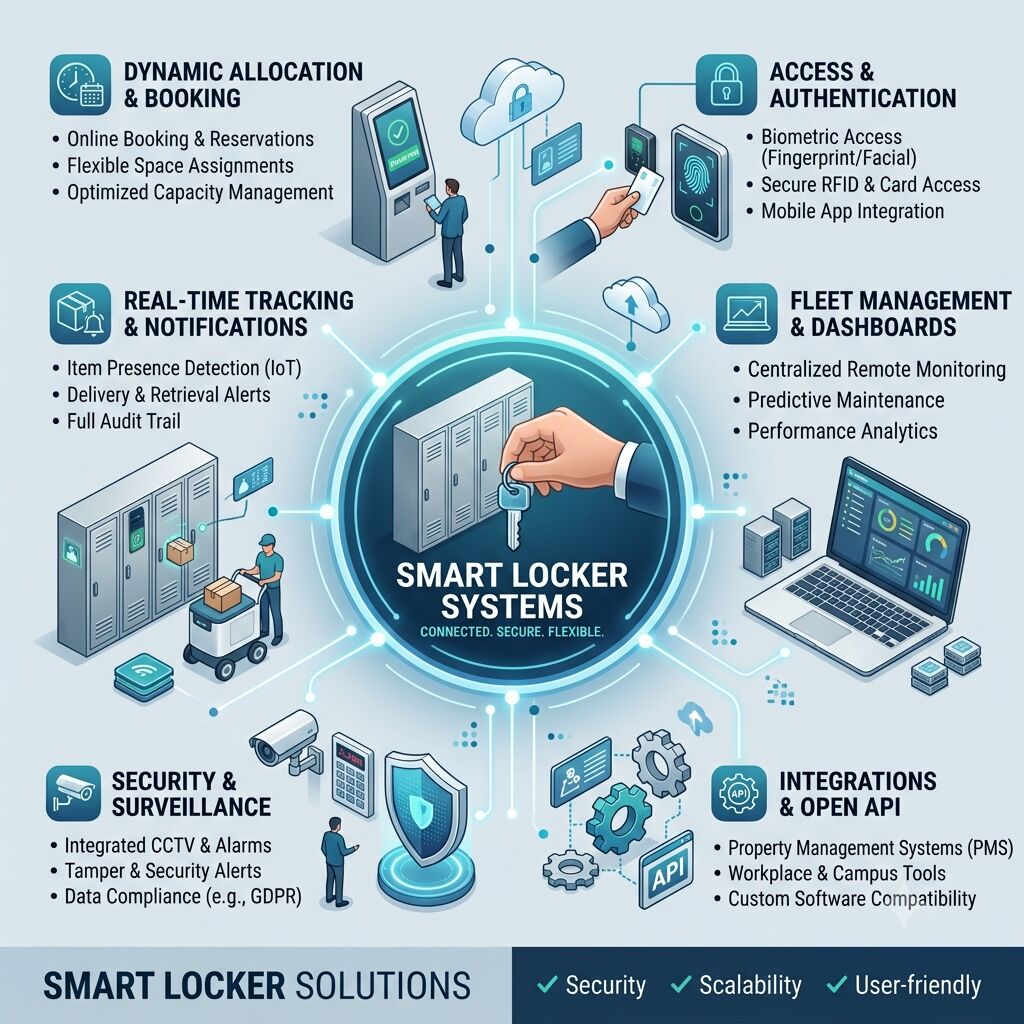
Unlike traditional lockers that rely on physical keys or basic electronic locks, smart lockers combine secure compartments with digital authentication, centralised management, real-time monitoring, and automated access. Depending on the application, users can access lockers through facial recognition, QR codes, PINs, RFID cards, mobile credentials, or other authorised methods.
From hotels managing guest deliveries to businesses handling employee belongings and logistics companies managing parcels, a Smart Locker System can improve security, convenience, and operational efficiency.
What Are Smart Locker Systems?
Smart Locker Systems are electronically controlled locker solutions designed to provide secure storage and automated access management. Each locker compartment can be managed through software, allowing administrators to control users, permissions, access times, and locker availability.
A modern Smart Locker System Saudi Arabia can combine electronic locking mechanisms with technologies such as:
• Facial recognition
• QR code authentication
• PIN access
• RFID cards
• Mobile credentials
• Touchscreen interfaces
• Cloud-based locker management
• Real-time notifications
These features allow organisations to move beyond conventional key-based lockers and create a more connected storage environment.
Why Smart Locker Systems Are Important in Saudi Arabia
Saudi Arabia's growing hospitality, retail, logistics, commercial, education, and smart-building sectors are creating new requirements for secure storage and self-service collection.
Traditional locker systems can become difficult to manage when there are hundreds of users, frequent deliveries, multiple locations, or a high turnover of visitors and employees.
A Smart Locker System Saudi Arabia can automate many of these processes. Administrators can assign compartments, control access digitally, track locker activity, and manage users from a central platform.
For organisations handling valuable items, parcels, documents, equipment, or personal belongings, smart lockers can provide an additional layer of convenience and accountability.
Smart Locker for Hotels
A Smart Locker for Hotels can help hospitality businesses manage guest deliveries, parcels, food orders, personal belongings, and other items.
Instead of requiring reception staff to manually receive and hand over every delivery, authorised guests can collect items from a secure locker using facial recognition, QR codes, PINs, or other credentials.
This can reduce pressure on reception teams while providing guests with a convenient self-service experience.
Electronic Locker System
An Electronic Locker System replaces conventional mechanical locks with digitally controlled locking mechanisms.
Electronic lockers can be configured for different users and access schedules, making them suitable for offices, schools, gyms, hotels, residential buildings, and other facilities.
Face Recognition Locker Access
Face Recognition Locker Access uses biometric authentication to provide a touchless way to open an assigned locker.
After the user's identity is verified, the system can provide access to the appropriate compartment. This can be useful in environments where convenience and stronger identity verification are important.
Digital Locker System
A Digital Locker System connects locker hardware with management software, allowing organisations to manage access electronically.
Digital lockers can support features such as temporary access, user assignment, activity tracking, notifications, and centralised administration.