Quick Recommendation
(i) Best for staircases, floorways & foot-level safety: Esysense 3W PIR Motion Sensor Foot Light — Delivers focused 180-lumen floor illumination with IP65 moisture protection and precise PIR detection.
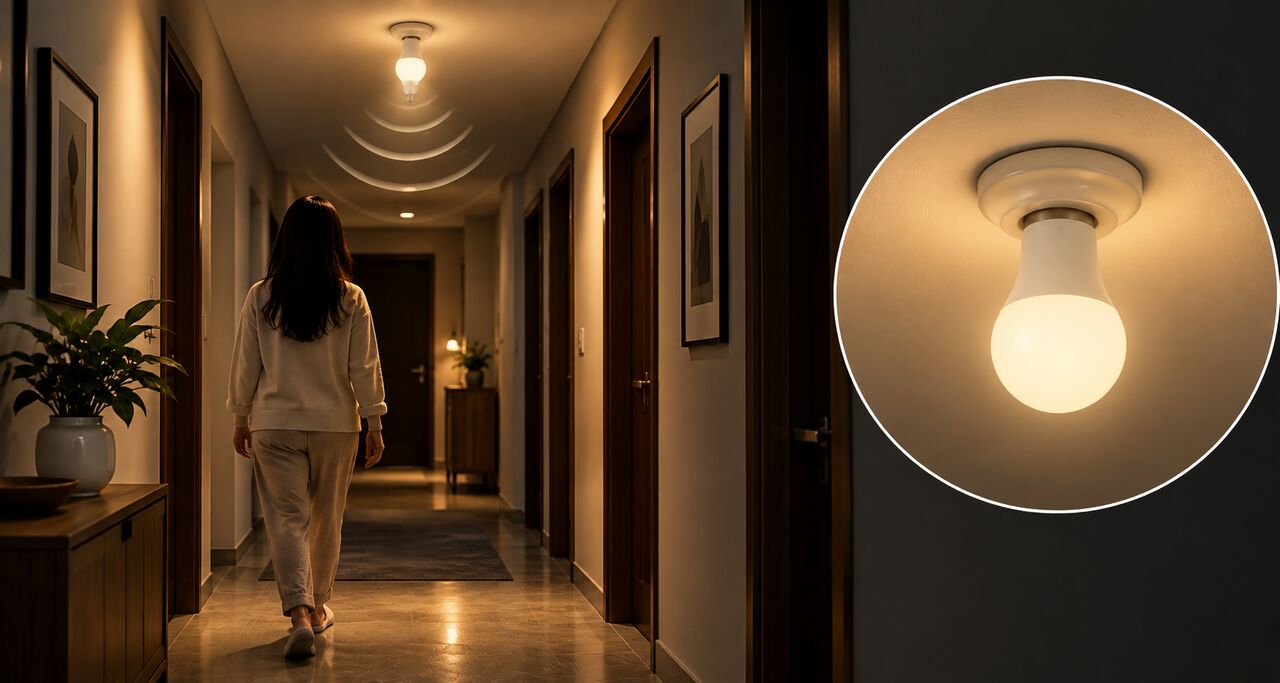
(ii) Best overall retrofit for small indoor rooms & closets: Esysense 7W B22 Motion Sensor Bulb — Plugs directly into standard Indian socket holders for automated, compact room lighting.
(iii) Best for wide indoor corridors & main entryways: Esysense 10W B22 Motion Sensor Bulb — Features high-sensitivity 360-degree radar detection for larger, high-traffic transit areas.
(iv) Avoid low-wattage PIR bulbs when: Installing inside thick, enclosed glass light fixtures, as solid glass shields block infrared heat signatures.
Product Overview
Low-wattage automated lighting fixtures integrate specialized motion-tracking electronics directly into compact lamp housings.
(i) What it is: An ultra-efficient, low-power automated LED unit designed for targeted nighttime guidance.
(ii) What it does: Remains in full standby mode when rooms are vacant and activates automatically when an occupant approaches.
(iii) Who it is intended for: Homeowners, families with young children or seniors, and apartment residents seeking effortless night navigation.
(iv) Primary features: Passive Infrared (PIR) body heat tracking or Radar wave detection, integrated daylight photocell (LUX) sensor, auto-off timer.
(v) Key specifications: 3W active power output, 180-lumen output, 3-meter detection radius, 30 to 60-second delay timer, standard B22, E27, or recessed foot-light mounting.
(vi) Main use cases: Stair steps, lower hallway walls, guest bathrooms, bedside floor-paths, walk-in closets, and cabinet entryways.
(vii) Important limitations: Low-wattage 3W units deliver pathway guidance rather than full overhead room brightness; wall switches must stay powered ON.
Why This Matters
Fumbling for wall switches in complete darkness increases the risk of trips and falls, while switching on standard 10W to 15W overhead lights disrupts natural sleep cycles. Deploying a low-wattage 3 watt motion sensor bulb or foot light provides gentle, immediate pathway visibility without jarring full-power illumination.
Understanding 3-Watt Motion Sensor Bulbs
Compact indoor sensor lights operate through micro-sensor logic that balances motion response with
ambient light detection.
(i) Standby State: When connected to an active power source, the fixture draws negligible power (<0.5W) while continuously monitoring the ambient environment.
(ii) Daylight Suppression: The built-in photodiode measures ambient natural light; if the space is bright, the motion trigger is suppressed to prevent daylight energy waste.
(iii) Occupancy Trigger: Upon sensing human motion (thermal heat signature or frequency shift) within a 3-meter radius, the driver energizes the LED array.
(iv) Auto-Shutoff: Once physical movement ceases, the micro-controller holds illumination for 30 to 60 seconds before powering down back to standby mode.
Key Features
(i) Low-Glare Illumination: Delivers 180 lumens of soft, directed output designed specifically to preserve night vision.
(ii) Daylight Photocell Control: Ensures activation occurs strictly in dark environments.
(iii) Instant Hands-Free Response: Eliminates manual wall switch toggling.
(iv) Universal Fitting Support: Available in plug-and-play B22 bayonet, E27 screw, or recessed wall cutouts.
Main Decision Factors
1. Light Output & Luminous Intensity (3W vs. Standard Overhead Wattage)
What to look for: Match the wattage to the visual task required in the space.
Why it matters: A 3 watt motion sensor bulb provides focused pathway light (~180 lumens), whereas 7W to 10W bulbs produce 600 to 1000 lumens intended for broad overhead room coverage.
Practical recommendation: Choose 3W fixtures for low-level night navigation (stair steps, footlights, powder rooms) and 7W/10W bulbs for primary overhead lighting in corridors or large storage rooms.
2. Sensor Mechanism (PIR Infrared vs. Microwave Radar)
What to look for: Identify whether line-of-sight thermal sensing or glass-penetrating wave tracking is required.
Why it matters: PIR (Passive Infrared) tracks moving body heat signatures within direct line of sight. Microwave Radar penetrates glass diffusers, lampshades, and thin partitions.
Practical recommendation: Use PIR sensors for focused indoor zones (stair treads, bedrooms, bathrooms) to prevent unwanted triggers from passing family members outside. Use Radar for enclosed glass fixtures.
3. Form Factor & Mounting Style
What to look for: Check existing fixture cutouts and socket base types.
Why it matters: Direct retrofit bulbs require standard socket fittings (B22/E27), whereas dedicated recessed footlights fit into wall concealed boxes at ankle height.
Practical recommendation: Use B22 or E27 retrofit bulbs like the Esysense 7W Motion Sensor Bulb for ceiling or wall holders, and Esysense 3W Motion Sensor Foot Light for low-wall step illumination.
Comparison: Base Fittings, Wattages, and Sensor Tech
Standard Continuous Night Light vs. 3-Watt Motion Sensor Light
(i) Standard Continuous Night Light is generally better when: Constant ambient illumination is needed all night regardless of occupancy.
(ii) 3-Watt Motion Sensor Light is generally better when: Maximum energy efficiency and zero light disturbance during sleep hours are preferred.
Use-Case & Application Guide
(i) Staircases & Transition Landings: Install an Esysense 3W Motion Sensor Foot Light on wall step recesses. It illuminates each step clearly to eliminate fall hazards without creating visual glare.
(ii) Indoor Corridors & Hallways: Use an Esysense 7W B22 Motion Sensor Bulb in existing overhead holders. Automatically lights up walkways when stepping out of bedrooms at night.
(iii) Enclosed Bathrooms & Powder Rooms: Install a compact sensor light bulb indoor fixture above the sink or doorway. Provides hands-free lighting for night visits while shutting off automatically after leaving.
(iv) Walk-In Wardrobes & Closets: Fit low-wattage sensor lights inside wardrobe cabinets or closet ceilings. Illuminates clothes and storage areas hands-free when doors open.
Performance, Results & Real-World Considerations
(i) Installation Height & Placement: For 3W floor lights, mount between 15 cm and 30 cm above floor level for optimal 180-degree pathway coverage. For overhead bulbs, standard ceiling or wall batten heights (2.5 m to 3.5 m) ensure full detection.
(ii) Obstacle Clearance: PIR sensors require an unobstructed l