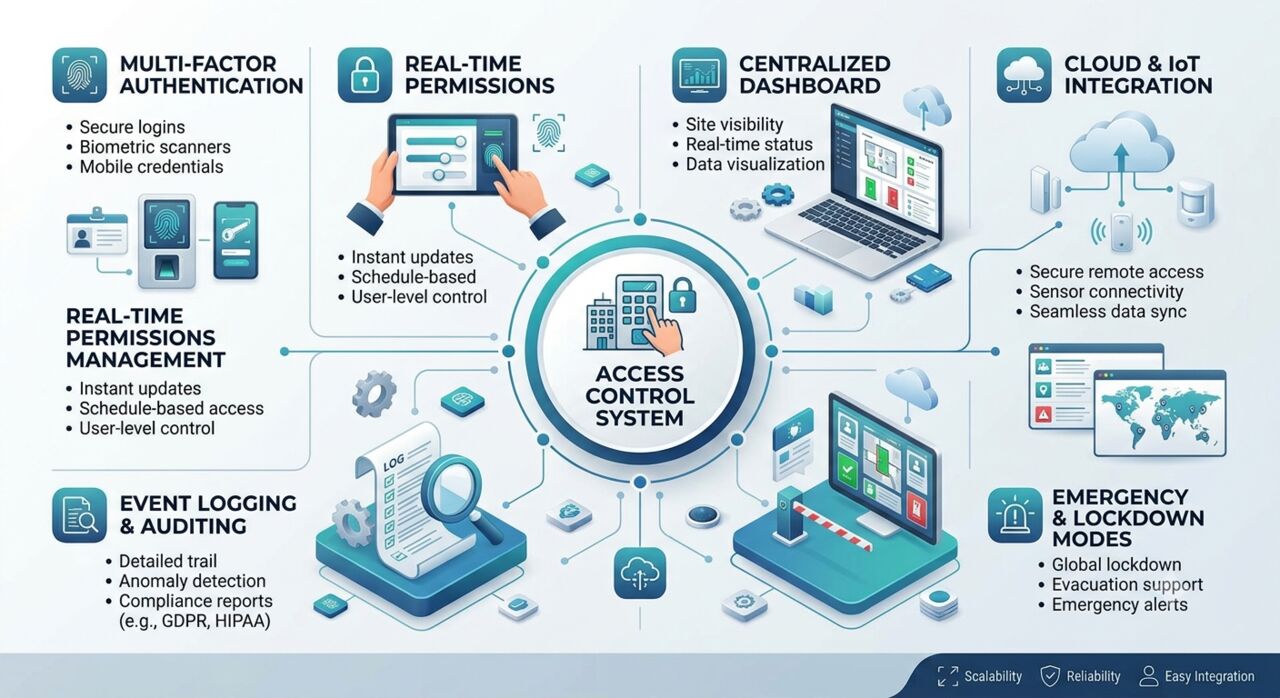
Modern access control provides organisations with a structured way to manage who can enter a building, which areas they can access, and when they are permitted to enter. Unlike traditional keys, these systems can use facial recognition, biometrics, smart cards, PINs, mobile credentials, and other technologies to authenticate users.
A professionally designed Access Control System can improve physical security, simplify access administration, provide real-time visibility, and integrate with other security technologies such as CCTV and visitor management.
What Is an Access Control System?
An Access Control System is a technology-based security solution that controls entry to buildings, rooms, gates, restricted zones, and other protected areas.
When a person attempts to enter a secured location, the system verifies their credentials. If the credentials are valid and the person has permission to access that area, the door or entry point is unlocked. If the credentials are invalid or access has not been authorised, entry is denied.
A modern Access Control System Saudi Arabia can also maintain digital records of access activity, allowing authorised administrators to review information such as users, access points, dates, and times.
Why Access Control Is Important in Saudi Arabia
Saudi Arabia has a diverse and rapidly developing business environment. Organisations operate from corporate offices, smart buildings, construction sites, warehouses, hospitals, schools, hotels, residential developments, and industrial facilities.
Many of these locations contain sensitive information, valuable equipment, restricted areas, or critical infrastructure. Controlling physical access is therefore an important part of an organisation's overall security strategy.
Traditional keys can be difficult to manage when employees leave, departments change, contractors require temporary access, or organisations operate across multiple locations.
An Access Control System Saudi Arabia allows organisations to manage access digitally and establish permissions according to individual users, roles, locations, and schedules.
How Does an Access Control System Work?
An access control solution typically combines several components to authenticate users and manage entry.
1. Authentication Device
The user presents a credential to an access reader or authentication device. This may be a fingerprint, face, card, PIN, mobile credential, or another supported method.
2. Access Controller
The controller receives the authentication information and checks the user's permissions.
3. Access Decision
If the user is authorised, the system sends a command to unlock the door or activate the relevant entry point. If access is not authorised, the entry remains secured.
4. Event Recording
The system can record access events, creating a digital history of entry activity.
5. Centralised Management
Security administrators can use management software to add users, assign permissions, configure schedules, review events, and manage multiple access points.
Types of Access Control Systems in Saudi Arabia
Different organisations have different security requirements. A modern Access Control System Saudi Arabia can use one or multiple authentication technologies.
Biometric Access Control
Biometric Access Control verifies users through unique physical characteristics, such as fingerprints or facial features.
Biometric authentication can reduce dependence on physical access cards and help organisations establish identity-based access.
Future of Access Control in Saudi Arabia
Access control technology is moving toward more intelligent, connected, and identity-focused security solutions.
Biometrics, facial recognition, mobile credentials, cloud management, artificial intelligence, and smart building technologies are increasingly influencing how organisations approach physical access.
Future access control environments are likely to place greater emphasis on seamless authentication, real-time monitoring, automated administration, and integration with other building and security systems.
As Saudi Arabia continues its digital transformation and development of smart infrastructure, modern Access Control System Saudi Arabia solutions can play an important role in supporting secure and efficient facilities.
Conclusion
An Access Control System Saudi Arabia provides organisations with a modern approach to controlling and monitoring physical access. By using technologies such as biometrics, facial recognition, RFID cards, PINs, and mobile credentials, businesses can establish flexible access policies while improving security and convenience.
The benefits go beyond simply locking and unlocking doors. A professionally designed access control solution can provide centralised management, detailed access records, temporary permissions, real-time monitoring, and integration with CCTV and visitor management systems.
Whether it is a corporate office, hospital, school, hotel, industrial facility, warehouse, residential community, or data centre, the right Access Control System can help create a more secure and manageable environment.
For organisations in Saudi Arabia, investing in a scalable and professionally installed access control solution can provide a strong foundation for modern physical security.