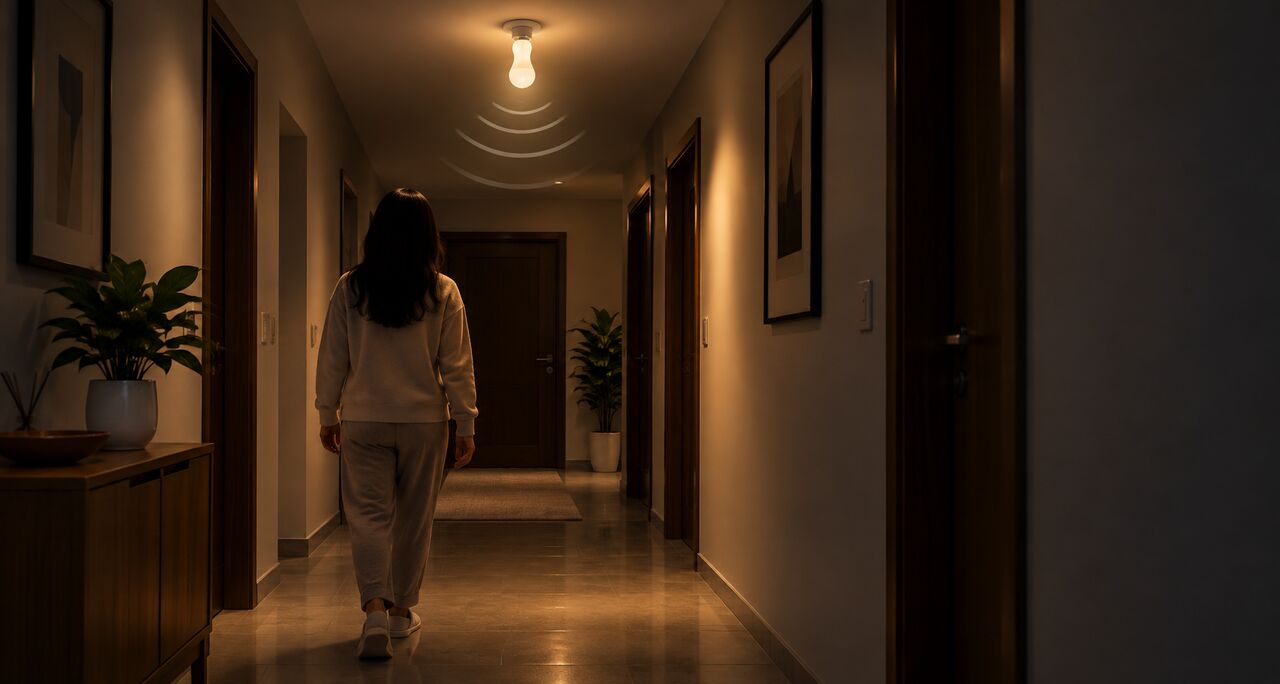
Quick Recommendation
(i) Best overall for hallways, staircases & continuous orientation: Esysense Auto-Dimmable Motion Sensor Lighting — Maintains a subtle baseline glow during vacant hours and smoothly ramps up to full output when foot traffic approaches.
(ii) Best plug-and-play retrofit for standard ceiling/wall sockets: Esysense 10W B22 Motion Sensor Bulb — Delivers standard binary auto ON/OFF motion detection with integrated daylight suppression for regular Indian bayonet holders.
(iii) Best for enclosed glass sconces & decorative diffusers: Esysense 10W E27 Motion Sensor Bulb — Utilizes 5.8GHz microwave radar technology to detect movement through glass domes and decorative shades.
(iv) Avoid continuous standby dimming when: Installing in small closed storage pantries or bedrooms, where complete dark states are preferred when unoccupied.
Product Overview
Automated motion-activated lighting technologies integrate sensing microcontrollers, LED arrays, and daylight photocells into unified lighting fixtures.
(i) What it is: An architectural lighting comparison between two-stage dimmable motion fixtures and single-stage ON/OFF motion sensor bulbs.
(ii) What it does: Regulates LED current output dynamically based on occupancy tracking, micro-controller timers, and ambient daylight thresholds.
(iii) Who it is intended for: Homeowners, hotel owners, facilities managers, and apartment residents seeking targeted balance between safety, visual comfort, and electrical efficiency.
(iv) Primary features: PIR body heat or microwave radar sensing, integrated LUX photocell (daylight suppression), two-stage step dimming vs. binary relay switching, universal B22/E27/concealed socket fittings.
(v) Key specifications: 3W to 20W power ratings, 10%–20% baseline dim levels, 180 to 1800 lumen full-power outputs, 3 to 9 meter detection radius, 30 to 60 second hold timers.
(vi) Main use cases: Staircase steps, multi-apartment corridors, hotel hallways, residential foyers, parking bays, and powder rooms.
(vii) Important limitations: Both fixture types require main wall light switches to remain continuously powered ON; dimmable internal drivers cannot be controlled via external wall Triac dimmers.
Why This Matters
Navigating completely unlit hallways or stairwells at night introduces trip hazards, while abruptly turning on 100% overhead lighting causes intense glare and disrupts sleep cycles. Selecting between a dual-level dimmable motion sensor light and a binary sensing bulb determines whether a transition zone maintains safe, continuous background orientation or toggles strictly between darkness and full illumination.
Understanding the Core Differences
The core distinction between these two smart lighting categories centers on micro-controller current regulation during idle periods.
(i) Standby State Execution: A standard sensing bulb cuts power completely to the main LED array when no motion is present, drawing negligible driver power (<0.5W). A dimmable motion sensor light supplies a restricted current to the LED array, keeping it lit at a soft 10% to 20% baseline brightness.
(ii) Daylight Suppression Check: In both systems, an integrated photodiode checks natural light levels. If natural light exceeds the pre-set LUX threshold, motion tracking is suppressed to prevent daytime electricity drain.
(iii) Motion Activation Logic: When a person enters the detection field in low ambient light, the sensor signals the internal driver. The binary bulb flips immediately to 100% full output, whereas the dimmable fixture smoothly transitions from low baseline to 100% intensity.
(iv) Vacant Return Cycle: After human movement stops and the hold-timer expires (30 to 60 seconds), the standard bulb turns off, while the dimmable light dims back to its low ambient standby level.
Main Decision Factors
1. Visual Comfort & Glare Control
What to look for: Evaluate how sensitive occupants are to sudden illumination changes during late-night hours.
Why it matters: Sudden switching from pitch-black darkness to 100% brightness causes pupillary shock and eye strain.
Practical recommendation: Install a dimmable motion sensor light in master bedroom hallways, nursery corridors, and elderly care pathways to preserve night vision.
2. Standby Power Draw vs. Absolute Zero Light
What to look for: Compare your energy reduction goals with pathway lighting requirements.
Why it matters: Standard sensing bulbs consume zero lighting power when unoccupied, making them ultra-efficient. Dimmable lights draw 1W to 3W during standby hours to maintain baseline illumination.
Practical recommendation: Use standard auto ON/OFF sensing bulb models for utility closets, pantries, and guest bathrooms where 100% dark states when empty are preferred.
3. Sensing Technology & Shade Penetration (PIR vs. Radar)
What to look for: Match the internal sensor module with the physical design of the fixture enclosure.
Why it matters: PIR (Passive Infrared) measures infrared heat movement within direct line of sight. Microwave Radar (5.8GHz) emits high-frequency waves that penetrate frosted glass shades, acrylic domes, and light partitions.
Practical recommendation: Choose PIR sensing bulbs for exposed socket holders. Choose Radar dimmable fixtures when installing behind decorative glass ceiling domes or enclosed sconces.
Standard Sensing Bulb vs. Dimmable Motion Sensor Light
(i) Standard Sensing Bulb is generally better when: Installed in enclosed, low-traffic storage spaces (pantries, walk-in closets, residential garages) where total darkness is desired when vacant to minimize power draw.
(ii) Dimmable Motion Sensor Light is generally better when: Installed in main indoor corridors, multi-family stairwells, and entrance foyers where continuous ambient orientation light prevents trip hazards.
Use-Case Guide
(i) Residential Hallways & Corridors: Recommended Esysense Auto-Dimmable Motion Sensor Fixtures. Provides a 10% warm background light overnight that brightens to 100% when family members walk through.
(ii) Indoor Staircases & Step Landings: Recommended Esysense 3W PIR Motion Sensor Foot Light or auto-dimming step fixtures. Maintains step visibility to prevent falls.
(iii) Enclosed Bathrooms & Powder Rooms: Recommended Esysense 7W B22 Motion Sensor Bulb. Turns 100% ON upon entry and