Quick Recommendation
(i) Best overall for standard home wall battens & stairwells: Esysense 10W B22 Motion Sensor Bulb — Combines PIR body heat tracking, automated day/night sensing, and bright 1000-lumen output for standard Indian sockets.
(ii) Best for decorative sconces & glass light fixtures: Esysense 10W E27 Motion Sensor Bulb — Utilizes 5.8GHz microwave radar to detect movement through enclosed glass shades and acrylic domes.
(iii) Best budget choice for compact restrooms & pantries: Esysense 7W B22 Motion Sensor Bulb — Focused low-wattage illumination designed for small spaces.
(iv) Avoid PIR auto-on bulbs when: Installing inside thick, opaque glass globes or sealed covers, as solid barriers block infrared thermal signals.
Product Overview
An auto on motion sensor bulb combines LED chips, motion-tracking optics, and automated switching electronics inside a standard light bulb shell.
(i) What it is: A self-contained, occupancy-sensing LED bulb that automates light switching directly at the fixture level.
(ii) What it does: Monitors physical movement and natural ambient light, automatically energizing the light array when someone enters a dark space.
(iii) Who it is intended for: Homeowners, elderly individuals, busy families, renters, and commercial facility managers seeking effortless hands-free convenience.
(iv) Primary features: PIR pyroelectric heat sensor or Microwave Radar module, built-in LDR daylight photocell, integrated delay timer, direct B22/E27 retrofit base.
(v) Key specifications: 7W to 10W active power draw, 650 to 1000 lumen output, 3 to 9 meter detection range, 30 to 60 second hold-time delay.
(vi) Main use cases: Hallways, staircases, master bathrooms, walk-in closets, balconies, and entrance foyers.
(vii) Important limitations: The wall light switch must remain continuously switched ON to keep the internal sensor circuit energized.
Why This Matters
Forgetting to turn off lights in hallways, stairwells, and guest bathrooms causes continuous electricity waste. Understanding how a motion sensor bulb works allows you to replace standard wasteful bulbs with automated smart fixtures that only run when spaces are occupied, providing safety at night and reducing monthly utility costs.
Understanding How Motion Sensor Bulbs Work
The automatic switching sequence of an auto on motion sensor bulb relies on a 5-step electronic loop:
(i) Continuous Standby Powering: With the main wall switch ON, the internal driver draws low standby power (<0.5W) to run the detection circuitry.
(ii) Daylight Suppression Check: Before triggering light output, the integrated photodiode (photocell) measures surrounding daylight. If ambient sunlight is sufficient, the switch loop stays open, preventing daytime power waste.
(iii) Occupancy Detection: When ambient conditions are dark, the motion sensor actively monitors its range. A PIR sensor detects moving body heat signatures, while a Microwave Radar sensor detects radio wave frequency shifts caused by movement.
(iv) Driver Activation: Upon detecting movement, the internal micro-controller closes the circuit, powering the LED array to 100% full brightness in less than 0.2 seconds.
(v) Auto-Off Countdown: Once movement stops, an internal timer counts down 30 to 60 seconds. If no further motion occurs, the driver powers down the LED array and returns to standby mode.
Main Decision Factors
1. Sensing Mechanism (PIR Thermal vs. Microwave Radar)
What to look for: Match the sensor type to your fixture setup.
Why it matters: PIR requires direct line-of-sight exposure because solid glass or plastic blocks infrared heat signals. Microwave Radar passes through glass shades, acrylic covers, and thin wooden doors to detect movement 360 degrees around the bulb.
Practical recommendation: Choose PIR auto-on bulbs for open ceiling battens in bedrooms and bathrooms. Choose Radar auto-on bulbs for enclosed glass sconces or covered outdoor porches.
2. Base Fitting & Plug-and-Play Compatibility
What to look for: Inspect your existing wall or ceiling socket before ordering.
Why it matters: Standard wall battens in India use B22 bayonet pin fittings, while decorative, imported, or pendant fixtures use E27 Edison screw threads.
Practical recommendation: Select a B22 auto on motion sensor bulb for standard room holders, or an E27 model like the Esysense 10W E27 Motion Sensor Bulb for screw-in lamp holders.
3. Daylight Photocell Integration
What to look for: Ensure the product includes an internal day/night sensor.
Why it matters: Bulbs lacking photocell controls activate every time someone walks past, even in direct daylight, reducing overall energy efficiency.
Practical recommendation: Always choose models with integrated LUX daylight suppression, like the Esysense Motion Sensor Bulb Collection.
When to Choose PIR vs. Microwave Radar
(i) PIR Auto-On Bulbs are generally better when: Installed in open, exposed holders (like restrooms, bedrooms, or pantries) where you want thermal detection confined strictly inside the room.
(ii) Microwave Radar Bulbs are generally better when: Placed inside enclosed frosted glass globes, decorative sconces, or wide open parking carports requiring high-sensitivity 360-degree detection.
Use-Case & Application Guide
(i) Staircases & Multi-Level Landings: Recommended Esysense 10W B22 Motion Sensor Bulb. Automatically lights up each landing as you climb or descend, eliminating trip hazards in the dark.
(ii) Bathrooms & Powder Rooms: Recommended Esysense 7W B22 Motion Sensor Bulb. Provides hands-free, hygienic illumination without touching wall switches with wet hands.
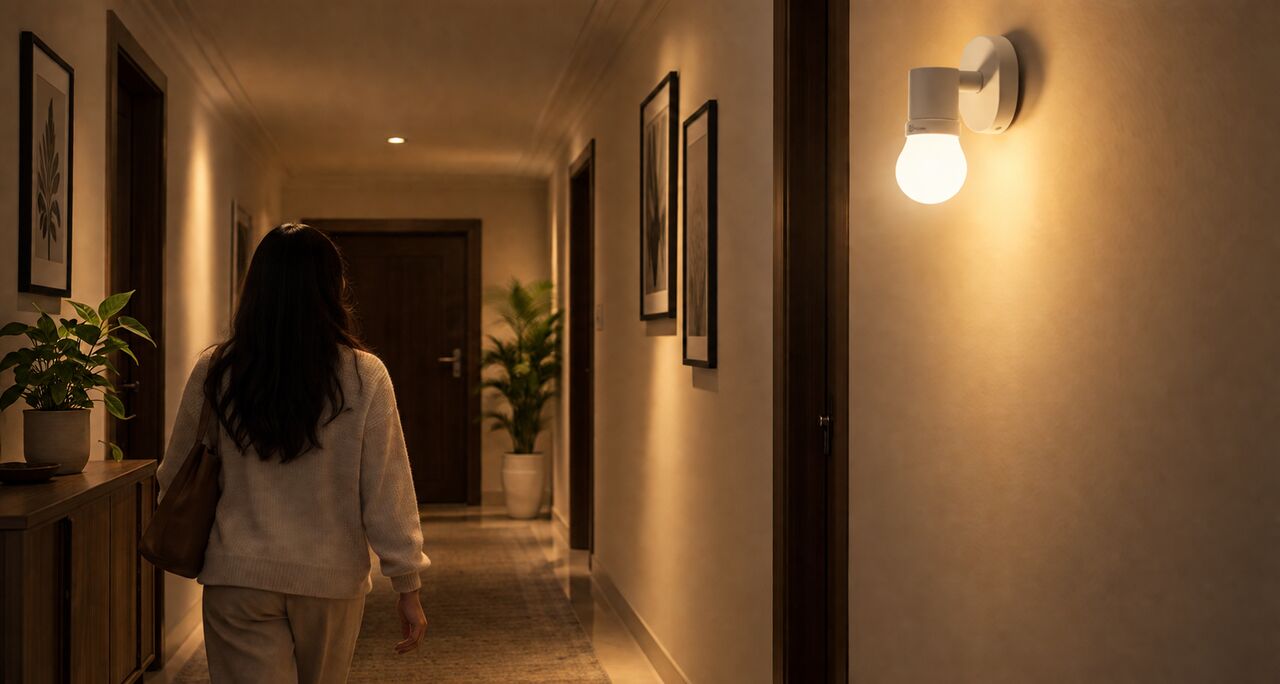
(iii) Indoor Hallways & Corridors: Recommended Esysense 10W B22 Motion Sensor Bulb. Eliminates energy waste caused by family members forgetting to turn off passageway lights.
(iv) Covered Porches & Balconies: Recommended Esysense 10W E27 Motion Sensor Bulb. Serves as an automated safety light that triggers instantly when guests or delivery personnel arrive at night.
Performance, Results & Real-World Considerations
(i) Mounting Height: For optimal coverage, install bulbs between 2.5m and 3.5m above floor level. Mounting higher than 4m reduces PIR thermal sensitivity.
(ii) Obstacle Clearance: PIR lenses must remain visible. Do not hide PIR bulbs behind decorative glass covers or tall indoor plants.
(iii) Thermal Source Clearance: Avoid placing PIR motion sensor bulbs directly in front of air conditioning discharge vents or space heater exhausts to prevent false thermal ac