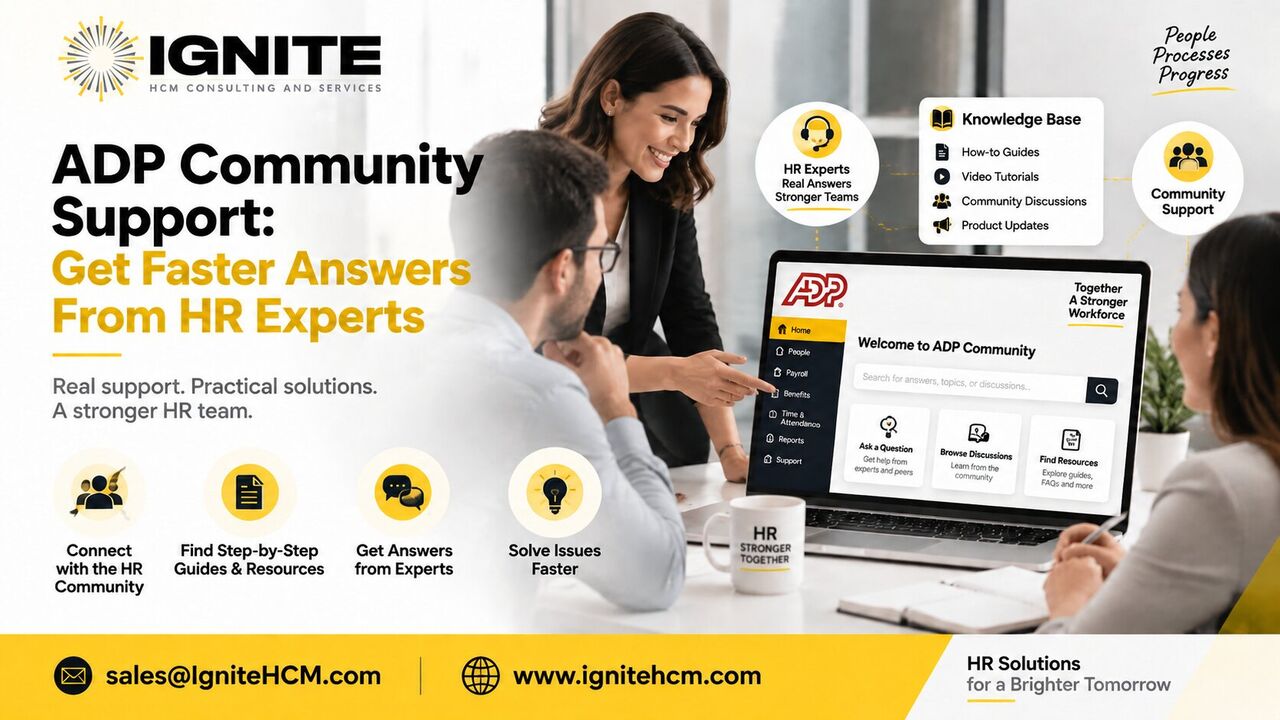
That makes access to knowledgeable support more than a convenience. HR and payroll teams need a way to find the right answer before an unfamiliar setting becomes a payroll correction. Ignite HCM describes its role as educating, training, and supporting the ADP community through user education, one-on-one training, and subscription support from experienced ADP service professionals.
Payroll questions become expensive when teams have to guess
Payroll administrators work inside systems where a small configuration decision can affect hundreds or thousands of records. Questions about earnings codes, deductions, tax settings, workflows, time data, security roles, or reporting can appear routine until someone applies the wrong fix across a larger employee population.
The risk becomes clearer when taxes are involved. The IRS says failure-to-deposit penalties can start at 2% of an unpaid employment tax deposit when it is 1 to 5 calendar days late and reach 15% under certain longer-delay conditions. Its failure-to-deposit penalty guidance also explains that employers can owe interest on penalties.
Fast access to someone who understands both the system and the payroll process can therefore change how a team responds. Instead of testing fixes directly in production or waiting until the next payroll cycle exposes the problem, administrators can confirm the cause and decide what should be changed.
Community support fills the gap between documentation and daily work
Documentation can tell an administrator where a setting appears. It doesn't always explain how that setting interacts with the employer's existing payroll process, security setup, reporting requirements, or prior configuration choices.
This is where ADP Community Support can become useful for teams that need practical guidance around their ADP environment. The value comes from connecting a specific problem with someone who has worked through similar configuration and process questions before.
Ignite HCM's solutions page describes several forms of assistance. Its ADP Virtual User Group offers monthly sessions on features and functionality, while its training services focus on one-on-one instruction. Its subscription support offering provides access to a dedicated solution consultant.
That mix matters because every support question doesn't require the same response. Some problems need a quick explanation. Others expose a knowledge gap, configuration issue, or process weakness that deserves a closer review.
Better answers begin with a better support request
HR teams can shorten the path to an answer by documenting the problem before asking for help. A useful request identifies the ADP module involved, what the user expected to happen, what actually happened, when the issue started, and whether any configuration or employee data changed beforehand.
The same discipline helps with payroll records. The U.S. Department of Labor requires covered employers to maintain records that include hours worked, pay rates, additions or deductions, wages paid, and the date of payment. Payroll records generally must be retained for at least 3 years, while records used to calculate wages generally have a 2-year retention requirement. The department's FLSA recordkeeping guidance explains these requirements in detail.
A support request backed by clear records gives the person investigating the issue more useful evidence. Screenshots, affected employee examples, report names, error messages, effective dates, and the steps already taken can reduce unnecessary back-and-forth.
Expert help should build internal knowledge, not dependency
The strongest support model helps the internal team understand why the problem occurred. Fixing the immediate setting matters, but the administrator should also know how to recognize the same issue later.
That is where ADP Training and Support can play a broader role. Ignite HCM states that its training includes one-on-one sessions designed to help users work with Workforce Now, while its monthly user group covers product features and functionality that organizations may not be using fully.
The principle is supported by research outside payroll as well. The National Institute of Standards and Technology describes structured job instruction as a method that combines explanation, demonstration, practice, and follow-up. NIST notes that consistent instruction can reduce the time supervisors spend correcting mistakes. Its Training Within Industry guidance uses a 4-step instruction model built around preparation, presentation, testing, and follow-up.
For an HR or payroll team, that can mean documenting a solved problem, explaining the reason for the correction, and showing another administrator how to handle it next time.
Consulting becomes useful when the same questions keep returning
A repeated support ticket can point to a bigger problem. If administrators repeatedly ask how to correct the same payroll result, handle the same data import, or work around the same manual process, answering the ticket may treat only the symptom.
ADP Consulting gives teams a reason to examine the process behind recurring questions. Ignite HCM's services cover areas such as implementation, payroll processing, compliance reviews, support, and HCM software improvement.
A consultant can look for the source of repeated work. The issue may come from system configuration, unclear ownership, missing training, poor source data, or an old process that hasn't been updated as the system changed.
The distinction matters because payroll deadlines don't move simply because a team is troubleshooting. Federal employment tax deposits, for example, may follow monthly or semiweekly schedules depending on the employer's circumstances. The IRS also requires electronic federal tax deposits and sets separate reporting requirements for employment tax forms. Its employment tax deposit guidance explains these schedules and reporting duties.
Outside support helps most when responsibilities remain clear
Consulting support shouldn't remove ownership from the internal HR or payroll team. The company still needs people who understand its policies, employee population, approval structure, payroll calendar, and business rules.
ADP HR and Payroll Consulting Services can work as an added source of system knowledge when the internal team reaches a question that requires deeper ADP experience. Ignite HCM says its services are performed by veteran ADP service professionals and include education, training, subscription consulting, implementation assistance, payroll processing, and compliance services.
The practical goal is to give internal administrators a clearer path when they don't know the answer. Teams should know which questions they can s