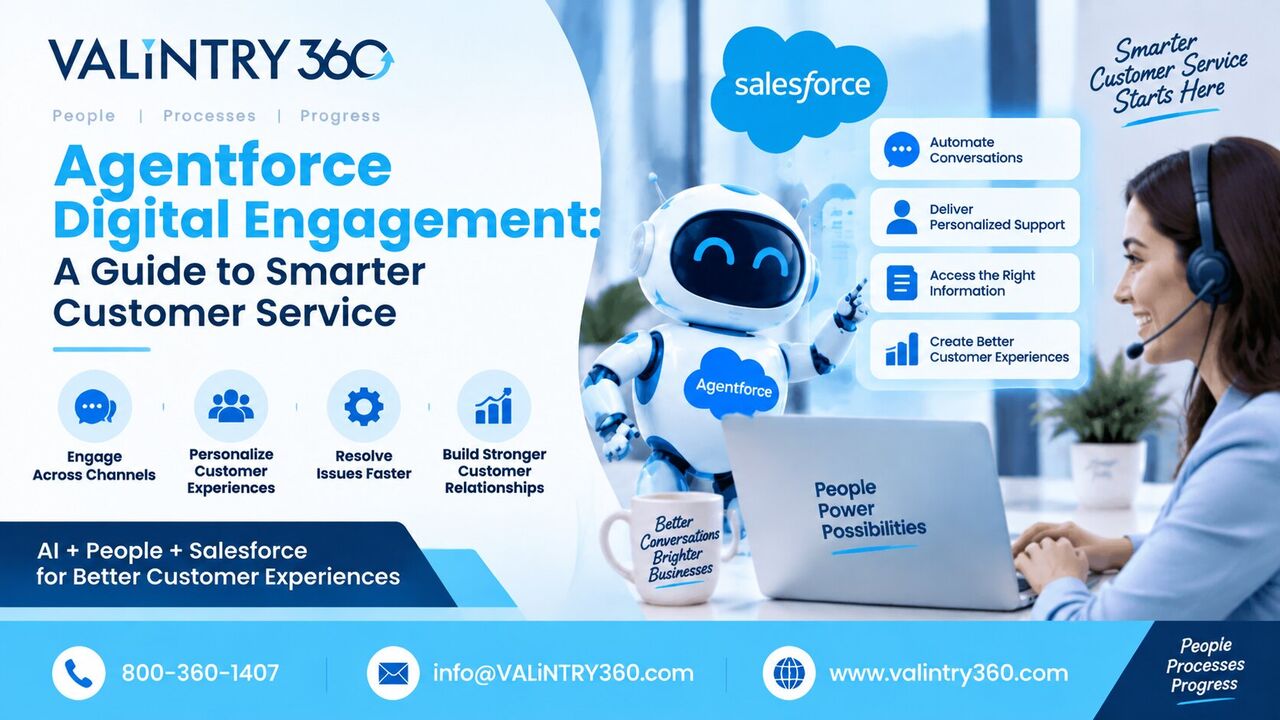
That shift explains the growing role of Agentforce in digital service. Salesforce now gives service teams ways to connect AI agents with messaging, CRM records, routing, and human support. The useful question is where automation should respond, where customer context should follow the conversation, and when a person should take over.
Digital service has moved beyond adding another chat window
Digital customer service once meant giving customers another way to contact support. A business might add web chat beside email, then introduce SMS or a messaging app. Each channel could still operate almost as its own queue, leaving service representatives to reconstruct context when a customer moved between them.
Salesforce's current messaging support covers channels including WhatsApp, Facebook Messenger, Apple Messages for Business, LINE, SMS, website messaging, and mobile app messaging. That makes channel coverage broad enough that architecture becomes as important as access. The Salesforce documentation for Messaging shows how these conversations can reach service teams through Salesforce rather than existing as unrelated communication streams.
This is where Agentforce Digital Engagement becomes relevant. The practical goal is to connect customer conversations with Salesforce context, routing rules, service workflows, and AI responses so the next action reflects what has already happened.
Channel choice still depends on what the customer is trying to do
The evidence warns against treating automation as the preferred answer for every interaction. In the XM Institute study, human-mediated channels received the highest average preference across the countries and activities measured. Digital preferences also differed sharply by market: digital channels were preferred by 62% of Chinese respondents across the activities studied, compared with 57% in South Korea and 48% in India.
Those differences matter when teams plan Salesforce Digital Engagement Channels. A password reset may suit self-service. A billing dispute with unclear account history may need a representative who can interpret the situation. Channel planning therefore needs to consider the task, customer expectations, available context, and the point at which human review becomes necessary.
The same principle applies to channel features. SMS, WhatsApp, web messaging, and Apple Messages for Business don't behave identically. A service design has to respect each platform's rules rather than pushing one conversation model everywhere.
Messaging rules can change the service workflow
The mechanics of a channel can affect how an AI-supported conversation is designed. Salesforce reported in June 2026 that an agent can enter about 840 characters for an outbound SMS message in Digital Engagement, with the text divided into 160-character messages. The same Salesforce guidance lists an approximate 2,000-character limit for Facebook Messenger messages.
WhatsApp introduces another operational boundary. Under the WhatsApp Business Messaging Policy, businesses can respond without an approved message template within 24 hours of a user's latest message. Outside that customer-service window, approved message templates are required for business-initiated communication. Meta's policy also requires clear escalation options when automated responses are used during that 24-hour period.
These rules turn channel configuration into part of service design. The phrase Key Agentforce Digital Engagement can therefore describe more than AI response setup. Teams also need routing conditions, escalation logic, consent handling, message rules, and a clear record of which system owns each step.
Agentforce changes what happens after a message arrives
An AI agent becomes more useful when it can act on service context rather than answer from a detached conversation window. Salesforce documentation describes connections that let an agent work across multiple channels while using response formats and Omni-Channel flows to route conversations between an agent and other destinations. Salesforce also notes that, beginning in April 2026, agent topics are called subagents in its documentation, while the underlying function remains the same.
In practice, the service flow can start with intent identification. The system can use available customer and case information to determine what the request concerns, apply the relevant instructions, and send the interaction to a person when the configured boundary is reached. The design matters because a fast automated answer has little value when it lacks the information needed to answer correctly.
A well-planned Agentforce Digital setup should therefore begin with service use cases rather than the desire to automate a large share of conversations. Teams can examine recurring questions, identify which records are needed to answer them, define escalation conditions, and then test the resulting path against real service scenarios.
Human handoff should preserve the work already done
Escalation often determines whether digital service feels connected or fragmented. A customer who has already explained an issue to an AI agent shouldn't have to reconstruct the same problem when a representative joins. The handoff needs to carry usable conversation history and the customer information required for the next decision.
Channel providers also create their own expectations around control. Apple's Messages for Business guidance says customers can use the service to ask questions, schedule appointments, resolve issues, and make purchases. Customers can start conversations from places such as Maps, Safari, Siri, Search, participating websites, and apps. Apple's guidance also lets users leave a business conversation when they no longer want follow-up messages.
That means service design needs a clear human path as well as an AI path. The conversation should arrive with enough context for the representative to continue it, while channel preferences and customer controls remain intact.
A practical rollout starts with a narrow service problem
The safest starting point is a service case whose boundaries can be defined and tested. Teams can select a repeatable request, document the information needed to resolve it, decide which answers can be handled by an AI agent, and specify the conditions that trigger human involvement. Testing should include incomplete data, ambiguous requests, channel interruptions, and cases where the customer changes direction.
VALiNTRY360's Agentforce Digital Engagement service describes this work through channel configuration, routing, automation, Salesforce CRM connections, testing, and post-launch monitoring. Those areas provide a useful implementation frame because each one can be checked against an observable service outcome rather than an abstract AI target.
The measurement stage should follow the same logic. Teams can