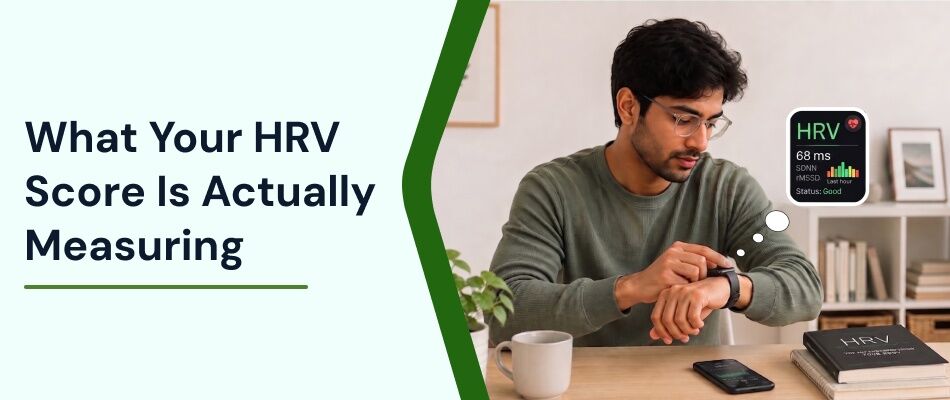
What HRV Score Measures
HRV quantifies the precise timing variation between successive interbeat (RR) intervals. For example, consecutive beats might measure 950 milliseconds, 1,020 milliseconds, 980 milliseconds, and 1,050 milliseconds.
These changes are partly influenced by the autonomic nervous system (ANS), which continuously adjusts cardiovascular function in response to internal and external demands.
What HRV score measures includes:
Beat-to-beat timing variations
Autonomic nervous system regulation
Your bodys ability to adapt to stress and recovery
Parasympathetic and sympathetic nervous system balance
HRV shows how your nervous system is working. But dont use it to measure stress. And dont use it alone to diagnose problems
Learn More About Recovery and Performance Monitoring
Build a deeper understanding of recovery, autonomic regulation, and performance. Explore the Certified Nutritionist Course to learn how nutrition, sleep, and stress management can support recovery and overall autonomic health.
Why is HRV important?
Your body is constantly responding to stress, from workouts to work deadlines to poor sleep. HRV is one window into how stressed or recovered your nervous system is.
Think of it this way: if your body is a phone battery, HRV tells you how much energy is left and how fast youre draining it. Low HRV might mean your battery is depleted. High HRV might mean youre charged and ready.
Why track it:
Know when your body genuinely requires rest rather than relying on guesswork
Make smarter training and recovery adjustments using objective data
Understand your nervous systems stress capacity without expensive lab test.
HRV wont tell you everything about your health. But its a useful clue about how your nervous system is managing stress and recovery.
Autonomic Nervous System and HRV
The autonomic nervous system regulates functions that largely occur without conscious control:
Heart rate
Blood pressure
Digestion
Breathing
Two branches are particularly relevant to understanding HRV:
A sympathetic nervous system helps your body respond to demands such as exercise, acute stress, and other challenges.
The parasympathetic nervous system supports resting and recovery functions. The vagus nerve plays an important role in cardiac regulation.
An important scientific clarification: HRV should not simply be interpreted as a measure of "sympathetic versus parasympathetic balance." HRV reflects interactions among several physiological regulatory systems, not just one simple balance.
Which HRV Metric Does Your Device Measure?
Different devices can report different HRV metrics. Understanding the measurement is important.
RMSSD (Root Mean Square of Successive Differences):
Reflects short-term beat-to-beat variation
Commonly used as an indicator of cardiac parasympathetic modulation
Frequently reported by consumer wearables
Can be useful for tracking changes in autonomic recovery
SDNN (Standard Deviation of Normal-to-Normal Intervals):
Describes overall variability during a recording period
Depends strongly on recording duration
A five-minute SDNN and a 24-hour SDNN should not be treated as interchangeable measurements
Frequency domain measures: HRV can also be analyzed according to frequency components, including high-frequency (HF) power, low-frequency (LF) power, and very-low-frequency (VLF) power.
Originally Published At : https://infs.com/blogs/what ...