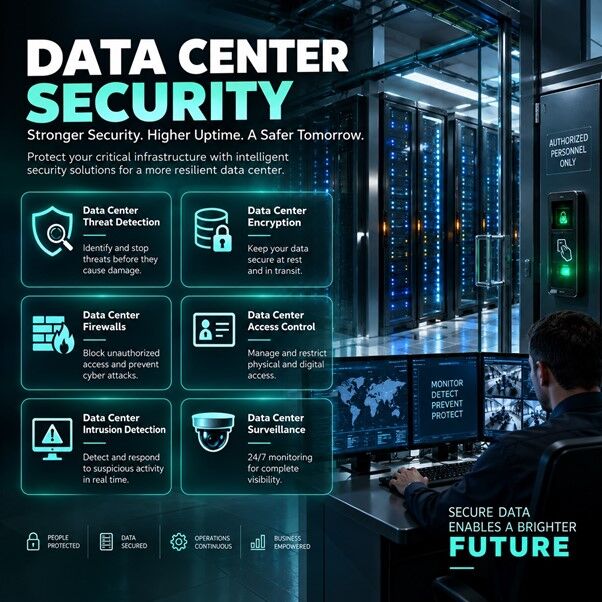
In this guide, we explain what data center security is, the main types of protection it includes, why it matters for businesses in Riyadh and across KSA, and how to choose the right features and provider.
What Is Data Center Security?
Data center security is the combination of physical measures, technology, and policies used to protect a data center's hardware, software, and data from damage, theft, unauthorized access, and cyberattacks.
It covers two connected sides of protection:
• Physical security — guarding the building, server rooms, and equipment from intruders, theft, fire, or natural disasters.
• Cybersecurity — protecting the network, servers, and stored data from hackers, malware, and other digital threats.
A strong data center security strategy brings both sides together so that a facility is safe from someone walking through the front door and safe from someone trying to break in through the network.
Types of Data Center Security
Data center security isn't a single tool — it's a layered system made up of different protections working together. Here are the main types every business should understand.
1. Cybersecurity for Data Center
Cybersecurity for data center environments focuses on protecting servers, storage systems, and networks from digital attacks. This includes:
• Intrusion detection and prevention systems
• Endpoint protection on all connected devices
• Regular vulnerability scanning and patch management
• Security monitoring and incident response
Without strong cybersecurity, even a physically secure data center can be breached remotely by attackers exploiting weak software or unpatched systems.
2. Data Center Encryption
Data center encryption protects information by converting it into unreadable code that can only be unlocked with the correct key. This applies to:
• Data at rest — information stored on servers and drives
• Data in transit — information moving across networks
• Data in use — information being actively processed
Encryption is one of the strongest defences available. Even if attackers manage to steal data, encrypted files are useless to them without the decryption key.
3. Data Center Firewalls
Data center firewalls act as a filter between trusted internal networks and the outside world. They inspect incoming and outgoing traffic and block anything that looks suspicious or unauthorized. Modern data center firewalls often include:
• Deep packet inspection
• Application-level filtering
• Segmentation between different zones of the network, so a breach in one area doesn't spread to the whole system
Firewalls are usually paired with Data Center Threat Detection tools that continuously watch network activity for unusual behaviour, flagging or blocking attacks in real time before they cause serious damage.
4. Data Center Security KSA
Data Center Security KSA refers to data center protection built around Saudi Arabia's specific regulatory and business environment. This includes compliance with local frameworks such as:
• The Personal Data Protection Law (PDPL), overseen by the Saudi Data and Artificial Intelligence Authority (SDAIA), which requires strong security measures to protect personal data and sets serious penalties for non-compliance.
• The National Cybersecurity Authority's (NCA) Essential Cybersecurity Controls, which set baseline cybersecurity requirements for government entities and critical infrastructure.
• The Data Centre Services Regulations issued by the Communications, Space and Technology Commission (CST), which came into force in 2024 and require data center service providers to arrange adequate on-site security and follow set operating standards.
A proper Data Center Security KSA setup means combining international best practices with these local legal requirements — something that matters a great deal for any business handling customer or government data inside the Kingdom.
Benefits of Strong Data Center Security
Investing in proper data center security brings real, measurable advantages:
• Protection against data breaches that could expose sensitive customer or company information.
• Reduced downtime, since well-protected systems recover faster from attacks or physical incidents.
• Regulatory compliance, avoiding heavy fines tied to laws like the PDPL, which can reach up to SAR 5 million per violation.
• Customer trust, since clients feel safer doing business with a company that clearly protects their data.
• Business continuity, keeping critical operations running even during an attempted attack or physical emergency.
• Stronger Data Center Access Control, ensuring only authorized personnel can reach sensitive servers and systems — reducing the risk of insider threats and accidental damage.
Why Data Center Security Matters for Businesses in Riyadh and KSA
Saudi Arabia's digital economy is expanding quickly, and with it, the amount of sensitive data businesses store and process. Here's why this matters specifically for organizations in Riyadh and across the Kingdom.
A Rapidly Growing Digital Economy
As part of Vision 2030, Saudi Arabia is investing heavily in cloud infrastructure, smart cities, and digital government services. New data centers are being built across Riyadh and other major cities to support this growth, which means more sensitive data is being stored locally than ever before.
Conclusion
Data center security is no longer optional — it's a core part of running a modern business. From Cybersecurity for Data Center environments and Data Center Encryption, to Data Center Firewalls and strong Data Center Access Control, every layer plays a role in keeping sensitive information safe. With Saudi Arabia's growing digital economy and stricter enforcement of laws like the PDPL and NCA controls, a proper Data Center Security KSA strategy — backed by real Data Center Threat Detection — is essential for any business operating in Riyadh or across the Kingdom.
Ready to strengthen your data centers security? Contact a professional data center security provider in KSA today for a full risk assessment and a protection plan tailored to your business.