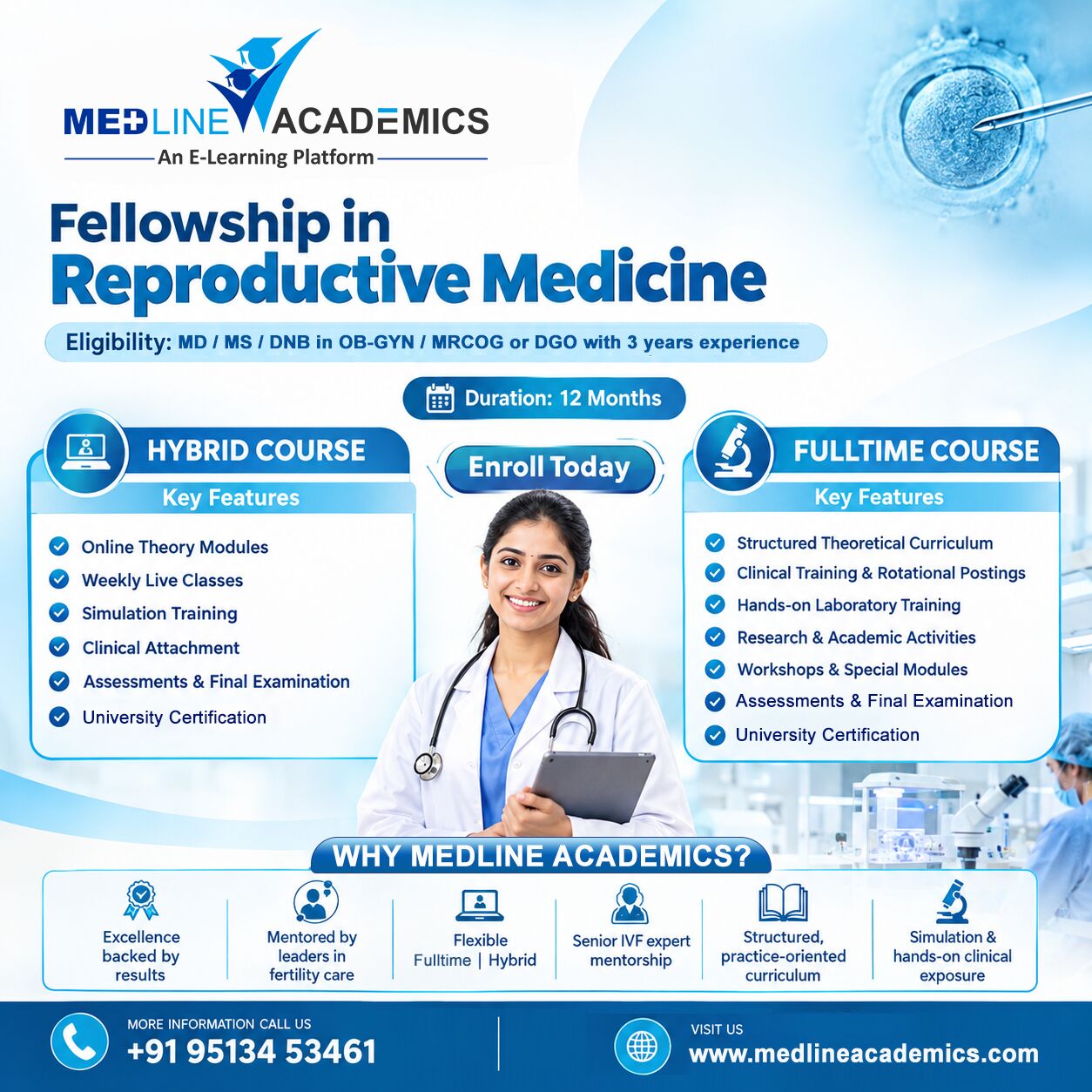
Fellowship in Infertility is an option for physicians who wish to advance their knowledge in this area and learn more about the diagnosis and treatment of infertility, reproductive endocrinology and assisted reproductive technologies (ARTs). These types of programs will allow participants to develop their understanding of medical knowledge and at the same time learn modern ways of treating fertility problems.
On the other hand, the presence of Online Infertility Courses has ensured that specialised education has become easier for working healthcare professionals. Online education can provide a certain amount of flexibility, whereas practical and clinical work can be used to relate theory to reality.
Those who are looking for specialised education need to know about an infertility fellowship, the role of online education in continuing education, and the benefit of working with an experienced IVF Hospital in Bangalore.
What Is a Fellowship in Infertility?
A Fellowship in Infertility is a training programme that concentrates on infertility research, diagnosis and management to a greater degree. It may incorporate the study of male and female infertility, reproductive endocrinology and infertility, Infertility assessments and assisted reproductive techniques, and details vary according to training centres and programmes.
Infertility is often not caused by a single factor. Fertility issues can be due to an ovulatory disorder, loss of ovarian reserve, tubal problems, endometriosis, male-factor infertility, age and others or a combination of conditions.
Therefore, specialised training should encourage a systematic approach to infertility assessment rather than focusing only on individual treatment procedures.
A comprehensive fellowship may introduce participants to:
• Female infertility evaluation
• Male infertility evaluation
• Reproductive endocrinology
• Ovulation and ovarian function
• Ovarian reserve assessment
• Semen analysis and male-factor infertility
• Ovulation induction
• Intrauterine insemination (IUI)
• IVF and ICSI
• Embryology fundamentals
• Recurrent implantation failure
• Recurrent pregnancy loss
• Fertility preservation
• Basic reproductive genetics
• Patient counselling and ethical considerations
This broader understanding can help healthcare professionals appreciate how different disciplines contribute to fertility care.
Why Consider Specialised Training in Infertility?
Assisted reproductive technology has revolutionised infertility treatment. What used to be very specialised treatments are now part of the modern infertility service.
For clinicians, advances in treatment mean that CPD is a regular requirement. A fellowship allows the study of reproductive medicine in a more formal environment rather than in a random collection of workshops, unaccredited lectures or self-guided learning.
It can also help participants understand the reasoning behind different treatment approaches.
For instance, IVF is not the first treatment that will be recommended to all patients with infertility issues. Instead, the fertility expert will conduct a number of investigations on the reproductive history, age, ovarian reserve, fallopian tubes, sperm characteristics and any prior treatments of the patient.
The Growing Role of Online Infertility Courses
Physicians and other health practitioners working may have challenges in attending classroom courses as a result of clinical commitments. This is one of the reasons why Online Infertility Courses are gaining popularity. Learners will be able to access academic content and learn from any geographical location while studying to their professional timetables through online education. Some courses might be conducted through recorded lectures, live interactions, study resources, case discussions and written assignments.
However, prospective learners should understand that online learning and practical clinical training serve different purposes.
Online education can be particularly useful for understanding:
• Reproductive physiology
• Infertility investigations
• Treatment protocols
• Reproductive endocrinology
• IVF concepts
• Embryology fundamentals
• Male infertility
• Fertility preservation
• Case-based clinical discussions
Practical training, on the other hand, can provide exposure to procedures, laboratory environments and clinical workflows.
For this reason, a programme that combines flexible online academic learning with appropriate practical or clinical exposure can offer a more comprehensive educational experience.
What Should You Look for in Online Infertility Courses?
Online Infertility Courses may not have the same format or content. Healthcare practitioners must consider a number of issues before joining any such courses.
Curriculum
The course should first cover the basic principles of infertility before moving on to more complicated ideas. The well-defined syllabus makes it easier for students to see the connection between various aspects of reproductive medicine.
Faculty
Experienced faculty can add clinical context to academic learning. Case discussions and practical examples can help participants understand how theoretical concepts are applied.
Interactive Learning
Active participation in live class sessions, interactions, and discussions makes online education more stimulating than mere video-based learning.
Assessments
Assessments, such as assignments or exams, can assist the learner in determining how well he or she understands the course content.
Practical Exposure
If a programme includes practical training, participants should understand what type of exposure is provided and where it takes place.
Medline Academics: Structured Medical Education for Healthcare Professionals
Medline Academics - Collaborate and discuss Infertility Education Medline Academics offers structured medical education programmes to healthcare professionals who are interested in increasing their understanding and knowledge base in specific medical areas including reproductive medicine and infertility. The learning modules provided are structured academic courses that, depending on the individual programme, will provide you with focused study modules, lectures from experts, case discussion and relevant hands on experiences. For healthcare professionals considering a Fellowship in Infertility, structured education programmes can help to bring concepts together such as infertility assessment, reproductive endocrinology, assisted reproductive technologies, embryology, and fertility management in one study pathway. The freedom to learn flexibly through digital education also makes it possible for working professionals to access focused academic courses and apply their learning in practice, in order to get the best possible exposure to t