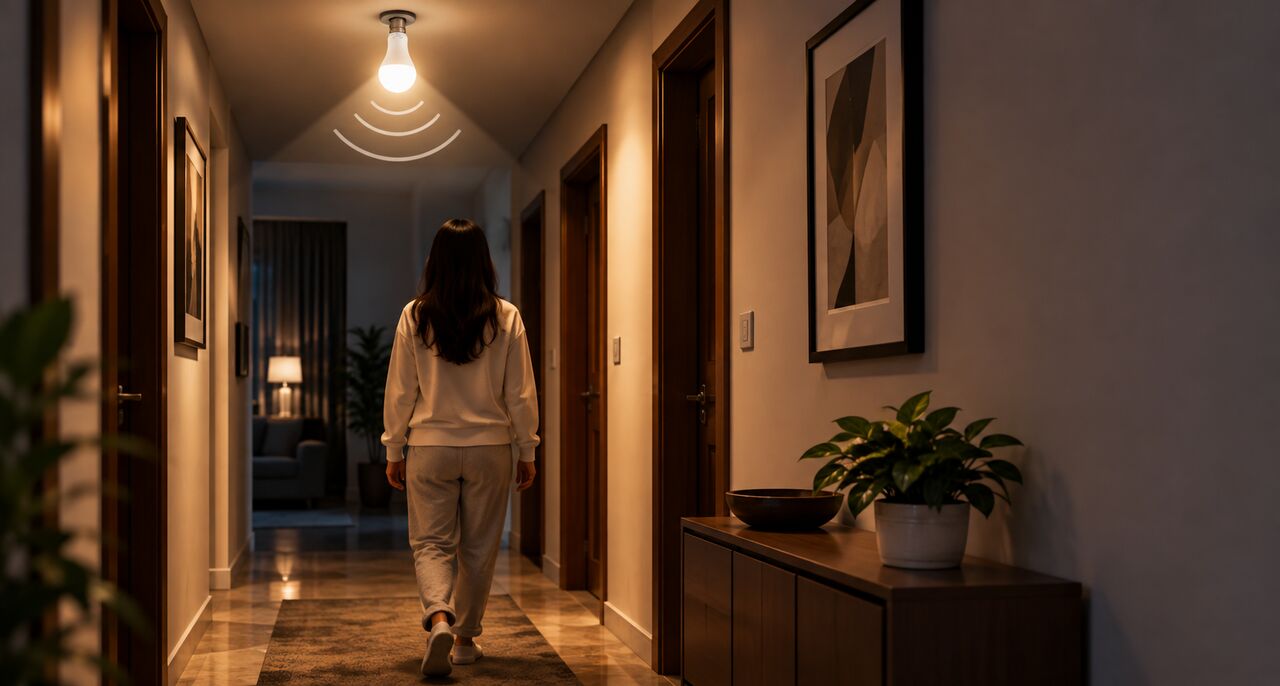
Quick Recommendation
(i) Best for enclosed glass fixtures & decorative sconces: Esysense 10W E27 Motion Sensor Bulb — A premium 5.8GHz microwave radar bulb that detects movement through glass globes, acrylic covers, and decorative lampshades.
(ii) Best overall for standard indoor sockets & open stairwells: Esysense 10W B22 Motion Sensor Bulb — Combines PIR body heat tracking, automated daylight sensing, and 1000 lumens of cool white light for standard Indian bayonet holders.
(iii) Best budget choice for compact washrooms & closets: Esysense 7W B22 Motion Sensor Bulb — Delivers focused, energy-efficient lighting tailored for smaller rooms and brief walk-through zones.
(iv) Avoid radar bulbs when: Installing on thin interior partition walls directly adjacent to high-traffic bedrooms, as high-frequency radar waves can occasionally penetrate light walls and cause unexpected triggers.
Product Overview
An automatic on/off bulb integrates solid-state LED chips, internal driver electronics, an ambient light sensor, and an occupancy-sensing module into a standard light bulb casing.
(i) What it is: A self-contained, sensor-driven LED light bulb that automates switching right at the socket without requiring external wall sensors or smart relays.
(ii) What it does: Continuously monitors surrounding motion and ambient light levels, automatically powering on full brightness when darkness is paired with human movement and switching off when the space is vacant.
(iii) Who it is intended for: Homeowners, renters, elderly individuals, busy parents, and facility managers looking for hands-free convenience, night safety, and reduced electricity costs.
(iv) Primary features: 5.8GHz Microwave Radar transceiver or PIR thermal element, built-in daylight photocell (LUX sensor), auto-off delay timer, standard B22 bayonet or E27 screw fitting.
(v) Key specifications: 7W to 10W active power draw, 650 to 1000 lumen light output, 360-degree radar or 120-degree PIR detection cone, 3 to 9 meter sensing distance, standby power under 0.5W.
(vi) Main use cases: Enclosed glass sconces, indoor staircases, main corridors, master bathrooms, walk-in closets, balconies, and entrance foyers.
(vii) Important limitations: The main wall switch supplying power to the socket holder must remain turned ON continuously to supply standby power to internal sensor circuits.
Why This Matters
For decades, automated lighting required cutting into walls, running low-voltage wiring, and mounting bulky external sensor boxes. Early occupancy bulbs also suffered from a major flaw: standard PIR sensors could not detect movement if placed inside glass fixtures because solid glass blocks thermal infrared heat. The arrival of the 5.8GHz radar bulb solves this issue completely. By emitting high-frequency waves that penetrate glass diffusers and lampshades, radar technology turns decorative light fixtures into smart, automated security lights without altering your home's aesthetics.
Understanding How Automatic On/Off and Radar Sensor Tech Operates
An automatic on/off bulb operates through a continuous 5-step electronic control loop managed by an internal microcontroller:
(i) Continuous Standby Power: As long as the wall switch remains ON, the internal driver draws minimal standby power (<0.5W) to keep the microcontroller and sensors armed.
(ii) Daylight Suppression Check (LDR Photocell): Before activating light, an integrated Light Dependent Resistor (LDR) measures ambient lighting. If natural daylight is sufficient, the sensor loop remains dormant to avoid daytime energy waste.
(iii) Motion Detection Wave Shift: In dark conditions, the occupancy sensor actively monitors its range. A radar bulb transmits continuous 5.8GHz high-frequency electromagnetic wave pulses. When a person moves within range, the reflected wave frequency shifts (the Doppler effect), triggering the sensor.
(iv) Instant Full Illumination: Upon receiving the motion trigger, the internal microcontroller closes the driver circuit, powering the LED array to 100% full brightness in less than 0.2 seconds.
(v) Auto-Off Countdown: When movement stops, an internal hold timer counts down 30 to 60 seconds. If no further motion occurs, the driver disconnects power to the LEDs and reverts to low-power standby mode.
Key Technical Mechanisms
(i) 5.8GHz Microwave Radar Transceiver: Emits high-frequency electromagnetic signals that easily pass through non-metallic physical barriers like glass globes, acrylic shades, and thin wood.
(ii) PIR Pyroelectric Element: Tracks moving thermal body heat signatures across split optical Fresnel lenses.
(iii) LDR Photodiode (LUX Sensor): Measures ambient light levels to enforce daytime shutoff.
(iv) Solid-State LED Driver: Regulates voltage, manages instant-on response, and controls auto-shutoff delay countdowns.
Main Decision Factors: Choosing Between Sensor Lighting Technologies
1. Fixture Design & Sensor Wave Penetration
What to look for: Determine whether your lighting fixture is open or enclosed behind glass.
Why it matters: PIR thermal sensors require direct line-of-sight exposure because glass acts as a thermal insulator, blocking body heat signals. A radar bulb uses electromagnetic waves that pass through frosted glass, acrylic domes, and fabric lampshades without loss of sensitivity.
Practical recommendation: Choose an automatic on/off bulb powered by PIR for exposed wall holders in bedrooms or hallways. Choose a radar bulb for decorative glass sconces, ceiling domes, or covered porch lanterns.
2. Detection Range & Coverage Angle
What to look for: Match the sensor's detection radius to the size of your room or entryway.
Why it matters: PIR motion sensors offer directional 120-degree cone detection up to 3 to 5 meters. Radar bulbs deliver omnidirectional 360-degree detection up to 6 to 9 meters.
Practical recommendation: Use 360-degree radar bulbs in wide open spaces like carports, long corridors, and double-height foyers. Use directional PIR bulbs in smaller rooms where localized detection is preferred.
3. Daylight Suppression Intelligence
What to look for: Ensure the bulb explicitly features an integrated LDR daylight photodiode.
Why it matters: Without daylight sensing, the motion sensor activates full brightness every time someone walks past during bright daylight hours, shortening LED lifespan and wasting power.
Practical recommendation: Always select dual-sensor bulbs