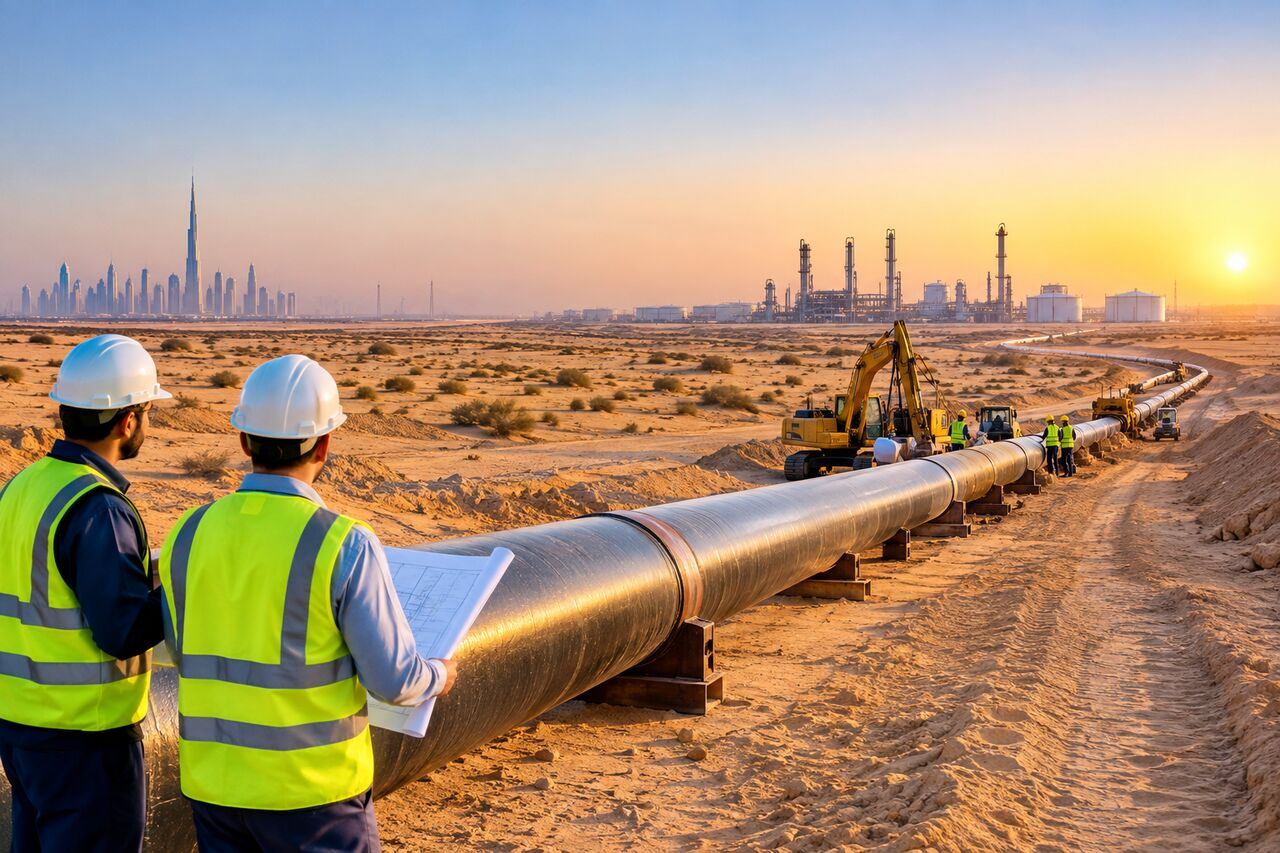
Cross-country pipelines are extensive, underground systems engineered to move crude oil, natural gas, water, or chemicals safely and efficiently over large distances between regions. Constructing these pipelines requires advanced engineering, meticulous planning, and strict adherence to rigorous safety standards and regulations. This article gives insight into these projects and the qualifications of cross-country pipeline contractors in the UAE.
What Is a Cross-Country Pipeline?
Cross-country pipelines connect oil fields to refineries, processing plants, storage facilities, or distribution centers over long distances. Unlike short pipelines found within industrial plants, these pipelines span many kilometers, traversing deserts, hills, rivers, highways, and populated areas. These pipelines are predominantly buried underground and constructed from carbon steel to withstand high pressures and ensure long-term durability.
Why Cross-Country Pipelines Matter in the UAE
The UAE's energy, industrial, and utility sectors rely on pipeline networks to transport large volumes of products between production, processing, storage, and distribution facilities. Long-distance pipelines can reduce dependence on road transportation and support continuous, high-volume movement of fluids. Desert terrain, extreme temperatures, groundwater conditions, and major infrastructure crossings make route planning and construction particularly important.
Key Stages of a Cross-Country Pipeline Project
Most cross-country pipeline projects follow several key stages:
Engineering and route design. Engineers assess terrain, soil quality, structural stresses, and necessary crossings, developing designs that adhere to international standards like ASME B31.4 and B31.8.
Material selection. The size and grade of carbon steel pipes used depend on the substance being transported and the pressure.
Corrosion prevention. Buried carbon steel pipelines are protected from corrosion using coatings such as three-layer polyethylene (3LPE) and fusion-bonded epoxy (FBE), along with cathodic protection systems.
Trenching and earthworks. Dewatering and sheet piling are done to ensure safety in wet or unstable soil conditions.
Welding and joining operations. Automatic and semi-automatic welding techniques improve weld consistency, with all welds inspected to meet standards such as API 1104.
Crossings. To minimize surface impact, roads, rivers, and mountains are often crossed using advanced trenchless technologies such as horizontal directional drilling (HDD), boring, and microtunnelling.
Testing and commissioning. Hydrostatic testing, cleaning, pigging, and purging are performed to verify the pipeline’s integrity and readiness for operation.
What Do Cross-Country Pipeline Contractors Do?
Contractors who provide pipeline construction in cross-country pipelines undertake some or all of the activities mentioned above. The usual range of activities undertaken by them includes:
Supply, installation, and welding of pipes
Long-radius cold bends are implemented to ensure smooth flow dynamics and reduce the need for excessive welding joints.
Control cable and cathodic protection system installation
Hot tapping, where a connection is made while the system is still operational
Cold cutting technique for sparkless cutting
Nitrogen purging and pigging
Some contractors manage the entire process as a package. Others may be responsible for specific phases within an engineering, procurement, and construction (EPC) contract. Further information on the services offered by a particular contractor can be found here in the cross-country pipeline services description.
How to Evaluate Cross-Country Pipeline Contractors in the UAE
Project owners generally base contractor evaluations on objective considerations instead of claims:
Relevant experience. Successful long-distance projects under comparable conditions and fluid service.
Technical capability. In-house expertise in design, coating, welding, trenchless crossings, and commissioning.
Safety and quality systems. Well-known management systems, certified welders and inspectors, and procedures.
Compliance with regulations. Awareness of UAE certification standards and project specifications.
Equipment and manpower. Sufficient equipment, skilled workforce, and supply chain integrity.
Documentation. Track record for materials, weld maps, and testing reports.
Frequently Asked Questions
What is a cross-country pipeline?
A pipeline designed to transport crude oil, natural gas, water, or other liquid chemicals underground across diverse terrain and over long distances between facilities.
What services do cross country pipeline contractors provide?
Cross-country pipeline contractors provide a comprehensive range of services, including engineering, material supply, coating, welding, crossings, testing, and commissioning—either as turnkey solutions or for specific project phases.
Why is coating essential for buried pipes?
3LPE and FBE coatings, combined with cathodic protection, help control external corrosion and protect buried steel pipelines.
How can pipelines be laid through roads and rivers?
Pipelines can be installed beneath roadways or rivers using trenchless technologies such as horizontal directional drilling (HDD), boring, and microtunnelling.
What are the main codes and standards governing pipeline installation in the UAE?
Depending on the pipeline service and project requirements, applicable standards may include ASME B31.4 for liquid and slurry transportation, ASME B31.8 for gas transmission and distribution, and API 1104 for pipeline welding, alongside client specifications and applicable UAE requirements.
How much time does a cross-country pipeline project take?
The project duration depends on several factors, including pipeline length and diameter, terrain complexity, permitting requirements, and the number and type of crossings.
Conclusion
Cross-country pipelines are complex undertakings, with safety and efficiency relying on proper design, high-quality materials, effective corrosion protection, and sound construction practices. In the UAE’s challenging environment, including difficult terrain and groundwater conditions, skilled contractors leverage their engineering expertise and utilize advanced techniques—such as trenchless crossings, precision welding, and rigorous commissioning—to deliver safe, reliable pipelines. Contractors with extensive experience, comprehensive technical knowledge, robust safety practices, and thorough documentation are best equipped to deliver safe, reliable pipelines for project owners.