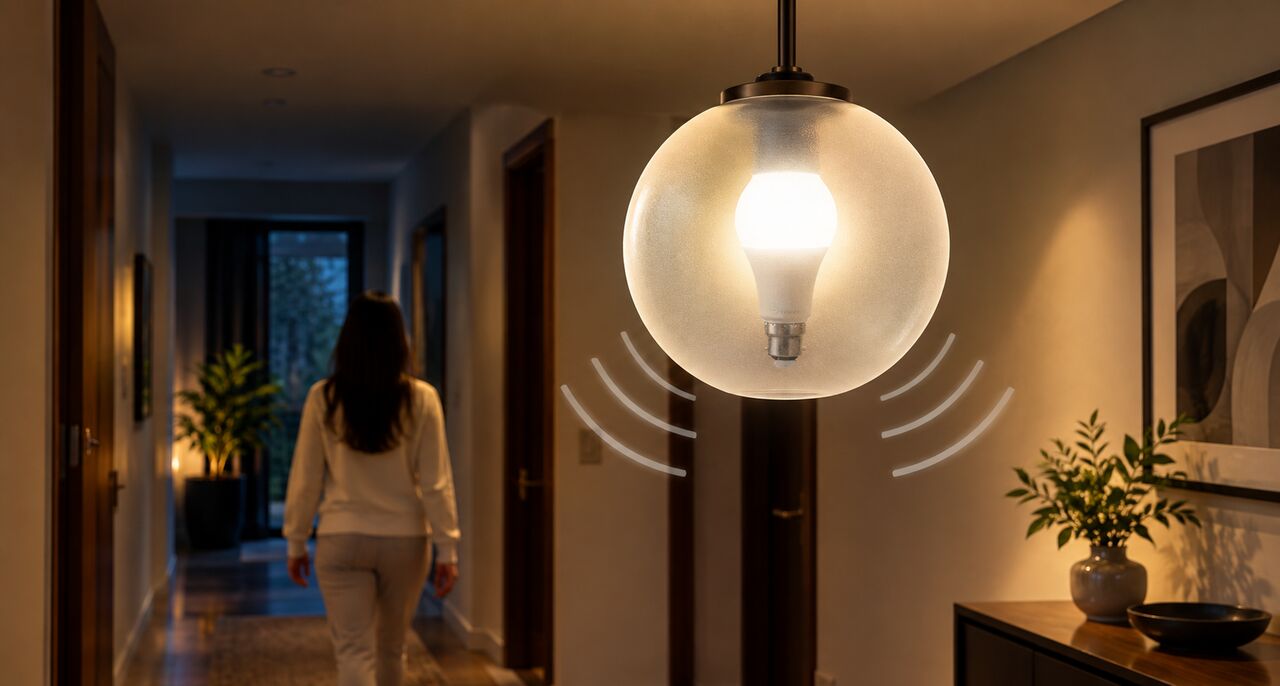
Quick Recommendation
(i) Best for enclosed glass sconces & ceiling fixtures: Esysense 10W E27 Motion Sensor Bulb — A premium 5.8GHz microwave radar bulb that detects movement through glass globes, lampshades, and acrylic diffusers.
(ii) Best overall for standard indoor sockets & open stairwells: Esysense 10W B22 Motion Sensor Bulb — Pairs PIR body heat tracking with an automated day/night photocell for standard Indian bayonet wall holders.
(iii) Best budget choice for compact washrooms & closets: Esysense 7W B22 Motion Sensor Bulb — Delivers focused, low-wattage auto-sensing illumination for smaller utility spaces.
(iv) Avoid radar bulbs when: Installing on thin drywall partitions right next to high-traffic bedrooms, as high-frequency radar signals can penetrate thin walls and cause unintended activations.
Product Overview
Next-generation sensor lighting integrates solid-state LED chips, internal driver electronics, ambient photodiode sensors, and advanced detection microcircuits directly inside a standard light bulb casing.
(i) What it is: Advanced occupancy LED bulbs engineered with 5.8GHz microwave radar modules or multi-stage auto-dimming LED drivers to automate switching at the socket level.
(ii) What it does: Continuously monitors ambient light levels and occupancy, adjusting output from standby off or dimmed ambient glow up to 100% brightness when human movement is detected in dark environments.
(iii) Who it is intended for: Homeowners, renters, senior citizens, commercial facility managers, and hospitality operators seeking hands-free lighting, night safety, and lower utility bills.
(iv) Primary features: 5.8GHz Microwave Radar transceiver, multi-stage dimming driver, built-in daylight photocell (LUX sensor), integrated hold-time countdown, standard B22 bayonet or E27 screw base.
(v) Key specifications: 7W to 10W active full power draw, 1.5W to 2W dimmed standby output, 650 to 1000 full lumens, 360-degree radar coverage up to 9 meters, standby power under 0.5W.
(vi) Main use cases: Enclosed glass sconces, multi-level staircases, long corridors, parking garages, master bathrooms, verandas, and entrance foyers.
(vii) Important limitations: The primary wall switch feeding the light socket must remain turned ON continuously to power the internal sensor circuitry.
Why This Matters
Traditional motion bulbs rely on Passive Infrared (PIR) sensors that track moving body heat. While effective in open sockets, PIR sensors cannot detect movement inside closed glass globes or fabric lampshades because glass acts as a thermal barrier. The introduction of the led radar bulb overcomes this limitation by using high-frequency electromagnetic waves that pass through glass diffusers. Meanwhile, an auto dimming light bulb solves the issue of pitch-black corridors by maintaining a soft, continuous background glow that brightens to full capacity upon approach, delivering comfort and security in transition zones.
Understanding How LED Radar Bulbs and Auto-Dimming Bulbs Operate
Advanced sensor bulbs operate through a 5-step electronic control cycle managed by internal micro-controllers:
(i) Continuous Low-Power Standby: As long as the main wall switch stays ON, the internal driver draws minimal standby power (<0.5W for radar bulbs; 1.5W–2W for auto-dimming models) to keep the sensors active.
(ii) Daylight Suppression Check (LDR Photocell): An integrated Light Dependent Resistor (LDR) continuously monitors ambient daylight levels. If natural sunlight or room light is sufficient, the sensor loop remains dormant, preventing daytime activation.
(iii) Occupancy Detection Trigger: In dark conditions, an led radar bulb emits continuous 5.8GHz electromagnetic wave pulses. When a person moves within range, the reflected wave frequency shifts (the Doppler effect), signaling the internal driver circuit.
(iv) Instant Output Scaling (Full Brightness): Upon detecting movement, the driver scales power output to 100% full lumen capacity within 0.2 seconds.
(v) Auto-Off or Return to Dimmed Mode: When physical motion stops, an internal timer counts down 30 to 60 seconds. A standard radar bulb then shuts off completely, while an auto dimming light bulb gently steps power down to a 15%–20% background glow until the next trigger.
Key Technical Mechanisms
(i) 5.8GHz Microwave Radar Module: Transmits high-frequency electromagnetic wave pulses that penetrate glass globes, acrylic covers, and thin wood.
(ii) Multi-Stage Dimming LED Driver: Regulates voltage output seamlessly between low-wattage standby glow and full active brightness.
(iii) Ambient Light Photocell (LDR): Prevents daytime activation by establishing a strict darkness threshold.
(iv) Doppler Processing Microcontroller: Filters out static background noise to detect active physical human motion.
Main Decision Factors: Choosing Between Radar and Auto-Dimming Lighting
1. Fixture Design & Barrier Penetration
What to look for: Determine whether your light fixture is open or enclosed behind decorative glass or plastic.
Why it matters: PIR thermal sensors require an open line-of-sight because solid glass blocks thermal heat signals. A led radar bulb uses high-frequency waves that pass right through frosted glass globes, acrylic diffusers, and fabric lampshades without sensitivity loss.
Practical recommendation: Choose an led radar bulb for enclosed ceiling domes, decorative wall sconces, or covered outdoor lanterns. Choose an open PIR bulb for standard wall sockets in open rooms.
2. Night Visibility Preference (Full Darkness vs. Soft Ambient Glow)
What to look for: Decide whether the area requires complete darkness when unoccupied or continuous low-level orientation light.
Why it matters: Standard motion bulbs shut off completely when no movement is detected. An auto dimming light bulb maintains a continuous 15% to 20% background illumination in dark spaces, scaling up to 100% full brightness only when someone walks near.
Practical recommendation: Use auto-dimming sensor bulbs in commercial hallways, hotel corridors, and staircase landings where pitch-black conditions present safety hazards. Use standard radar auto-off bulbs in residential washrooms, walk-in closets, and balconies.
3. Socket Base Fitting Compatibility
What to look for: Check your existing fixture socket holder before purchasing.
Why it