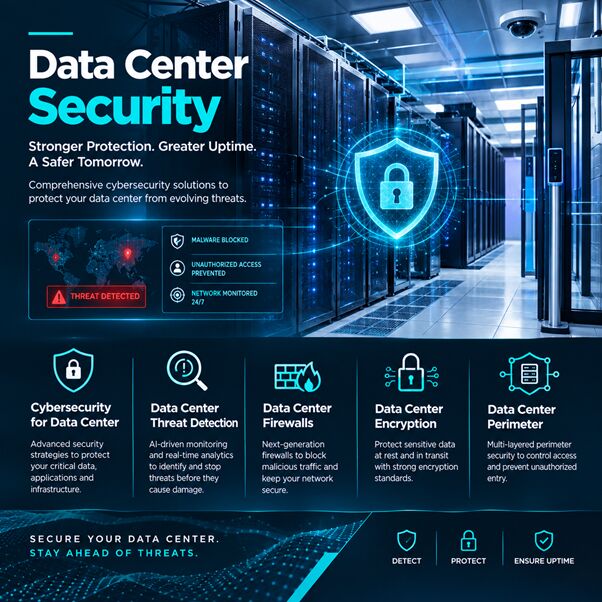
What Is Data Center Security?
Data center security is the set of tools, policies, and practices that protect a data center from threats. It covers two areas:
• Physical security: Keeping unauthorized people away from servers, storage, and network equipment.
• Cyber security: Keeping hackers, malware, and misuse away from the data and systems inside.
Both are needed. A strong firewall won't help if someone can walk into the server room. A locked door won't help if an attacker breaks in over the network.
Types of Data Center Security
Data center security is not one product. It is a mix of layers that work together.
Data Center Security Solutions
This is the complete package. Data center security solutions combine several layers:
• Physical access control: Badges, biometrics, and mantraps at doors.
• Video surveillance: Cameras that record entrances, aisles, and racks.
• Cyber protection: Firewalls, intrusion prevention, and endpoint tools.
• Monitoring and response: A team or system that watches for problems around the clock.
A good solution protects the Data Center Perimeter, the outer edge of your site and network, as well as everything inside it.
Data Center Encryption
Encryption scrambles data so that only people with the right key can read it. It should protect data in two states:
• Data at rest: Information stored on disks, servers, and backups.
• Data in transit: Information moving across the network or to the cloud.
If a drive is stolen or traffic is intercepted, encrypted data is useless to the thief. Good key management matters just as much. Keys should be stored separately and rotated regularly.
Why Choose a Professional Provider?
Security tools only work well if they are designed, installed, and managed correctly. A professional provider helps you:
• Assess your risks. They review your site, network, and data to find weak points.
• Design the right solution. You get a plan that fits your business and budget instead of a generic package.
• Install and integrate. They make sure firewalls, encryption, access control, and monitoring work together.
• Monitor and respond. Experts watch for threats and act quickly when something happens.
• Keep everything updated. Regular patches, testing, and reviews keep protection current.
• Train your team. Many incidents begin with human error, so staff awareness matters.
• Support you locally. Fast on-site help reduces downtime.
Choose a provider with proven experience, certified engineers, clear service terms, and local references.
Conclusion
Data center security protects the systems your business depends on. By combining physical protection, encryption, firewalls, and Data Center Threat Detection, you can keep your data safe and your services running. For businesses in Kuwait, the right approach is a layered one, planned and supported by an experienced local partner.
Ready to Secure Your Data Center?
Talk to our team about Data Center Security Kuwait solutions. We will review your data center, protect your perimeter, and build a security plan that fits your business. Contact us today for a free consultation and quote.