Quick Recommendation
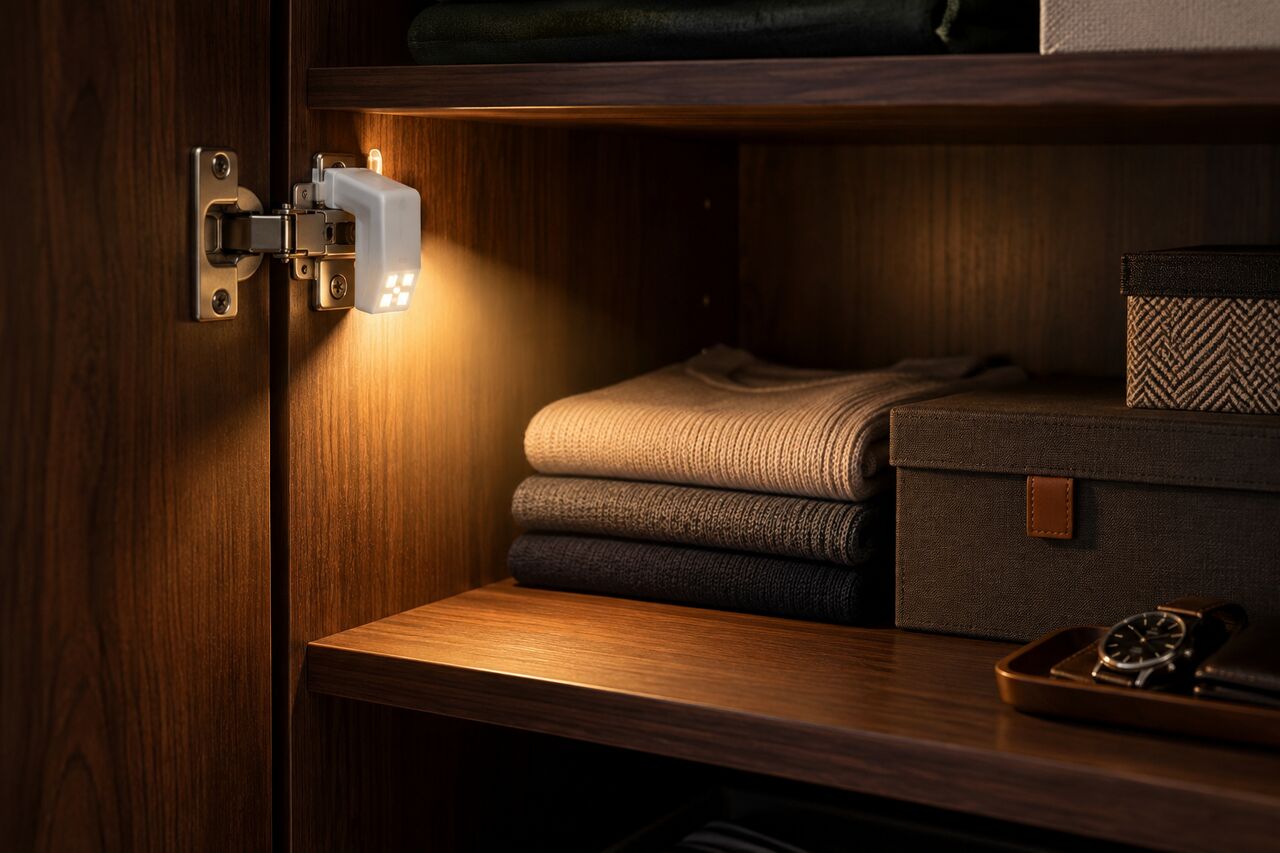
(i) Best for compact cupboards & single shelves: Esysense Hinge Light with Battery — Mounts in minutes onto existing cabinet hinges, offering localized automatic spot lighting for small storage spaces.
(ii) Best for full-length wardrobes & multi-door closets: Esysense Rechargeable Wardrobe Lights with Sensor — Wireless, magnetic PIR light bars that stick onto any wooden surface to illuminate wide hanging bays.
(iii) Best permanent, zero-maintenance solution for modular closets: Esysense Push Button Wardrobe Light Switch ESY-TC36 — A hardwired 110–270V AC mechanical door switch that powers interior LED profile strips reliably with no batteries to charge or replace.
(iv) Avoid wireless battery hinge lights when: Illuminating deep, floor-to-ceiling walk-in wardrobes, as 3-LED spot modules lack the lumen output required for multi-shelf visibility.
Product Overview
Automated cabinet lighting elevates interior design by illuminating dark storage areas hands-free the moment doors are opened or motion is detected.
(i) What it is: A direct comparison between localized, hinge-mounted mechanical lights and wide-angle, USB-rechargeable PIR motion bar lights for closets and cabinets.
(ii) What it does: Automatically activates interior LED lighting when a closet door opens or when human movement is detected, shutting off automatically when closed or vacant.
(iii) Who it is intended for: Homeowners, renters, interior designers, and carpenters seeking to remove dark shadows from wardrobes, kitchen cupboards, and display cabinets.
(iv) Primary features: Mechanical door-plunger switches vs. PIR heat sensors, battery-powered (12V 23A) vs. USB-rechargeable lithium cells, magnetic tape vs. hinge screw mounting.
(v) Key specifications: Hinge lights (3 LEDs, 12V battery, ~15–30 lumens); Rechargeable PIR bars (10–30 LEDs, 1000–1500mAh battery, 80–200 lumens, 120-degree PIR sensing angle); Hardwired switches like the ESY-TC36 (2A 110–270V AC rating).
(vi) Main use cases: Bedroom almirahs, walk-in closets, kitchen pantries, crockery units, and shoe racks.
(vii) Important limitations: Hinge lights require compatible European cup hinges; rechargeable sensor bars require periodic removal for USB charging every 30 to 60 days.
Why This Matters
Installing interior wardrobe lighting shouldn't mean guessing which system fits your furniture layout. Choosing a cabinet hinge light for a huge 6-foot wardrobe will leave lower shelves in pitch darkness. On the flip side, installing high-lumen rechargeable wardrobe lights with sensor bars inside ten small kitchen cabinets means pulling down ten separate light bars every month to charge them via USB. Matching the right lighting mechanism to your wardrobe scale ensures seamless functionality without unnecessary maintenance.
Key Differences: Mechanical Hinge Lights vs Rechargeable PIR Light Bars
(i) Triggering Mechanism: A cabinet hinge light relies on physical mechanical contact—opening the cabinet door releases a spring-loaded plunger to turn the LEDs on instantly. A rechargeable wardrobe light with sensor bar uses a PIR pyroelectric sensor to detect infrared body heat, turning on when your hand or body enters the closet bay.
(ii) Illumination Area & Brightness: Hinge lights feature 3 focused LED chips (15–30 lumens) that cast a concentrated beam directly onto the top shelf. Rechargeable sensor light bars feature long LED strip arrays (80–200 lumens) that distribute light evenly down hanging clothes and multi-tier shoe racks.
(iii) Power Source & Maintenance Cycle: Hinge lights run on replaceable 12V 23A alkaline batteries that last 8 to 12 months because they draw zero standby power. Rechargeable sensor lights use built-in lithium-ion batteries that require plugging into a micro-USB/Type-C charger every 30 to 60 days depending on usage.
(iv) Mounting Requirements: Hinge lights mount beneath existing cabinet hinge plate screws. Rechargeable sensor bars attach using magnetic iron strips backed by 3M double-sided adhesive tape.
Main Decision Factors: Choosing Between Hinge Lights & Rechargeable Motion Bar Lights
1. Storage Scale & Depth
What to look for: Assess the total volume and depth of your cabinet or almirah shelf.
Why it matters: A single cabinet hinge light is ideal for small, partitioned compartments (like single kitchen cupboards or compact nightstand drawers). Large wardrobe bays packed with hanging coats require linear light output across the entire width.
Practical recommendation: Use hinge lights for small overhead cupboards and single-door cabinets; choose rechargeable wardrobe lights with sensor bars or hardwired LED profiles for full-size bedroom wardrobes.
2. Maintenance Tolerance (Recharging vs Battery Replacement vs Zero-Maintenance)
What to look for: Decide how often you are willing to maintain or recharge your light fixtures.
Why it matters: Rechargeable PIR light bars draw a tiny amount of standby power (<0.2W) to keep their PIR sensors armed, requiring USB charging every few weeks in high-traffic closets. Hinge lights use zero standby power, lasting up to a year on a single coin battery.
Practical recommendation: If you dislike taking lights down to charge them, choose battery hinge lights or install a hardwired switch like the Esysense Push Button Wardrobe Light Switch ESY-TC36 for permanent, mains-powered lighting.
3. Cabinet Door & Hinge Architecture
What to look for: Inspect your door hinge hardware.
Why it matters: Hinge lights require standard European concealed cup hinges with removable base plate screws. Sliding wardrobe doors, pocket doors, or frame-less glass doors cannot accept hinge-mounted lights.
Practical recommendation: For sliding wardrobe doors, bypass hinge lights entirely and opt for magnetic PIR motion bars or specialized sliding door IR sensors from the Esysense Wardrobe & Cabinet Sensors.
Comparison: Cabinet Hinge Light vs Rechargeable Wardrobe Light with Sensor vs Hardwired Push
Switch
1. Cabinet Hinge Light
Trigger Technology: Mechanical spring plunger (Door release).
Power Source: Replaceable 12V 23A battery (Wireless).
Brightness Output: 15–30 Lumens (Focused spot lighting).
Standby Battery Drain: 0.00W (Circuit