Quick Recommendation
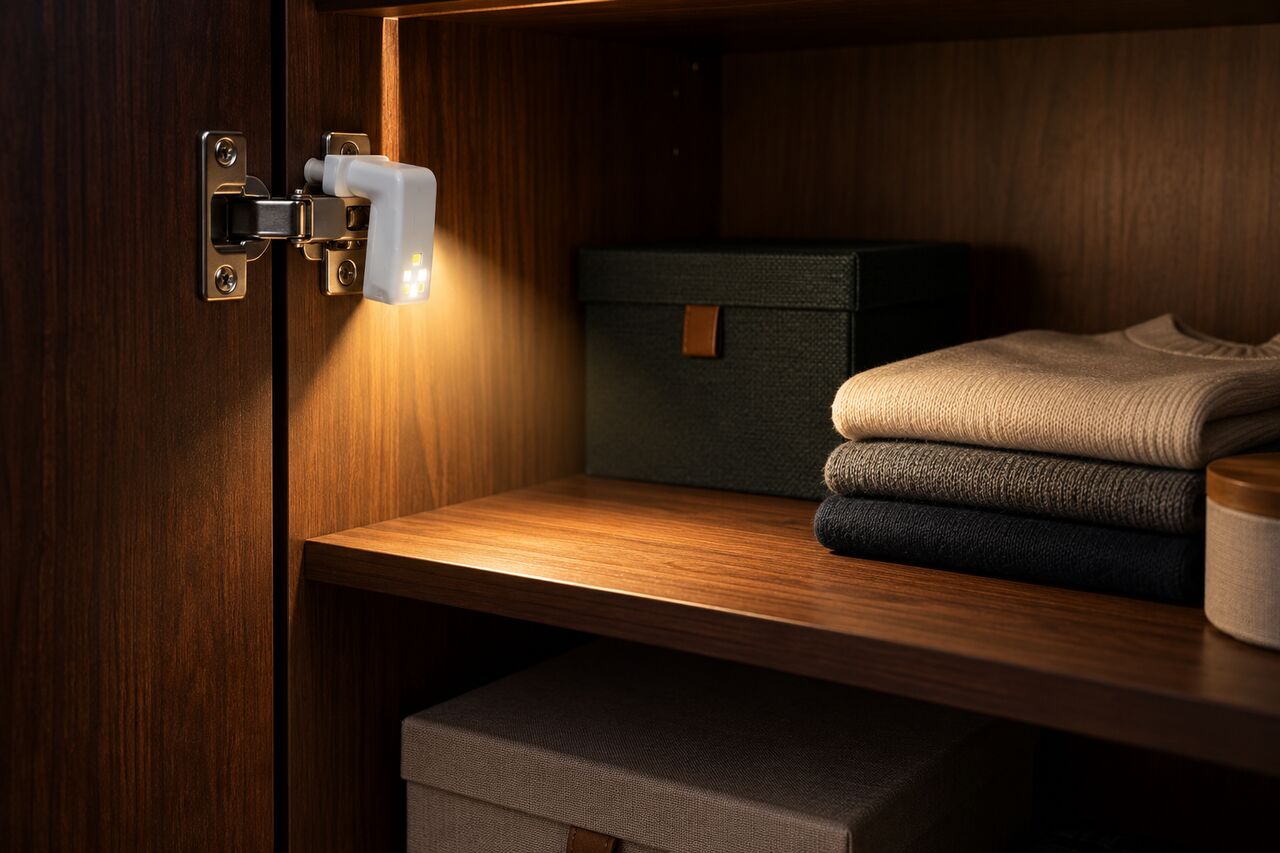
(i) Best wireless battery option for existing cabinet hinges: Esysense Hinge Light with Battery — Mounts onto standard European cup hinges with a single screw, powered by a 12V 23A battery with 3 high-luminance LEDs.
(ii) Best AC mechanical switch for direct-wired cabinet lights: Esysense ESY-TC36 Push Button Switch — A spring-loaded push-type door switch designed for 110–270V AC operating voltages, ideal for built-in wardrobe lighting fixtures.
(iii) Best non-contact dual-door IR sensor for LED strips: Esysense ESY-M23 Double Door Cabinet Sensor — Features dual IR receivers that control 12V/24V LED strip lights across two adjacent wardrobe doors with a 5–6 cm sensing range.
(iv) Avoid wireless battery hinge lights when: Illuminating large walk-in closets or full-height wardrobe channels that require high-lumen, full-length LED strip profiles (where a wired IR proximity sensor or push switch connected to a DC driver is preferred).
Product Overview
Door-activated storage lighting combines ultra-compact LED modules with responsive door-sensing mechanics to turn dark cabinets and closets into illuminated, modern storage spaces.
(i) What it is: A specialized lighting system—ranging from battery-operated hinge units to inline IR proximity sensors and mechanical push switches—designed to trigger lights when a cabinet or wardrobe door opens.
(ii) What it does: Automatically powers connected LEDs when a closet door swings open and disconnects power as soon as the door presses flat against the frame.
(iii) Who it is intended for: Homeowners, interior designers, carpenters, and renters looking to upgrade dark wardrobes, kitchen cupboards, and storage drawers.
(iv) Primary features: Concealed mounting options, pressure plunger micro-switches or short-range IR transmitters, low-voltage (12V/24V) or battery operation, and zero standby energy consumption for mechanical units.
(v) Key specifications: 3-LED battery units (12V 23A) or 12V/24V DC inline sensors supporting up to 60W LED profile loads; 5–6 cm detection range for IR proximity sensors; 110–270V AC rating for mechanical push switches.
(vi) Main use cases: Bedroom wardrobes, kitchen pantry cabinets, crockery units, bathroom vanities, and storage drawers.
(vii) Important limitations: Mechanical hinge lights require standard European cup-style cabinet hinges with removable base screws for proper mounting.
Why This Matters
Deep wardrobes, overhead kitchen cabinets, and corner almirahs often lack adequate room lighting, making it frustrating to locate clothing, utensils, or accessories. Relying on room ceiling lights casts dark shadows inside deep shelves. Installing a smart hinge light or an inline sensor button for wardrobe doors solves this by placing bright light right inside the cabinet, turning on automatically only when you need it.
How Door-Activated Wardrobe Lighting Technology Works
Door-activated lighting operates using three primary mechanisms: mechanical pressure release, hinge movement triggering, or active infrared proximity reflection.
(i) Resting State (Door Closed): When the wardrobe door is shut, the door frame presses against the spring-loaded plunger of a smart hinge light or a mechanical sensor button for wardrobe installations. This breaks the electrical circuit, keeping the light completely OFF.
(ii) Door Opening Movement: As you open the cabinet door, pressure is released from the mechanical plunger or the hinge bracket moves forward.
(iii) Instant Circuit Closure: The internal spring pushes the plunger outward, closing the copper contacts inside the switch within milliseconds.
(iv) Immediate Illumination: Power flows instantly to the 3-LED array (in battery hinge lights) or to the 12V LED strip profile, illuminating every corner of the closet interior.
(v) Automatic Shut-Off upon Closure: Closing the door depresses the plunger back into its housing, opening the electrical contacts and cutting power instantly to ensure zero wasted energy.
Key Technical Mechanisms
(i) Spring-Loaded Decompression Plunger: Uses physical door pressure to mechanically bridge circuit contacts without complex microchips or idle standby power.
(ii) Cup-Hinge Bracket Adapter: Fits beneath standard European cabinet hinge mounting screws to align the light unit with the door frame.
(iii) Active Infrared (IR) Optical Transceiver: Emits invisible IR light pulses over a short 5–6 cm distance. When the door is closed, reflected IR light triggers the internal switch to keep the circuit off. (iv) When the door opens and reflection stops, the circuit opens to turn the light on.
(v) 12V–24V Low-Voltage DC Control: Manages power delivery safely for hidden LED strip channels inside wooden cabinetry.
Main Decision Factors: Choosing Wardrobe Lighting Solutions
1. Installation Effort & Power Source
What to look for: Choose between battery-powered hinge lights or hardwired low-voltage LED strip setups.
Why it matters: Battery-powered hinge lights attach in minutes using existing hinge screws, making them ideal for quick DIY upgrades and rental homes. Hardwired 12V LED strips provide continuous full-length illumination but require a concealed power driver and simple wiring during cabinetry assembly.
Practical recommendation: Choose the wireless Esysense Hinge Light with Battery for quick DIY updates on existing cabinets. Choose an inline IR sensor or push button switch for custom modular wardrobes with recessed LED strips.
2. Cabinet Door Configuration (Single, Double, or Sliding Doors)
What to look for: Match the sensor type to how your wardrobe doors open.
Why it matters: Standard single hinged doors work effortlessly with single hinge lights or push switches. Double-door wardrobe compartments require dual IR receivers so that opening either door turns on the interior lights.
Practical recommendation: For two-door wardrobe sections, install a dual-receiver IR unit like the Esysense ESY-M23 Double Door Cabinet Sensor to ensure reliable operation from both sides.
3. Illumination Brightness & Coverage
What to look for: Evaluate shelf depth and total internal space.
Why it matters: A single 3-LED hinge light delivers localized spot lighting perfect for compact cupboards, small almirahs, and drawers. Full-length wardrobes with multiple hanging sections require 12V LED strip profiles running vertically or horizontally along the frame.
Practical recommendation: Use hinge lights for small-to-medium cabinet compartments; pair hi