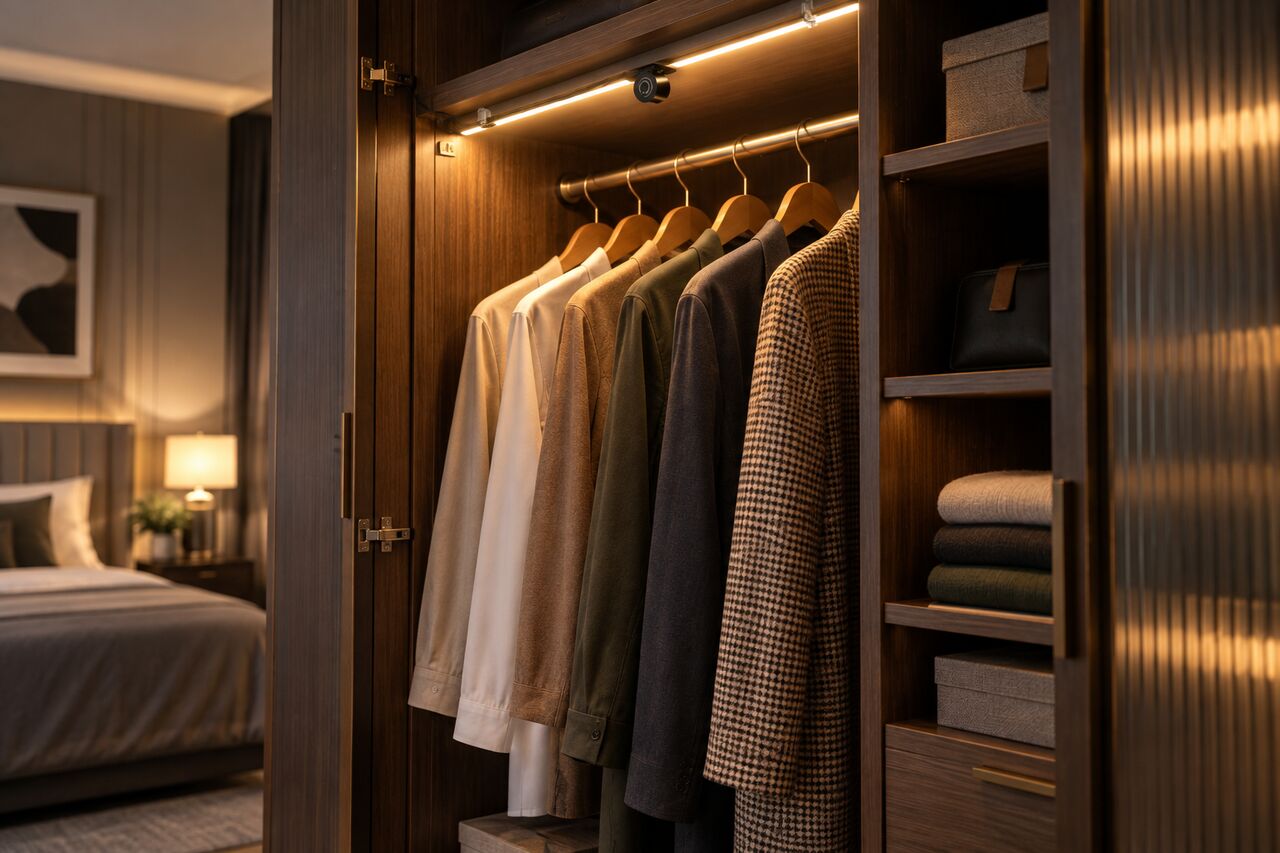
Quick Recommendation
(i) Best overall for custom modular wardrobes: Esysense ESY-M23 Double Door Cabinet Sensor — Dual IR proximity probes that trigger 12V LED strips automatically whenever either wardrobe door is opened.
(ii) Best for open walk-in closets & dressing bays: Esysense PIR Motion Sensor Switch for LED Strips — Compact 12V inline PIR sensor module that turns on LED strips upon detecting body motion inside open closets.
(iii) Best budget choice for quick retrofit installation: Esysense Hinge Light with Battery — Wireless 3-LED hinge light that installs in minutes onto existing cabinet hinges.
(iv) Avoid battery-powered PIR sensor strips when: Illuminating large, full-height walk-in wardrobes with deep shelving, as frequent battery replacements or USB recharging cycles quickly become impractical compared to a hardwired 12V LED driver setup.
Product Overview
Automating closet lighting involves pairing low-voltage LED strip lights with smart proximity or thermal controllers inside custom wardrobe carpentry.
(i) What it is: A comprehensive automated lighting system utilizing flexible LED profile channels controlled by PIR thermal sensors, IR door proximity heads, or mechanical door switches.
(ii) What it does: Automatically activates internal LED strip lighting when a wardrobe door opens or when a person walks into a closet bay, powering off automatically when closed or vacant.
(iii) Who it is intended for: Homeowners, interior designers, modular carpenters, and renovators seeking hands-free visibility inside wardrobes, walk-in closets, and dressing rooms.
(iv) Primary features: Flexible 12V/24V DC LED strips, surface or recessed aluminium profiles, PIR motion modules or non-contact IR proximity heads, low standby power draw.
(v) Key specifications: 12V/24V DC operating voltage; 5W to 14.4W per meter LED power draw; 120-degree PIR sensing angle or 5–6 cm IR proximity range; up to 60W load capacity per sensor.
(vi) Main use cases: Bedroom wardrobes, walk-in closets, shoe cabinets, kitchen pantries, and glass display units.
(vii) Important limitations: Hardwired LED strip setups require concealing a 12V DC power driver (transformer) inside or above the wardrobe framework during carpentry assembly.
Why This Matters
Overhead room lights cast deep shadows inside dark wardrobes, making it difficult to distinguish clothing colors and locate accessories. Planning a practical wardrobe automatic light setup with a motion sensor led strip light wardrobe india configuration delivers hotel-style luxury and complete visibility directly onto clothing shelves without wasting electricity on continuous lighting.
Understanding How Automatic Wardrobe Light & Sensor LED Strips Operate
An automated wardrobe LED strip setup operates through a seamless 5-step electronic control cycle:
(i) Low-Voltage Power Standby: The 12V DC driver stays connected to home power, keeping the inline sensor module (PIR or IR proximity) armed while drawing less than 0.1W in standby.
(ii) Occupancy or Door Trigger: In an open walk-in closet, an inline PIR motion sensor detects moving infrared body heat. In a closed wardrobe, an IR door proximity sensor detects when a door leaf swings open beyond 5–6 cm.
(iii) Instant DC Circuit Closure: The sensor module closes the 12V DC circuit within milliseconds, sending power straight to the connected LED strip light.
(iv) Uniform Low-Glare Illumination: Diffused aluminium channels spread light evenly across hanging clothes and shelves without harsh glare.
(v) Automatic Off Countdown: When you step away or close the wardrobe door, the sensor counts down 30 to 60 seconds (or immediately upon door closure) before disconnecting power to return to low standby mode.
Key Technical Mechanisms
(i) PIR Pyroelectric Thermal Module: Tracks body heat movement across 120-degree optical zones.
(ii) Non-Contact IR Proximity Receiver: Measures infrared beam bounce over 5–6 cm distances to detect door position.
(iii) Aluminium Profile Channel with Frosted Diffuser: Protects LED chips from dust while softening light output.
(iv) 12V/24V DC Constant Voltage Driver: Converts 220V AC household current safely for low-voltage cabinet lighting.
Main Decision Factors: Planning Practical Cabinet Lighting
1. Closet Layout: Enclosed Doors vs. Open Walk-In Bays
What to look for: Match the sensor technology to your closet's door architecture.
Why it matters: Enclosed swing or sliding doors require IR proximity sensors or door switches so lights turn off when doors close. Open walk-in dressing bays operate best with PIR motion sensors that trigger as you walk into the room.
Practical recommendation: Use door proximity sensors like the Esysense ESY-M23 Double Door Cabinet Sensor for hinged wardrobes; use PIR motion sensors for open walk-in closets.
2. Power Supply Planning: Hardwired 12V Driver vs. Wireless Battery
What to look for: Decide whether to install a hardwired driver or use battery-operated light strips during wardrobe design.
Why it matters: Hardwired 12V LED drivers provide high lumen output continuously without recharging. Battery-operated motion strips are quick to install but require USB recharging every few weeks in active closets.
Practical recommendation: Specify a concealed 12V DC power driver during wardrobe fabrication for a permanent, zero-maintenance system.
3. LED Profile Channel & Diffuser Selection
What to look for: Select the right aluminium channel shape (recessed, corner, or surface mount) with frosted acrylic diffusers.
Why it matters: Bare LED strips cast harsh dot reflections on glossy wardrobe laminates. Housing the strip inside an aluminium profile with a frosted diffuser creates smooth, continuous light bar illumination.
Practical recommendation: Choose corner-mounted 45-degree aluminium profiles for hanging bays and recessed flat profiles for shelving channels.
Comparison: Wardrobe Automatic Light Options
1. 12V Hardwired LED Strip with IR Proximity Sensor
Trigger Mechanism: Touchless IR proximity reflection (5–6 cm range).
Brightness & Coverage: High (800–1200 Lumens per meter, full-length coverage).
Power Source: Hardwired 12V DC power driver (Connected to AC mains).
Maintenance Level: Zero maintenance (No batteries to charge or replace).
Best Application: New modular wardrobes, custom bedroom closets, luxury cabinets.
2. 12V Hardwired LED Strip