Quick Recommendation
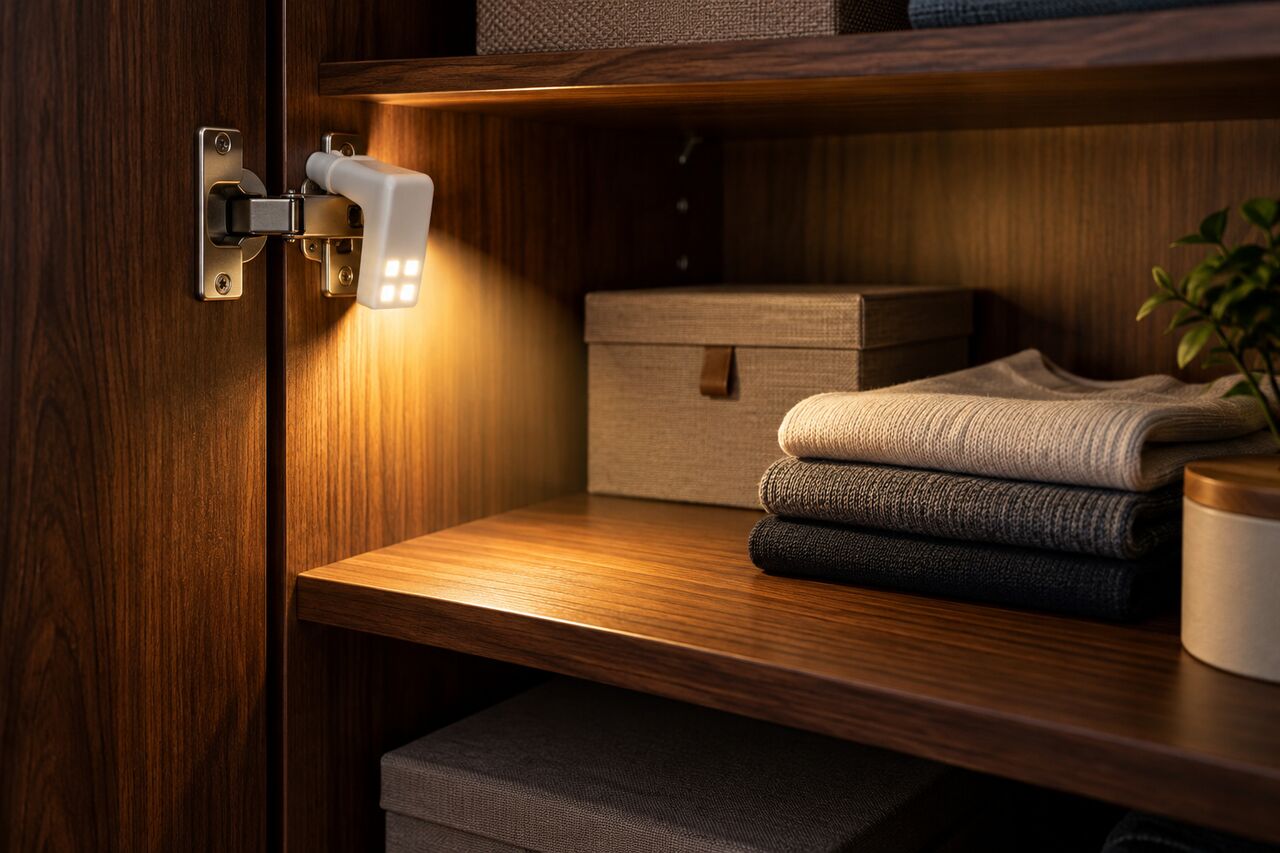
(i) Best wireless option for single shelves & compact cupboards: Esysense Hinge Light with Battery — Mounts onto standard cabinet hinges in under 3 minutes, providing localized 3-LED automatic spotlighting.
(ii) Best heavy-duty mechanical switch for AC cabinet fixtures: Esysense Push Button Wardrobe Light Switch ESY-TC36 — A spring-loaded 110–270V AC mechanical door switch engineered for direct frame mounting in modular closets.
(iii) Best touchless optical sensor for double-door LED profiles: Esysense ESY-M23 Double Door Cabinet Sensor — Dual IR proximity heads that trigger 12V LED strips automatically whenever either wardrobe door leaf opens.
(iv) Avoid battery hinge lights when: Illuminating deep, floor-to-ceiling walk-in wardrobes with multi-tier hanging rods, as 3-LED spot modules lack the lumen output needed for large closet bays.
Product Overview
Door-based lighting controls automate cabinet illumination by using the physical movement of doors to trigger internal light sources without manual wall switches.
(i) What it is: A comparison between hinge-mounted battery spotlights and frame-mounted inline switch sensors designed for storage cabinetry.
(ii) What it does: Automatically energizes interior cabinet lights when doors open and disconnects power the moment doors are returned to their closed position.
(iii) Who it is intended for: Homeowners, renters, interior designers, carpenters, and modular furniture manufacturers looking for hands-free wardrobe visibility.
(iv) Primary features: Mechanical spring plungers, optical IR proximity heads, low-voltage (12V/24V DC) or mains AC control, zero-standby mechanical circuits, and concealed mounting options.
(v) Key specifications: Hinge lights (3 LEDs, 12V 23A battery, ~15–30 lumens); Mechanical push switches (ESY-TC36: 2A 110–270V AC rating); Optical IR sensors (ESY-M22/M23: 12V/24V DC, max 60W load, 5–6 cm proximity range).
(vi) Main use cases: Bedroom wardrobes, kitchen pantry cupboards, crockery units, shoe racks, and vanity cabinets.
(vii) Important limitations: Hinge lights require compatible European concealed cup hinges; hardwired switch sensors require concealing a 12V DC power driver inside or above cabinet framework.
Why This Matters
Installing automatic closet lighting shouldn't lead to mismatching control mechanisms with your furniture scale. Mounting a single led hinge light inside a 6-foot wardrobe bay leaves lower shelves in shadow. Conversely, installing complex hardwired wardrobe switch sensor setups inside small kitchen cupboards creates unnecessary wiring complexity. Understanding how these door-based controls differ ensures you select the right system for your closet layout and lighting goals.
Understanding How LED Hinge Lights and Wardrobe Switch Sensors Operate
Door-based control systems operate through physical mechanical decompression or short-range optical reflection:
How an LED Hinge Light Operates
(i) Resting Closed State: When the cabinet door is shut, the inner door surface depresses a spring-loaded mechanical plunger on the hinge bracket. This keeps the electrical contact separated (Circuit OPEN, 0.00W power draw).
(ii) Door Opening Release: As the door swings open, the hinge bracket moves forward, releasing pressure from the spring plunger.
(iii) Instant Mechanical Contact: The internal spring pushes the copper plunger forward, bridging the circuit to power the 3-LED module instantly via an internal 12V 23A battery.
(iv) Automatic Shutoff: Closing the door presses the plunger back into its housing, breaking contact and cutting power immediately.
How a Wardrobe Switch Sensor Operates
(i) Low-Voltage Standby: A hardwired wardrobe switch sensor (IR proximity or mechanical push switch) sits inline between a 12V DC power driver and LED strips.
(ii) Optical or Mechanical Trigger:
1. Mechanical Push Switch: Closing the door depresses a plunger installed in the cabinet rebate to break the electrical current. Opening the door decompresses the switch to close the circuit.
2. IR Proximity Sensor: Emits an invisible infrared beam over a 5–6 cm range. When the door is closed, reflected IR signals keep the circuit off. Opening the door loses the reflection, signaling the controller to energize the connected 12V LED strips.
3. Continuous Illumination: Power flows to high-lumen LED profile channels, illuminating all shelves evenly.
4. Zero-Delay Shutoff: Closing the door restores physical pressure or IR reflection, turning off the LEDs instantly.
Key Technical Mechanisms
(i) Decompression Spring Plunger: Uses physical door mechanics to bridge electrical contacts without idle standby electronics.
(ii) Active Infrared (IR) Optical Transceiver: Measures light reflection over a 5–6 cm distance to enable touchless door sensing.
(iii) Inline DC Switching Transistor: Controls up to 60W of 12V LED profile lighting silently without mechanical wear.
Main Decision Factors: Choosing Door-Based Lighting Controls
1. Cabinet Structure & Hinge Hardware
What to look for: Inspect your cabinet door hinges and frame rebates.
Why it matters: An led hinge light requires standard European concealed cup hinges with removable base plate screws. Sliding doors, pocket doors, or traditional flush pin hinges cannot accept hinge-mounted lights.
Practical recommendation: Use hinge lights on standard cup-hinged kitchen cabinets. For sliding doors or custom partition rebates, choose frame-mounted IR proximity sensors or push-button switches.
2. Lighting Output & Load Scale
What to look for: Evaluate the overall height, depth, and lumen requirement of your wardrobe.
Why it matters: Hinge lights output localized spot lighting (15–30 lumens) perfect for small, single shelves. Full-length bedroom wardrobes with multi-tier hanging rods require linear LED strips delivering 800 to 1200 lumens per meter.
Practical recommendation: Choose a hardwired wardrobe switch sensor connected to 12V LED strips for full-size closets; choose hinge lights for small cupboards and nightstands.
3. Maintenance & Wiring Requirements
What to look for: Decide between wireless battery operation and hardwired installation.
Why it matters: Hinge lights run on compact 12V 23A batteries that require replacement every 8 to 12 months. Hardwired switch sensors connect directly to your home's electrical grid via a 12V DC driver, offering zero-maintenance operation for years.
Practical recommendation: Select hardwired frame sw