Quick Recommendation
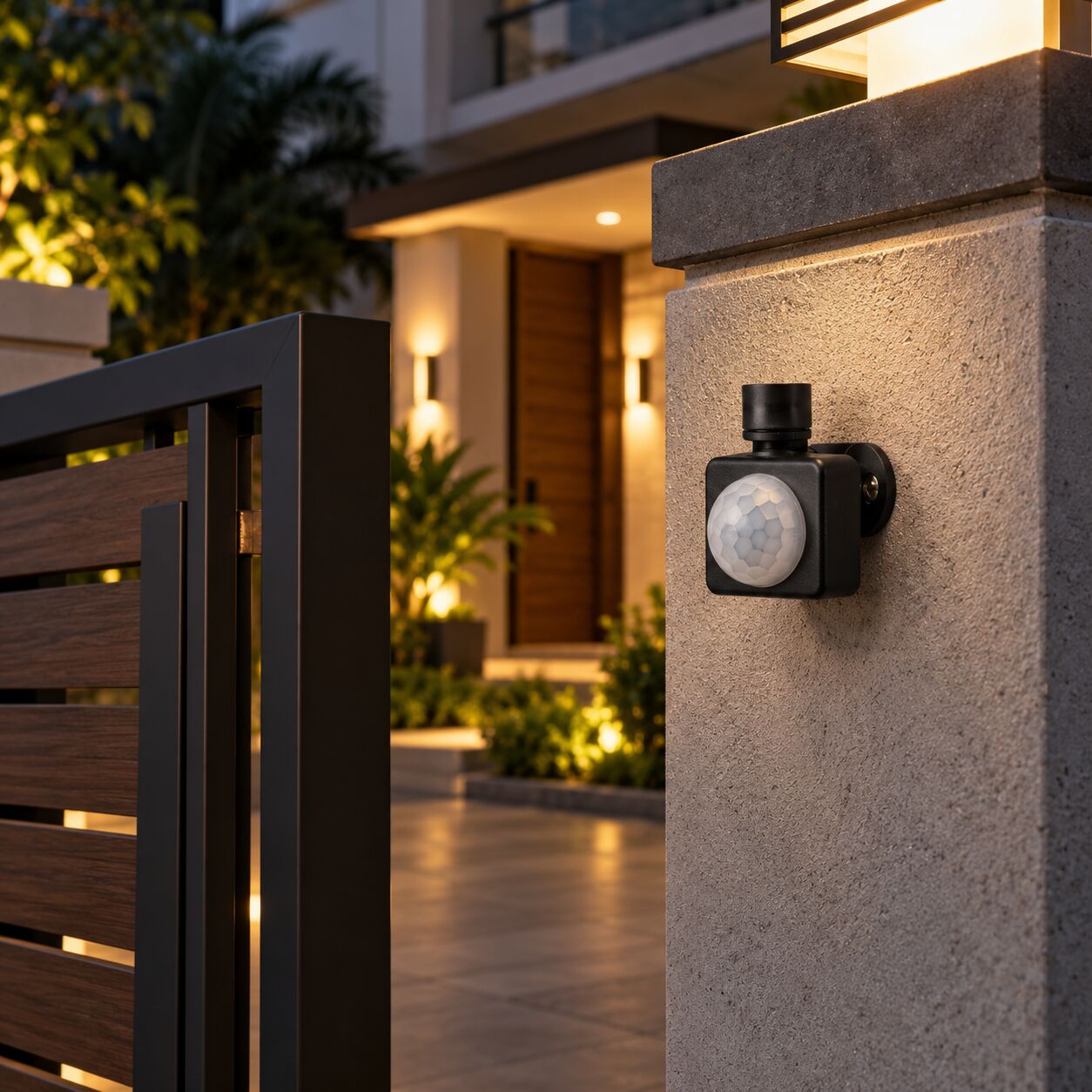
(i) Best weather-resistant outdoor motion sensor for gates & entryways: Esysense ESY-P31 180° Outdoor PIR Sensor — IP65-rated all-weather housing with 180° coverage, 1–7 m adjustable sensing range, and wide 2–2000 Lux ambient light control.
(ii) Best compact wall-mount option for semi-covered porches & verandas: Esysense Wall Mount PIR Motion Sensor 180 or Esysense Wall Mount PIR Sensor — Wall-mounted PIR sensor engineered for precise directional control along covered pathways.
(iii) Best ultra-miniature sensor for sheltered soffits & overhangs: Esysense Mini PIR Motion Sensor — Minimalist 30 mm cutout mini sensor for discreet recessed installation in soffits and entryway ceilings.
(iv) Avoid non-weatherproof indoor PIR sensors outdoors: Standard IP20-rated indoor sensors like the Esysense 160° Concealed Wall Mount PIR Sensor or Esysense 360° Infrared PIR Motion Sensor will suffer moisture ingress and circuit failure if exposed directly to rain or wind-driven dust.
Product Overview
Automating exterior perimeter lighting relies on integrating weather-sealed, short-range infrared detectors into exterior walls, entry gates, and architectural facades.
(i) What it is: An IP65-sealed, small-footprint Passive Infrared (PIR) motion detector engineered specifically to operate under variable exterior weather conditions.
(ii) What it does: Continuously scans exterior spaces for moving thermal sources (human body heat), closing a low-voltage or AC circuit to activate security floodlights, pathway LEDs, or wall sconces automatically upon approach.
(iii) Who it is intended for: Homeowners, landscape designers, facility managers, security specialists, and electrical contractors looking for discreet, energy-efficient exterior automation.
(iv) Primary features: IP65 dust and water resistance, 180° field of view, 1 to 7 meter adjustable sensing radius, 2 to 2000 Lux adjustable photocell (LUX) sensor, 3-second to 12-minute time delay control, and wide operating temperature range (-20°C to +55°C).
(v) Key specifications (ESY-P31): Operating Voltage: 110–270V AC; Power Frequency: 50–60Hz; Installation Height: 1.8 to 2.5 meters; Dimensions: 41mm (L) x 44mm (B) x 34mm (H); Weight: 300 Grams; Standby Draw: <0.1W.
(vi) Main use cases: Main gate entrances, villa driveways, terrace gardens, exterior boundary walls, covered porches, stairwells, and perimeter walkways.
(vii) Important limitations: PIR technology requires line-of-sight and responds to moving thermal contrast; direct exposure to blowing tree foliage or intense thermal exhaust vents can cause false triggers if sensitivity is set too high.
Why This Matters
Leaving exterior security lights switched on all night wastes electricity and attracts unwanted insects to entrance doors. Conversely, navigating dark pathways or entry gates without lighting creates tripping hazards and security vulnerabilities. Installing a dedicated small outdoor PIR sensor provides hands-free illumination the instant motion is detected, preserving curb aesthetics while slashing utility costs.
How Small Outdoor PIR Sensors Work
An outdoor motion sensor using passive infrared technology operates through a 5-step thermal detection and switching cycle:
(i) Ambient Thermal Baseline Scanning: The sensor's pyroelectric element receives ambient infrared radiation through a multi-segmented Fresnel lens cover.
(ii) Daylight Photocontrol Suppression: An integrated Lux photodiode measures surrounding daylight. If ambient light exceeds the configured threshold (e.g., 2000 Lux daytime), the sensor suppresses load activation to avoid wasting power during the day.
(iii) Differential Thermal Shift Detection: When a warm body (human or animal) moves across the 180° optical field, it crosses alternating optical detection zones. The pyroelectric sensor detects a rapid shift in differential surface temperature.
(iv) Circuit Activation: Upon detecting a valid thermal shift within its 1–7 meter range, the internal relay closes, sending 110–270V AC power to the connected outdoor floodlights or LED sconces.
(v) Adjustable Countdown & Shutoff: An internal timer counts down the configured delay period (from 3 seconds up to 12 minutes). If no further thermal motion is detected before the timer expires, the relay opens, turning off the lights automatically.
Key Technical Mechanisms
(i) Pyroelectric Infrared Sensor Element: Detects subtle infrared wavelength variations (8–14 µm) emitted by human bodies.
(ii) IP65 Weather-Sealed Enclosure: Protects sensitive internal electronics against rain jets, humidity, dust, and temperature extremes (-20°C to +55°C).
(iii) Adjustable Sensitivity Dial (SENS & LUX): Allows precise calibration of detection distance (1 to 7 meters) and daylight activation thresholds (2 to 2000 Lux).
Main Decision Factors: Choosing a Small Outdoor PIR Sensor
1. Ingress Protection (IP Rating)
What to look for: Always verify an IP65 or higher rating for exposed exterior walls and entry gates.
Why it matters: Outdoor sensors are exposed to rain, dew, high humidity, and airborne dust. An IP20 indoor sensor (such as the Esysense 160° Concealed Wall Mount PIR Sensor) lacks water seals and will short-circuit when exposed to rain.
Practical recommendation: Choose the IP65-rated Esysense ESY-P31 180° Outdoor PIR Sensor for any exterior wall, gate pillar, or exposed building facade.
2. Form Factor & Mounting Flexibility
What to look for: Look for a low-profile housing with an adjustable swivel neck.
Why it matters: Large, bulky motion detectors ruin modern architectural aesthetics and are difficult to aim accurately down narrow pathways. A compact PIR sensor measuring just 41 mm x 44 mm x 34 mm blends discreetly into wall cladding while allowing precise vertical and horizontal aiming.
Practical recommendation: Select swivel-mount compact sensors for targeted coverage along garden pathways and villa driveways.
3. Load Handling & Voltage Flexibility
What to look for: Ensure wide AC input voltage tolerance (110–270V AC) and robust switching capacity.
Why it matters: Outdoor power grids often experience voltage fluctuations. A sensor supporting 110–270V AC guarantees stable performance without relay chatter or false triggers.
Practical recommendation: Pair a high-capacity sensor switch like the Esysense PIR Motion Sensor Switch or ESY-P31 with outdoor LED floodlights up to 300W load r