Quick Recommendation
(i) Best non-contact sensor for double-door wardrobes: Esysense Double Door Cabinet IR Sensor ESY-M23 — Features twin IR proximity probes operating on OR-gate logic to trigger 12V/24V LED strips whenever either door leaf opens.
(ii) Best non-contact sensor for single-door cupboards & drawers: Esysense Single Door Cabinet IR Sensor ESY-M22 — Compact IR proximity probe with a 5–6 cm detection range tailored for individual cabinet doors, pantries, and pull-out trays.
(iii) Best heavy-duty mechanical switch for AC cabinet wiring: Esysense Push Type Wardrobe Light Switch ESY-TC36 — Spring-loaded 110–270V AC mechanical switch engineered for direct frame-rebate mounting in modular closets.
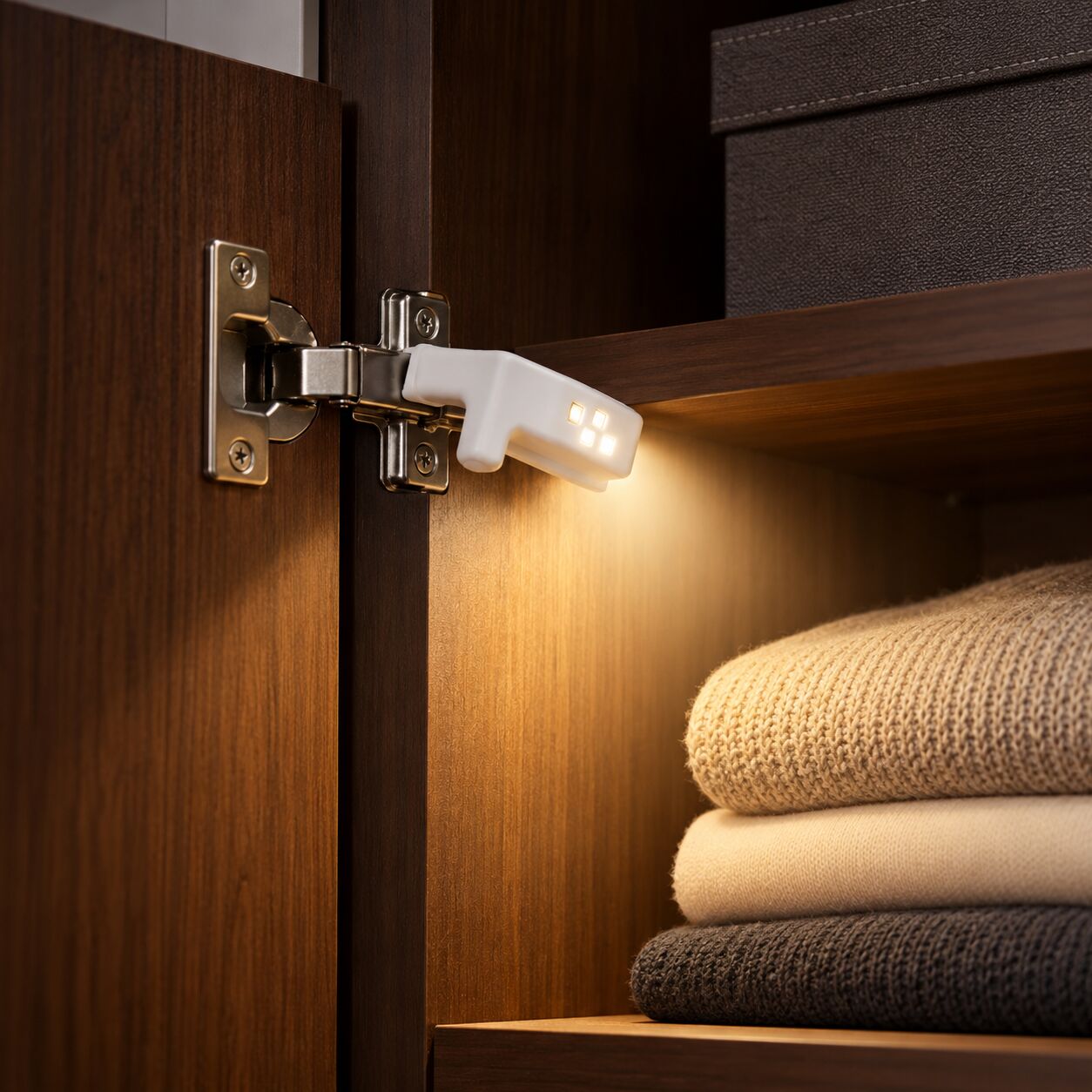
(iv) Best wireless option for quick DIY hinge retrofits: Esysense Motion Sensor Hinge Light — Screws onto standard European cup hinges in under 3 minutes to provide targeted 3-LED spotlighting.
(v) Best cordless motion & mood light for open dressing bays: Esysense 3W Rechargeable RGB Motion Sensor Light — Cordless 2200mAh light bar with 360° PIR motion sensing, warm/cool white task lighting, and multi-color RGB accent modes.
Product Overview
Automating interior closet illumination involves pairing responsive door-activated switches or optical proximity sensors with low-voltage LED strip profiles or self-contained lighting fixtures.
(i) What it is: Door-operated lighting controls—including dual-head IR proximity probes, single-probe IR sensors, mechanical push switches, hinge spotlights, and rechargeable PIR light bars—designed to illuminate cabinet interiors upon opening.
(ii) What it does: Automatically energizes interior LED profiles or spotlights when a wardrobe door opens, turning them off instantly when the door closes or the area becomes vacant.
(iii) Who it is intended for: Homeowners, renters, interior designers, carpenters, and modular furniture makers seeking hands-free night-time closet visibility.
(iv) Primary features: Touchless short-range IR reflection (5–6 cm threshold), mechanical spring-plunger physical isolation, 12V/24V DC low-voltage safety, 360° PIR thermal motion tracking, and zero-standby mechanical circuits.
(v) Key specifications: Low-voltage DC proximity models (12V–24V DC supporting 40W–60W max load); AC mechanical switches (110–270V AC, 2A rating); wireless hinge lights (3 LEDs, 12V 23A battery); IP20 indoor protection rating.
(vi) Main use cases: Bedroom wardrobes, double-door almirahs, walk-in dressing bays, kitchen pantries, glass display units, and vanity storage drawers.
Important limitations: Non-contact IR proximity probes require an unobstructed inner door surface within 5–6 cm when closed to reflect the infrared beam properly.
Why This Matters
Searching for clothing, shoes, or accessories at night often means turning on bright overhead bedroom lights that disturb sleeping family members. Traditional unmonitored cabinet lighting requires manual wall switches that are easily forgotten, wasting electricity. Installing dedicated wardrobe door lights equipped with a responsive sensor wardrobe light system provides gentle, targeted visibility directly onto your clothes the instant a closet door opens—combining luxury convenience with energy efficiency.
How Automatic Wardrobe Door Lighting Works
Door-activated wardrobe door lighting systems operate through active infrared reflection, mechanical decompression, or thermal motion tracking:
(i) Active IR Proximity Sensing (Door-Activated): Proximity modules like the Esysense Double Door Cabinet IR Sensor ESY-M23 and Esysense Single Door Cabinet IR Sensor ESY-M22 project short-range invisible infrared light pulses. When the door is closed, its interior face reflects IR light back into a photodiode within 5–6 cm, keeping the circuit open (Light OFF). Opening the door moves the surface away, breaking the reflection and closing the 12V/24V DC circuit to illuminate connected LED strips instantly.
(ii) Decompressed Spring Plunger (Mechanical Push Switch): Mechanical switches like the Esysense Push Type Wardrobe Light Switch ESY-TC36 and Esysense Motion Sensor Hinge Light rely on physical door contact. Closing the door depresses a spring plunger, separating internal contacts to cut power. Opening the door releases plunger pressure, bridging contacts to energize the light.
(iii) Passive Infrared (PIR) Motion Tracking: Cordless fixtures like the Esysense 3W Rechargeable RGB Motion Sensor Light use pyroelectric sensors to detect moving body heat across a 360° area up to 2 meters away, turning task or RGB ambient lighting on upon approach and off after 30 seconds of inactivity.
Main Decision Factors: Choosing Door-Activated Wardrobe Lights
1. Cabinet Structure & Door Configuration
What to look for: Match the sensor mechanics to your wardrobe's door layout.
Why it matters: Using a single-head proximity sensor on a double-door wardrobe leaves the interior dark if you open the unmonitored door leaf. Open walk-in bays without doors cannot operate proximity probes or mechanical frame switches.
Practical recommendation: Choose the dual-head Esysense Double Door Cabinet IR Sensor ESY-M23 for two-door wardrobes; use the single-head Esysense Single Door Cabinet IR Sensor ESY-M22 for single almirahs; deploy 360° PIR motion light bars like the Esysense 3W Rechargeable RGB Motion Sensor Light for open walk-in closets.
2. Wiring Setup: Hardwired Low-Voltage DC vs. Wireless Battery
What to look for: Decide whether your cabinetry permits running low-voltage wires and concealing a power driver.
Why it matters: Hardwired 12V/24V DC LED strips connected to an AC-to-DC driver deliver continuous high-lumen illumination across all shelves without battery changes. Wireless battery fixtures attach directly to existing furniture without wiring, but require periodic battery swaps or USB charging.
Practical recommendation: Specify hardwired 12V LED profile channels with inline proximity sensors during modular carpentry builds; use the wireless Esysense Motion Sensor Hinge Light for quick DIY upgrades on finished cabinets.
3. Lighting Functionality & Aesthetics
What to look for: Choose between high-luminance task illumination and touchless gesture/dimming controls.
Why it matters: Standard clothing bays require bright 3000K Warm White or 6500K Cool White task lighting. Glass display units and vanity cabinets benefit from touchless hand-swipe controls with dimming features.
Pract