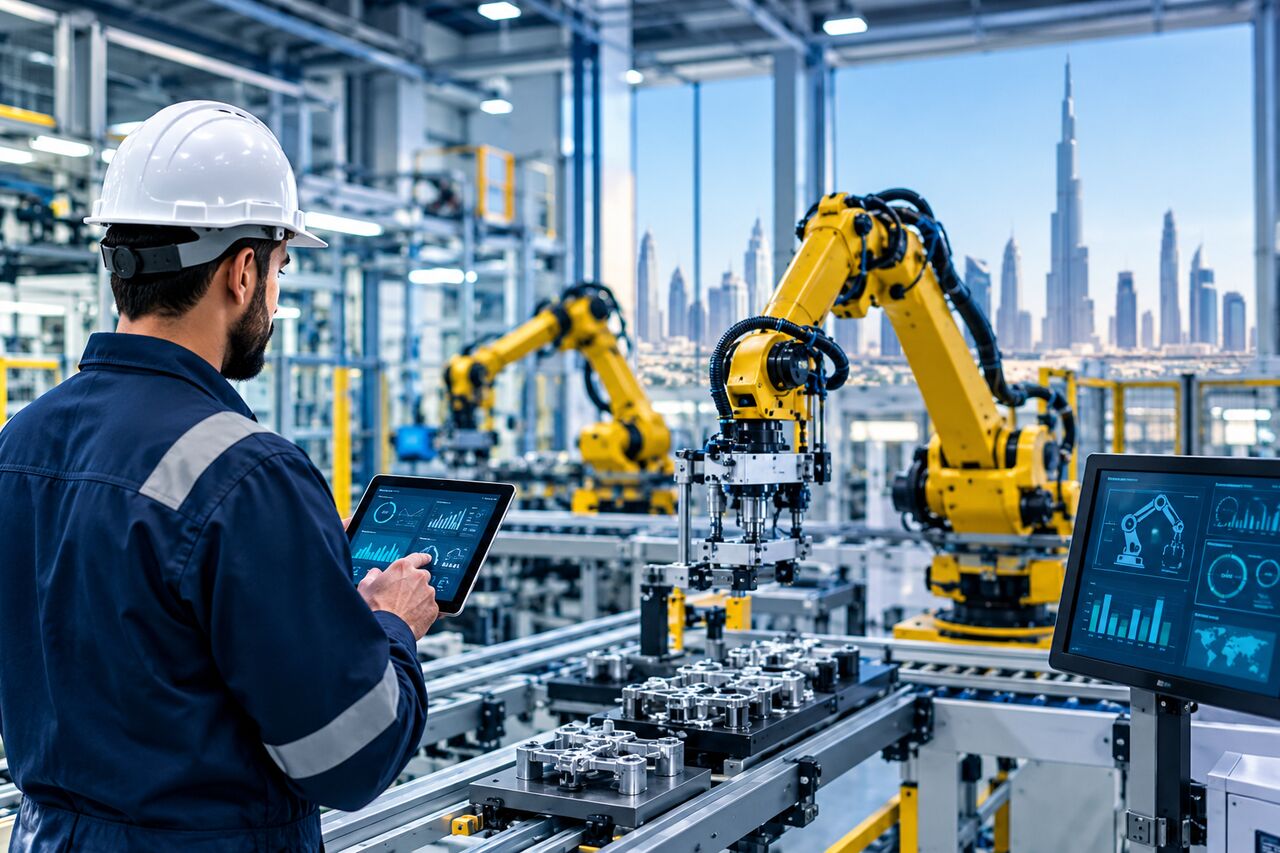
Industrial automation in the UAE involves using control systems, sensors, software, and robotics to run industrial processes with minimal manual intervention. In the Emirates, industrial automation has evolved from a mere efficiency choice to the backbone of industry. This shift is driven by national industrial policies and a growing emphasis on resilience.
What Is Industrial Automation in the UAE?
Industrial automation involves hardware such as PLCs, DCS, and SCADA systems, as well as software that collects, analyzes, and acts on data in real time. In the UAE, these tools are implemented across sectors such as oil and gas, petrochemicals, power generation, desalination, food processing, pharmaceuticals, and warehousing.
Across all industries, the goals remain the same: stable production, enhanced safety, and reduced waste. With industrial automation, machines respond dynamically to real-world conditions rather than relying solely on preset schedules.
Why the UAE Is Investing in Smart Plants
Industrial automation in the UAE is driven by several reasons, including:
National policy: Operation 300bn, launched in 2021, aims to lift the industrial sector's GDP contribution from AED 133 billion to AED 300 billion by 2031. Advanced manufacturing and Industry 4.0 adoption sit at the center of that plan.
Climate and environment: High heat, humidity, and dust make continuous automated monitoring valuable for protecting equipment and maintaining process stability.
Energy and sustainability goals: The UAE's net-zero-by-2050 initiative encourages facilities to track and reduce energy use, emissions, and water consumption, all of which automation systems can measure accurately.
Safety and workforce: Automation reduces human exposure to hazardous tasks and supports consistent quality where skilled labor is limited.
Core Technologies Behind Smart Plants
PLC, DCS, and SCADA: Control and observation of machinery and operations.
Industrial Internet of Things (IIoT): Internet-connected devices that monitor and transmit data on temperature, vibration, pressure, and flow.
AI and predictive maintenance: Early detection of potential problems through analysis.
Robotics and autonomous machines: Automate repetitive, precise, and dangerous operations in manufacturing and logistics.
Digital twins: Virtual replicas allow engineers to simulate and optimize changes before implementing them in the physical environment.
Operational technology cybersecurity: Protects connected control networks from cyber threats, ensuring the integrity and safety of industrial operations.
Where Automation Is Making the Biggest Impact
Automation enables precise control and real-time monitoring of safety instrumented systems in oil, gas, and petrochemical plants. Utilities use automation to balance loads in power and desalination plants and to continuously monitor water quality, ensuring efficient and reliable operations. Automated production lines and storage facilities are prevalent in the manufacturing and food industries, streamlining the movement of goods along trade routes.
Key Benefits of Industrial Automation
Companies that adopt automation technology see significant improvements in productivity, quality, safety, and cost management. Consistent monitoring minimizes variability in operational output, while predictive maintenance lowers repair costs and extends asset lifespans. Safety protocols can automatically halt production when abnormal situations are detected. Over time, the data collected supports better planning, such as optimizing spare parts inventory or energy procurement.
The Role of EPC Contractors in Automation Projects
Automation delivers the most benefit when it is incorporated from the outset of the design process, instead of being retrofitted later. This is where EPC contractors play a critical role, overseeing the integration of control systems architecture, instrumentation, electrical systems, and commissioning within a unified framework. Companies like Tekzone, operating as EPC contractors in Dubai, exemplify how automation is integrated into projects from the initial design phase.
Early involvement helps avoid compatibility issues with equipment vendors, speeds up commissioning, and guarantees accurate data flow from field devices to the control room.
Challenges Facing Industrial Automation in the UAE
There are challenges associated with adoption. Legacy equipment in existing facilities needs to be integrated with new systems through careful engineering. Expertise in control systems, data analysis, and OT cybersecurity remains in high demand. As network connectivity grows, so do cybersecurity threats. To justify investments, businesses must demonstrate returns through reduced downtime, lower energy consumption, and enhanced safety.
Future Outlook
Driven by the UAE National Strategy for Artificial Intelligence 2031 and major investments in 5G and edge computing, the country is moving toward greater automation powered by data-driven technologies. Expect the increased use of AI for process optimization, remote operations centers, and energy management systems that interface directly with sustainability reports. As these technologies advance, smart plants are poised to become the benchmark for future industrial projects.
Frequently Asked Questions
Q1.Industrial Automation in UAE?
It refers to integrating control systems, sensors, software, and robotics to operate industrial processes efficiently and safely across sectors such as energy, manufacturing, utilities, and logistics in the UAE.
Q2.Which industries in the UAE are utilizing automation?
Oil and Gas, Petrochemical, Power and Water Utilities, Food Processing, Manufacturing, and Logistics are the major industries using Industrial Automation in the UAE.
Q3.How does automation contribute to UAE’s sustainable development?
Automation enables real-time monitoring of energy use, water consumption, and emissions, allowing facilities to quickly identify inefficiencies and optimize resource usage in line with national net zero goals.
Q4.What are the responsibilities of EPC contractors in automation projects?
EPC contractors plan, design, construct, and install control and instrumentation systems at facilities.
Q5.What challenges are commonly faced when implementing automation?
Key challenges include integrating legacy systems, a shortage of skilled professionals, heightened cybersecurity risks, and high upfront costs.
Conclusion
UAE’s industrial automation is moving from being an added benefit to being a basic necessity in today’s industry. By leveraging smart plants and implementing technology through coordinated national strategies and engineering expertise, facilities are operating more safely and sustainably. Organizations that proactively embrace automation and invest in developing the right skills and networks will be best positioned to benefit from