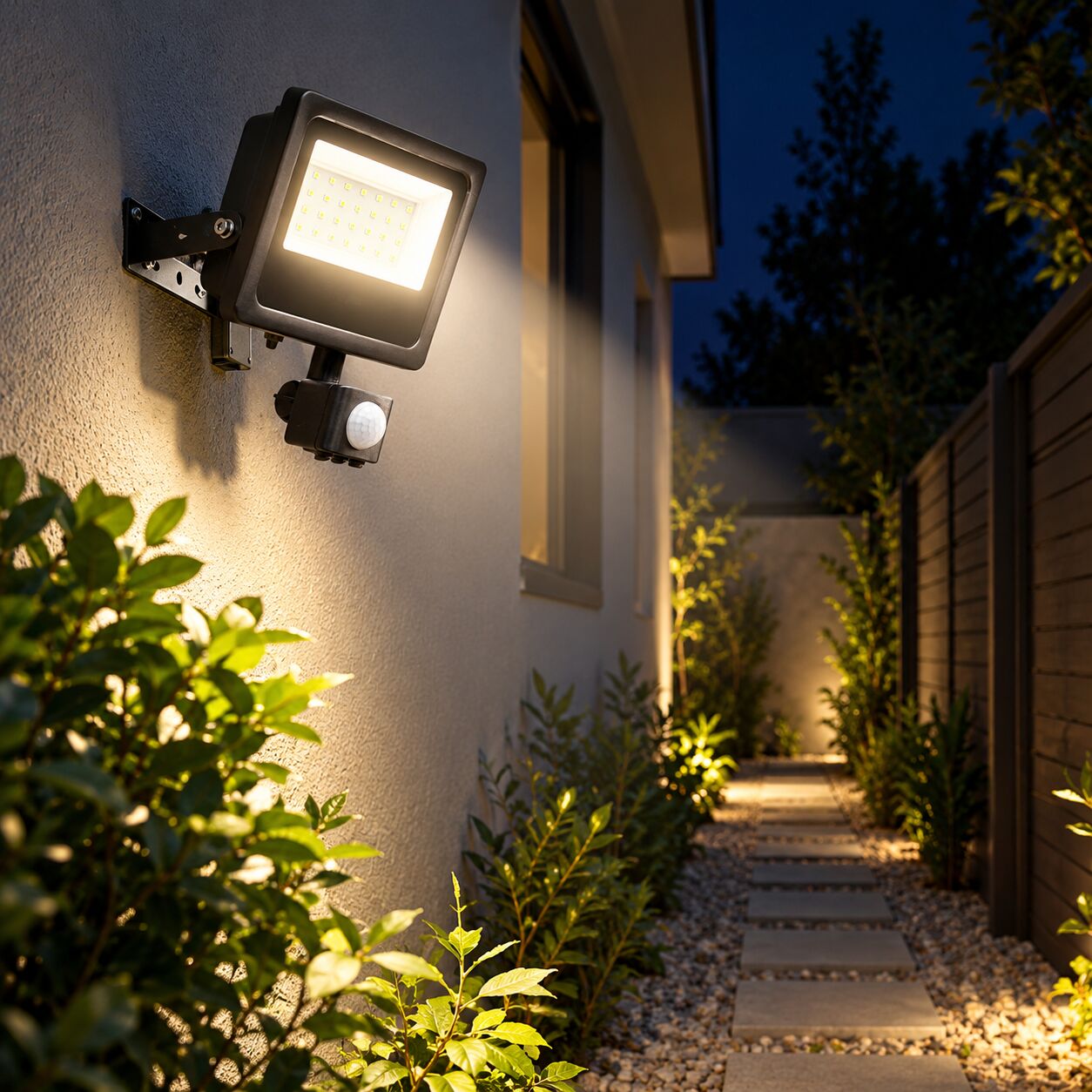
Quick Recommendation
(i) Best for wide perimeter floodlighting: High-output dual-head LED motion floodlights featuring 180° to 270° PIR motion tracking, adjustable dual lamp heads, and an integrated daylight photocell for driveways, backyards, and side aisles.
(ii) Best for commercial perimeter walls & exterior corridors: Heavy-duty IP65 waterproof motion sensor bulkhead lights or auto-dimmable motion street lights that maintain a 30% continuous ambient glow from dusk to dawn and ramp to 100% full power upon motion.
(iii) Best for off-grid & zero-wiring installations: Integrated solar motion security floodlights powered by internal lithium-ion batteries and high-efficiency photovoltaic panels for remote gates and perimeter fences.
(iv) Explore the complete outdoor sensor lighting range: Browse specifications, mounting options, and order directly from the official smart sensors and sensor-based outdoor lighting.
Product Overview
Outdoor motion security lighting represents the primary defense line for residential and commercial property illumination, combining optics, thermal sensing, and automation.
(i) What it is: A comprehensive category of motion-activated outdoor lighting systems—including dual-head motion floodlights, auto-dimmable motion streetlights, solar PIR security lights, motion bulkhead fixtures, and standalone photocell sensors.
(ii) What it does: Automatically detects motion and ambient daylight levels, illuminating dark outdoor zones upon human or vehicular approach while remaining off or dimmed during vacant hours.
(iii) Who it is intended for: Homeowners, property managers, commercial facility directors, electrical contractors, and security planners seeking automated perimeter lighting.
(iv) Primary features: Passive Infrared (PIR) thermal heat sensing, 180°–270° wide detection angles, dusk-to-dawn Lux photocell suppression, adjustable time delay timers (30 seconds to 5 minutes), DualBrite/two-level ambient dimming, and IP65 weatherproofing.
(v) Key specifications: Power Draw: 20W to 50W LED (equivalent to 150W–500W traditional halogen); Voltage: 110V–270V AC (or 3.7V/12V DC solar); Luminous Output: 2,000 to 5,000 Lumens; (vi) Detection Distance: 30 to 70 feet (9 to 21 meters); Operating Temperature: -25°C to +50°C.
(vii) Main use cases: Residential driveways, garage entryways, dark side yards, commercial parking areas, warehouse perimeters, and perimeter fence lines.
(viii) Important limitations: PIR sensors require an unobstructed line-of-sight to detect moving heat signatures; mounting behind glass or dense foliage will block thermal infrared waves.
Why This Matters
Leaving traditional halogen or high-wattage LED floodlights running continuously overnight wastes electricity and contributes to severe light pollution. Conversely, navigating dark driveways or unlit walkways poses tripping hazards and creates blind spots for security cameras. Installing a Defiant motion security light or modern outdoor motion-activated light system ensures high-intensity floodlighting turns on only when movement is detected in the dark, combining maximum deterrence with energy savings.
How Motion-Activated Outdoor Lighting Works
A modern motion security light coordinates three interconnected sensing and control mechanisms to deliver responsive hands-free illumination:
1. Passive Infrared (PIR) Thermal Motion Detection
The motion sensor head houses a pyroelectric sensor positioned behind a curved, segmented Fresnel optical lens. Unlike radar sensors that transmit radio waves, PIR sensors are entirely passive—they detect infrared radiation (heat energy) naturally emitted by objects. When a warm body (a person, animal, or car engine) moves across the sensor's multi-zone detection grid, it creates a rapid temperature differential across adjacent pyroelectric elements, triggering the light circuit.
2. Ambient Lux Photocell (Dusk-to-Dawn Control)
To prevent energy waste during daylight hours, a photodiode Lux sensor measures ambient natural light. If ambient daylight exceeds 10 to 20 Lux (such as during full daylight or bright dusk), the photocell locks the motion trigger circuit open. The PIR motion sensor arms automatically only after natural light drops below the calibrated threshold at dusk.
3. Dual-Level Ambient Dimming (DualBrite Technology)
Advanced fixtures feature dual-level night lighting. From dusk to dawn, the light maintains a soft accent illumination (e.g., 30% brightness or warm mood lighting). When the PIR sensor detects motion within its 30 to 70 ft coverage field, the microcontroller instantly ramps output up to 100% full brightness (e.g., 2,000 to 5,000 lumens). Once motion ceases and the timer delay expires, the fixture smoothly returns to its continuous low-level ambient state.
Key Technical Mechanisms
(i) Segmented Fresnel Lens Array: Splitting incoming thermal IR signals into distinct focal zones allows the sensor to detect horizontal movement across the sensor face with high sensitivity.
(ii) Differential Dual-Element Sensor: Prevents false triggers caused by uniform environmental temperature changes (such as gradual ambient warming or cooling) by measuring contrast between two adjacent pyroelectric receiver plates.
(iii) Adjustable Sensitivity & Delay Dials: Allows users to adjust detection sensitivity (preventing false trips from wind-blown foliage) and calibrate the shut-off timer delay (from 30 seconds up to 5 minutes).
Main Decision Factors: Choosing a Motion Security Light
1. Detection Angle & Coverage Distance
What to look for: Evaluate the sensor's field of view (180° vs. 270°).
Why it matters: Wide 270° sensors placed on building corners cover two perpendicular walls simultaneously, while 180° sensors are ideal for flat wall mounting above garage doors.
Practical recommendation: Select a 270° dual-head floodlight for corner placements and driveway openings; use a 180° sensor fixture for straight wall mountings over side doors.
2. Power Infrastructure: Hardwired AC vs. Solar + Battery
What to look for: Check whether an AC electrical junction box exists at the mounting site.
Why it matters: Hardwired 110V–270V AC fixtures provide unlimited high-lumen operation without relying on sunlight. Solar PIR floodlights require no line wiring, making them ideal for remote gates, fences, and outbuildings.
Practical recommendation: Install hardwired 20W to 50W LED moti