Quick Recommendation
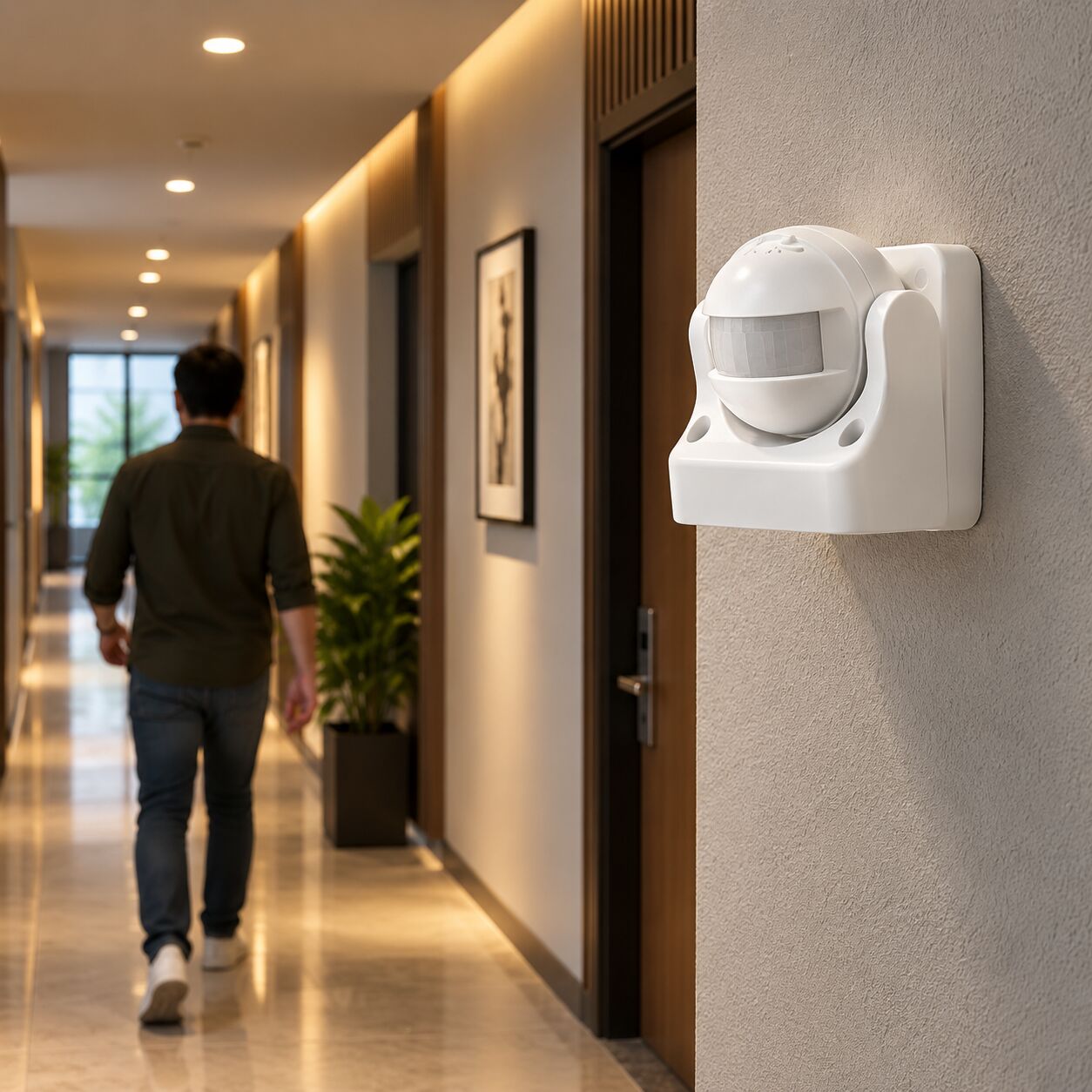
(i) Best for directional wall mounting & hallways: Esysense Wall Mount PIR Motion Sensor — Features an adjustable wall-mount head that directs PIR coverage across targeted corridors, entry gates, and long rooms.
(ii) Best for open-plan offices, lobbies & large rooms: Ceiling-mounted 360-degree PIR sensors — Installed centrally on ceilings at heights of 2.2 to 4 meters to deliver 360-degree multi-directional coverage across square or wide spaces.
(iii) Best for wall switch replacement in smaller rooms: 110-degree to 160-degree switch-box PIR sensors — Replaces existing wall switches directly to monitor door entry points in private offices and bedrooms.
(iv) Explore complete motion sensor options: Browse detailed specifications, voltage ratings, and mounting options for motion automation solutions.
Product Overview
Passive Infrared (PIR) sensors automate lighting by detecting infrared thermal energy (body heat) emitted by moving people across a designated detection field.
(i) What it is: Motion-sensing control modules available in directional wall-mount configurations (110-degree field of view) or multi-directional ceiling-mount configurations (360-degree field of view).
(ii) What it does: Automatically energizes connected LED fixtures, tubelights, or floodlights upon detecting human movement in low-light environments, shutting power off after a calibrated delay timer expires.
(iii) Who it is intended for: Homeowners, commercial facility managers, electrical contractors, and office administrators upgrading to occupancy-based lighting automation.
(iv) Primary features: Dual-element pyroelectric heat detection, Fresnel lens zone segmentation, adjustable daylight photocell (3 to 2000 Lux), customizable off-delay timer (10 seconds to 7 minutes), and manual override settings.
(v) Key specifications: Operating Voltage: 110V–270V AC, 50/60Hz; Switching Load Capacity: 1200W Incandescent / 300W LED; Sensing Distance: 2 to 12 meters; Ideal Mounting Height: 1.8m–2.5m (Wall Mount) / 2.2m–4.0m (Ceiling Mount); IP Rating: IP20 indoor to IP65 weatherproof.
(vi) Main use cases: Hallways, staircases, private offices, open workstations, conference rooms, restrooms, basements, and exterior pathways.
(vii) Important limitations: PIR sensors require an unobstructed optical line-of-sight; physical partitions, glass walls, or tall furniture will block infrared thermal detection.
Why This Matters
Installing a sensor with a mismatched detection angle causes persistent lighting issues. A 110-degree wall sensor placed in a wide conference room will leave corners completely dark, while a 360-degree ceiling sensor placed near a hallway doorway may trigger lights accidentally whenever someone passes by outside. Understanding how 110-degree and 360-degree PIR sensors project their detection fields ensures optimal PIR sensor coverage and maximum energy efficiency.
How PIR Motion Sensors Work
PIR motion sensors rely on pyroelectric elements located behind a curved Fresnel optical lens array to monitor environmental thermal energy:
1. Thermal Infrared Differential Sensing
A PIR sensor does not emit energy; it passively receives far-infrared thermal radiation. The internal sensor housing contains two balanced pyroelectric receiver plates. When a person walks across the detection zone, their body heat passes from one sensor segment to the next, creating a sudden voltage differential across the pyroelectric elements that triggers the internal relay to turn the lights ON.
2. 110-Degree Directional Fan Pattern (Wall Mount)
A 110-degree PIR sensor uses a semicircular lens structure to project a horizontal fan-shaped detection field outward from a wall. It is most sensitive to movement occurring across its field of view (transverse motion) rather than directly toward the sensor lens.
3. 360-Degree Conical Coverage Pattern (Ceiling Mount)
A 360-degree PIR sensor utilizes a dome-shaped, multi-faceted Fresnel lens to cast a conical detection footprint downward onto the floor. As mounting height increases, the ground coverage diameter expands proportionately (typically yielding a detection floor diameter equal to 2 to 2.5 times the ceiling height).
Main Decision Factors: Choosing Detection Angles
1. Room Layout & Mounting Surface
What to look for: Determine whether your room layout favors wall or ceiling installation.
Why it matters: Long, narrow spaces (like corridors and aisles) match the directional wedge of 110-degree sensors. Square, rectangular, or open-plan spaces require the multi-directional umbrella coverage of 360-degree ceiling sensors.
Practical recommendation: Choose wall-mounted models like the Esysense Wall Mount PIR Motion Sensor for hallways and narrow passageways; choose 360-degree ceiling sensors for square offices, conference rooms, and open living spaces.
2. PIR Detection Angle & Walk-Path Orientation
What to look for: Align the sensor so occupants walk across the detection beams rather than directly toward the sensor lens.
Why it matters: PIR sensors detect transverse movement (across the beam) far better than radial movement (directly toward or away from the lens).
Practical recommendation: Position a 110-degree wall sensor perpendicular to the primary walking path so footsteps cross the detection sectors immediately upon entry.
3. Physical Obstructions & Line-of-Sight
What to look for: Identify furniture, cubicle partitions, storage racks, and door swings that could block infrared thermal visibility.
Why it matters: PIR sensors cannot penetrate solid obstacles, glass windows, or drywall.
Practical recommendation: Mount 360-degree sensors high on the ceiling in rooms with high cubicles or furniture to allow the downward detection cone to clear top edges.
Technical Comparison: 110° vs 360° PIR Sensors
1. 110-Degree Wall-Mount PIR Sensor
Primary Mounting Surface: Vertical Wall / Wall-Corner / Junction Box.
Detection Pattern: Horizontal wedge fan pattern (110° spread).
Maximum Detection Reach: 8 to 12 meters forward.
Optimal Mounting Height: 1.8 to 2.5 meters above floor level.
Target Sensitivity: High sensitivity to movement crossing from side to side.
Best Application: Long hallways, entrance gates, side walkways, garages, and narrow rooms.
2. 360-Degree Ceiling-Mount PIR Sensor
Primary Mounting Surface: Horizontal Ceiling (Surface Mount or Flush Concealed).
Detection Pattern: Downward circular conical footprint (360° full circle).
Maximum Detection Reach: 6 to 10 meters