Quick Recommendation
(i) Best for residential corridors, stairwells & pantries (PIR Thermal Sensing): 18W T5 PIR Motion Sensor Tubelight — Compact, highly responsive 2-foot linear profile featuring integrated PIR thermal body tracking and an automatic 60-second shutoff delay.
(ii) Best for commercial basements, parking areas & wide hallways: 20W T5 PIR Motion Sensor Tubelight — High-output 2000-lumen linear batten providing 180° coverage up to 9 meters to handle foot and vehicular movement effortlessly.
(iii) Explore the complete range of automatic linear fixtures: Browse technical specifications, color temperatures, and order directly from the official Esysense Motion Sensor Tubelight.
Product Overview
An LED tube with PIR motion sensor combines surface-mounted diode (SMD) LEDs, an optical Fresnel lens array, a pyroelectric thermal sensor, and an internal driver into a single plug-and-play linear fixture.
(i) What it is: A self-contained linear batten profile featuring integrated PIR body-heat tracking and an ambient Lux photocell.
(ii) What it does: Detects moving thermal infrared radiation emitted by humans or pets, energizing the LEDs automatically when dark, and turning off when vacant.
(iii) Who it is intended for: Homeowners, facility managers, office administrators, residential welfare associations (RWAs), and building operators looking for switch-free linear lighting.
(iv) Primary features: Integrated PIR pyroelectric sensor, 180° wide field of view, 6–9 m sensing distance, 30–60 s auto-off timer, built-in LED driver, direct 110V–270V AC mains connection.
(v) Key specifications: Wattage: 18W / 20W; Lumens: 1800 lm / 2000 lm (100 lm/W); Detection Angle: 180°; Sensing Distance: 6 to 9 meters; Delay Timer: 30–60 seconds; IP Rating: IP20 indoor protection.
(vi) Main use cases: Residential hallways, building staircases, office corridors, restrooms, basements, and underground parking garages.
(vii) Important limitations: PIR sensors rely on line-of-sight thermal detection; physical walls, glass doors, or heavy obstructions block sensor visibility.
Why This Matters
Leaving linear tube lights turned on 24/7 across staircases, corridors, and basements wastes electricity and shortens LED driver lifespans. Installing a motion sensor tube light ensures linear lighting turns on only when people are physically present, saving up to 95.1% on energy costs while delivering hands-free nighttime convenience.
How PIR Motion Sensor LED Tubelights Work
A PIR tube light synchronizes three internal components inside its diffuser profile:
1. Pyroelectric Sensor & Fresnel Lens Array
The center or end-cap of the tube housing contains a pyroelectric sensor positioned behind a curved Fresnel optical lens array. When a person moves across the sensor's 180° field of view, the lens splits their emitted body heat into moving thermal zones. This temperature differential triggers an internal electronic switch, illuminating the LED array instantly.
2. Ambient Lux Photocell (Daylight Suppression)
An integrated ambient daylight sensor continuously measures surrounding natural light. If daylight exceeds approximately 10 to 15 Lux, the photocell keeps the light circuit open—preventing the tube from turning on during bright daylight hours even if motion is present.
3. Smart Delay Timer & Relay Driver
Once triggered, the internal driver maintains 100% full brightness while movement continues. After the occupant exits the detection zone, an integrated timer counts down 30 to 60 seconds before
safely switching off the fixture to an ultra-low 0.15W standby state.
Main Decision Factors: Choosing a PIR Tube Light
1. Sensing Technology: PIR Line-of-Sight vs. Radar
What to look for: Match the sensor mechanics to your room structure.
Why it matters: PIR sensors detect body heat in direct line-of-sight, making them immune to false triggers caused by movement behind thin walls or glass doors. Radar (microwave) sensors penetrate thin partitions, which can cause false activations from adjacent rooms.
Practical recommendation: Choose an LED tube with PIR motion sensor for enclosed home hallways, bedrooms, and stairwells where contained line-of-sight sensing is required.
2. Wattage & Lumen Output: 18W vs. 20W
What to look for: Select the wattage based on ceiling height and space length.
Why it matters: 18W models (1800 lumens) deliver crisp, energy-efficient lighting for compact home passages; 20W models (2000 lumens) offer wide-beam coverage for long commercial corridors and parking bays.
Practical recommendation: Use 18W tubelights for residential corridors and stair landings; select 20W tubelights for wide commercial corridors, basements, and parking lots.
3. Installation Simplicity & Wiring Setup
What to look for: Look for integrated T5 surface-mounting battens.
Why it matters: Integrated sensor tubelights contain their own internal driver and motion circuit, wiring directly into standard 110V–270V AC mains without external starters, ballasts, or separate motion sensor boxes.
Practical recommendation: Mount the batten profile directly to wall or ceiling points using the included mounting clips for a fast, clean installation.
Use-Case & Application Guide
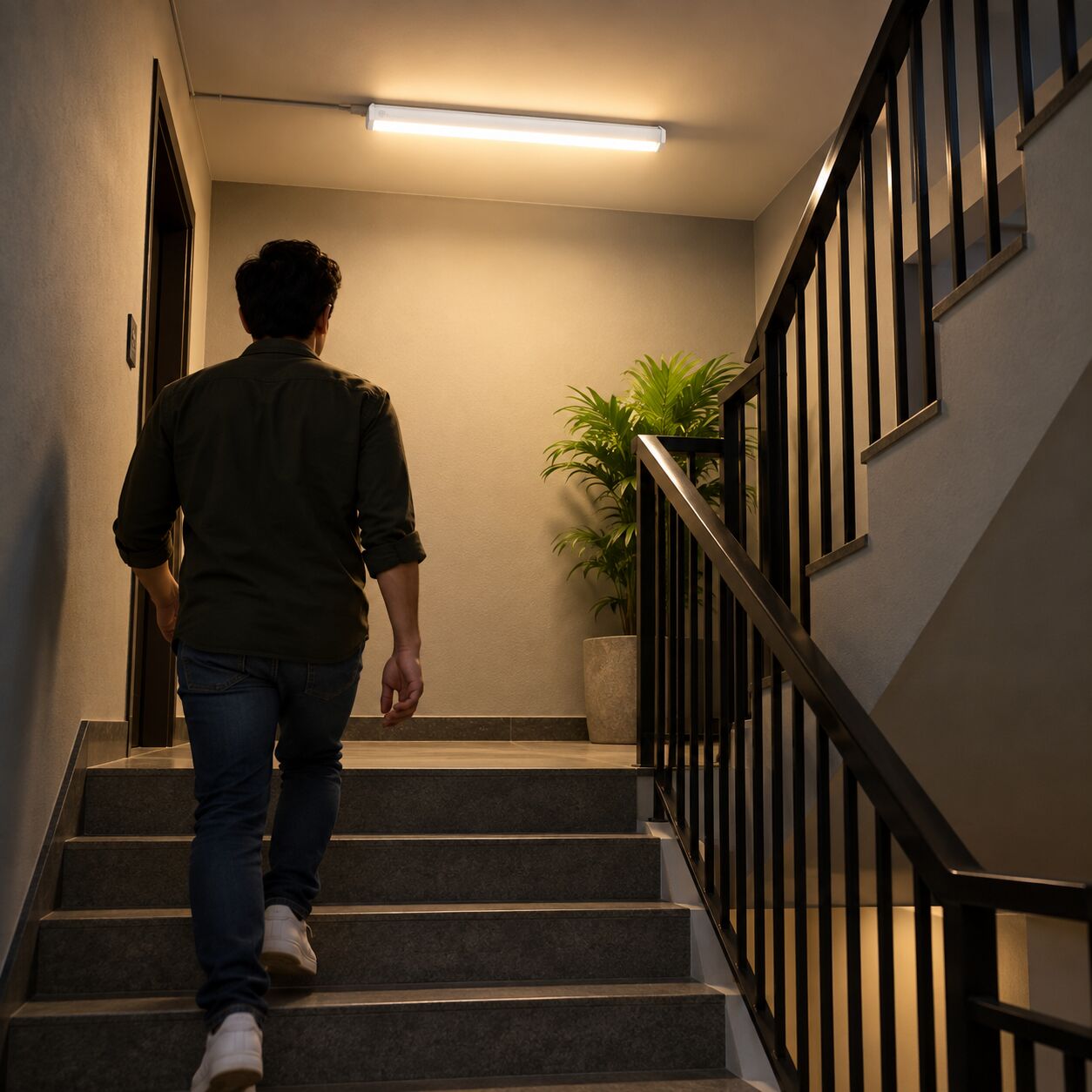
(i) Apartment Building Stairways: Install an 18W or 20W PIR tube light on each floor landing. Lights activate step-by-step as residents walk up or down, turning off automatically behind them.
(ii) Commercial Office Corridors: Deploy 20W PIR tubelights spaced every 4 to 6 meters. The lights remain dormant when halls are empty, instantly illuminating as staff exit office doors.
(iii) Home Entryways & Garages: Mount an 18W motion sensor tube light above entrance doors or parking bays for instant hands-free visibility when carrying groceries or driving in at night.
(iv) Restrooms & Storage Bays: Use PIR tubelights to prevent lights from being left turned on accidentally in unoccupied utility rooms.
Performance, Results & Real-World Considerations
(i) Positioning for Transverse Movement: PIR thermal sensors are most sensitive when people walk across the sensor face rather than directly toward it. Position the tubelight perpendicular to the primary walk-path for immediate activation.
(ii) Avoiding Thermal Interference: Do not install PIR sensor tubelights directly in front of air conditioning ducts, space heaters, or hot water pipes, as sudden warm air blasts can cause false triggers.
(iii) Line-of-Sight Clearance: Ensure the sensor lens on the tubelight dome is not obstructed by hanging signboards, t