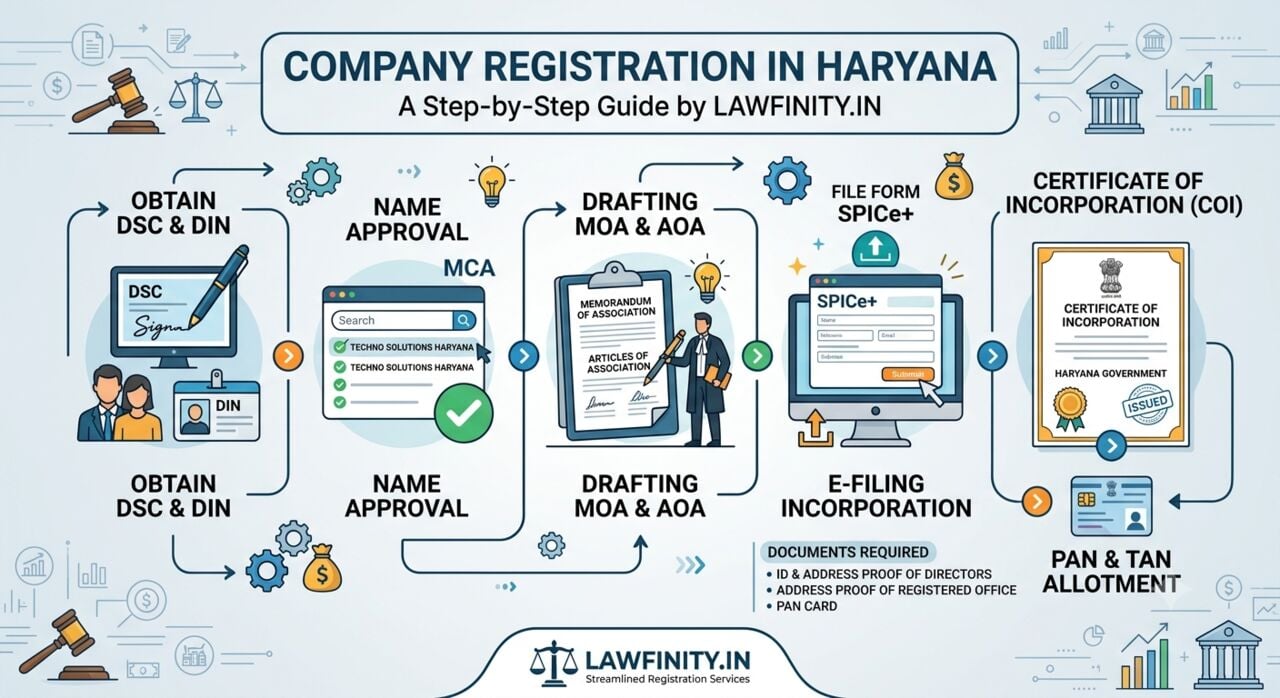
Haryana has developed into an important business and industrial destination, with commercial activity spread across cities such as Gurugram, Faridabad, Panchkula, Panipat, and other growing business centres. Entrepreneurs entering this market need to understand the basic formalities involved in establishing a business.
Company registration in Haryana generally begins with selecting a suitable legal structure. Entrepreneurs can consider options such as a Private Limited Company, Limited Liability Partnership, or other applicable forms depending on their business objectives.
The structure selected can affect ownership, management, liability, taxation, compliance requirements, and the ability to bring in investors. Therefore, founders should evaluate their expected business scale and future plans before making a decision.
Documentation is another important part of incorporation. Depending on the structure, promoters and directors may be required to provide identity proof, address proof, photographs, registered office information, and other supporting documents. Accurate documentation can help avoid unnecessary delays or requests for clarification.
The incorporation procedure is handled through the applicable government systems, and digital documentation has made it possible for many entrepreneurs to complete substantial parts of the process remotely. However, the exact requirements can vary according to the business structure and circumstances of the applicants.
After incorporation, businesses may need additional registrations based on their activities. For example, a business dealing with taxable supplies may need GST registration, while establishments operating from commercial premises may have separate local compliance requirements. Businesses involved in regulated sectors may also require specialised licences or approvals.
Entrepreneurs should also keep future compliance in mind. Registration establishes the business, but it does not eliminate ongoing legal and financial responsibilities. Companies may need to maintain records, submit periodic filings, manage taxation, and complete annual regulatory obligations.
Professional support can make the process easier by helping founders understand documentation requirements, preparing applications, coordinating filings, and identifying additional registrations relevant to their activities.
For someone planning to establish a new venture, understanding the registration process before starting can prevent avoidable mistakes. A clear plan covering the business structure, documents, registered office, tax requirements, and future compliance can make the overall setup more organized.
Whether the venture is a small startup or a growing enterprise, proper legal establishment provides a structured base from which the business can operate and expand.