Quick Recommendation
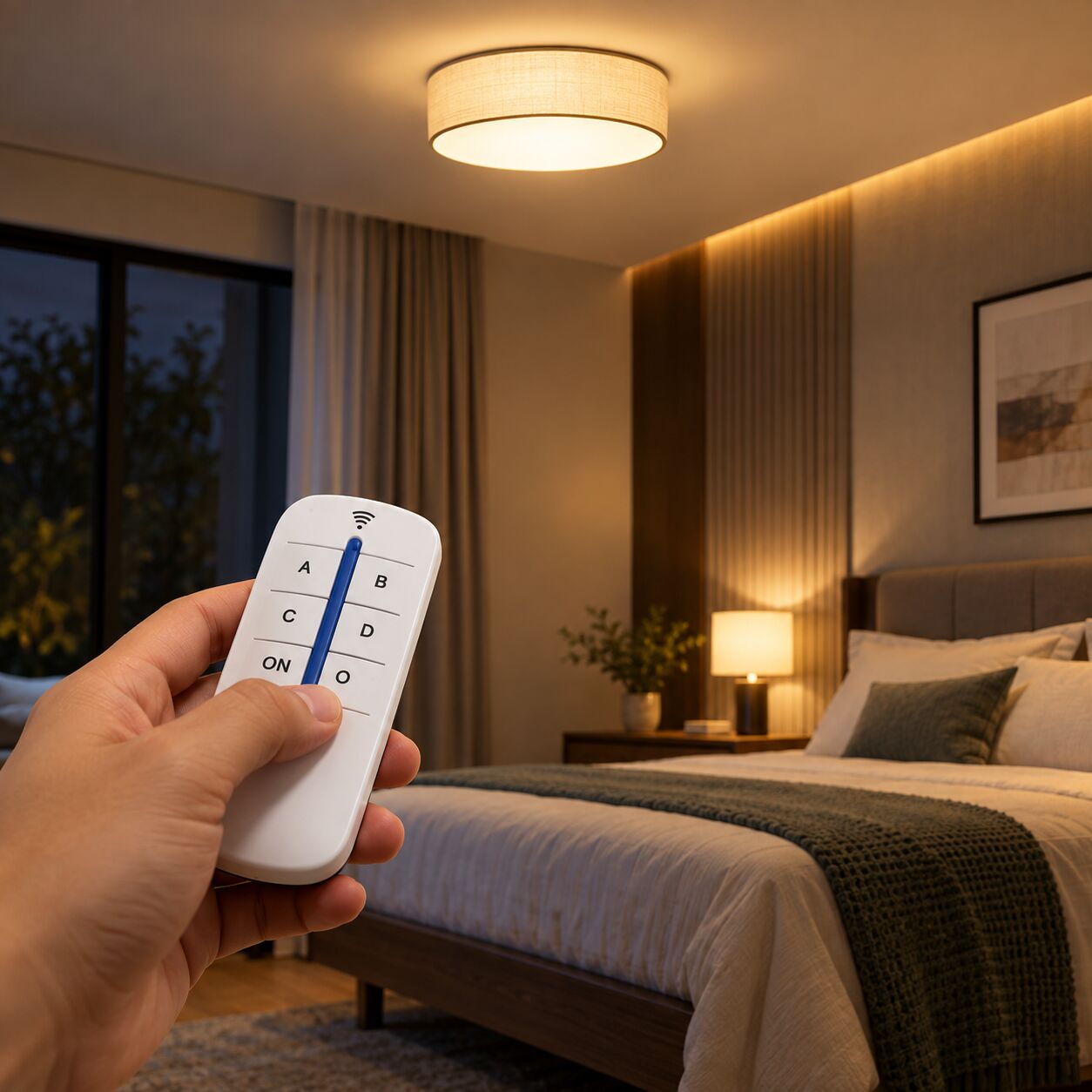
(i) Best for multi-point bedroom, living room & entertainment control: Esysense 4-Way Remote Control Switch ESY-TC35 — Controls up to 4 independent electrical channels (lights, fans, decorative LEDs) with a compact RF remote and dual manual switch operation.
(ii) Best for hands-free hallways, stairwells & restrooms: Automated PIR motion sensor switches — Ideal for transient spaces where hands-free occupancy sensing is preferred over manual button selection.
(iii) Best for outdoor perimeters & security floodlights: Dusk-to-dawn photocell sensors — Automates lighting based on natural ambient sunlight levels rather than manual wireless commands.
Product Overview
Modern residential and commercial electrical systems benefit from both wireless remote switching and automated sensor controls, each solving distinct user requirements.
(i) What it is: A high-performance wireless receiver module installed behind existing wall switch plates or ceiling rose fittings, paired with a handheld RF remote control transmitter.
(ii) What it does: Converts up to 4 separate electrical lighting lines (e.g., ceiling tubelights, fans, ambient cove LEDs, and wall sconces) into wirelessly controllable zones without running new line wires across walls.
(iii) Who it is intended for: Homeowners, senior citizens, hotel managers, interior designers, and renovators looking for wireless lighting convenience without replacing existing switchboard infrastructure.
(iv) Primary features: 4-channel independent RF switching, omnidirectional signal transmission (works through brick walls up to 20–30 m), dual manual switch and remote operation, anti-interference digital coding, and high load capacity.
(v) Key specifications: Operating Voltage: 110V–270V AC, 50/60Hz; Receiver Dimensions: Compact profile for concealed switchbox mounting.
(vi) Main use cases: Master bedrooms, living room entertainment centers, conference rooms, multi-fixture chandeliers, and ceiling fan controls.
(vii) Important limitations: Unlike motion sensors, digital remote switches require explicit user button presses to activate or deactivate connected circuits.
Why This Matters
Waking up or settling into bed only to realize main ceiling lights were left ON requires getting up to reach the wall switchboard. Simultaneously, running separate wires for 4 individual lighting zones in a renovated living room adds expensive conduit work. Installing a dedicated digital remote control switch brings effortless bed-side or couch-side wireless control to standard electrical fittings, blending tactile convenience with multi-zone lighting management.
How Digital Remote Control Switches Work vs. Automatic Sensors
Understanding the operational mechanics behind a remote control light switch versus automatic sensors helps clarify where each system delivers maximum value:
1. Radio Frequency (RF) Signal Transmission
A digital lighting switch uses 433.92 MHz Radio Frequency (RF) waves rather than line-of-sight Infrared (IR). When a button on the handheld transmitter is pressed, a coded digital signal penetrates timber doors, glass partitions, and brick walls up to 30 meters away to reach the concealed receiver module.
2. Multi-Channel Relay Logic
Inside a receiver module like the Esysense 4-Way Remote Control Switch ESY-TC35, four independent electromagnetic relays manage separate line outputs. Pressing button "A", "B", "C", or "D" toggles the corresponding relay, while a master "ON/OFF" button controls all 4 channels simultaneously.
3. Hybrid Control: Remote Command vs. Sensor Automation
Digital Remote Switches: Operate on user intent. Lights turn ON or OFF only when commanded by the user, making them ideal for living rooms, bedrooms, and media rooms where occupants want specific light levels regardless of movement.
Automatic Sensors (PIR/Photocell): Operate on environmental triggers. Lights activate automatically when body heat or darkness is detected, making them ideal for staircases, corridors, and exterior entryways.
Main Decision Factors: Remote Control vs. Automatic Light Control
1. Control Flexibility & User Intent
What to look for: Determine whether lighting should respond to user choice or movement.
Why it matters: In a bedroom or home theater, people often sit still for long periods reading or watching movies. An automatic motion sensor would mistakenly turn lights OFF due to lack of movement. A digital remote control switch keeps selected lights ON as long as desired.
Practical recommendation: Use a 4-channel wireless switch for bedrooms, living rooms, and media spaces; deploy motion sensors for hallways, walk-in closets, and stairwells.
2. Wiring Architecture & Modular Fitting
What to look for: Evaluate the effort required to add multi-point switching to existing rooms.
Why it matters: Adding 2-way or 4-way wall switches traditionally requires chiseling concrete walls to lay new copper wires between switchboards.
Practical recommendation: Hide a compact module like the Esysense 4-Way Remote Control Switch ESY-TC35 behind your existing switchboard to instantly upgrade up to 4 lighting lines without modifying wall masonry.
3. Load Capacity & Multi-Fixture Management
What to look for: Verify maximum rated wattage per channel for your connected fixtures.
Why it matters: High-output ceiling chandeliers or multiple heavy LED panels require robust internal relays that handle inductive driver loads without contact welding.
Practical recommendation: Ensure the receiver supports at least 300W LED or 1000W resistive load per channel to handle multiple tubelights, LED panels, or ceiling fans safely.
Technical Specification Comparison
Digital Remote Control Switch
Control Mechanic: Wireless RF Handheld Remote + Manual Wall Switch Toggle.
Operating Voltage: 110V–270V AC, 50/60Hz.
Channels / Outputs: 4 Independent Switched Lines.
Wireless Range: 8 to 15 Meters (360° Omnidirectional through walls).
Best Application: Master bedrooms, living rooms, home theaters, ceiling fan + light combos.
Use-Case Guide
(i) Master Bedrooms & Senior Care Rooms: Install the Esysense 4-Way Remote Control Switch ESY-TC35 behind the main switchboard. Connect channel A to main tubelights, channel B to night lamps, channel C to cove mood lighting, and channel D to the ceiling fan. Occupants can control everything from bedside without getting up.
(ii) Living Room Entertainment Zones: