Quick Recommendation
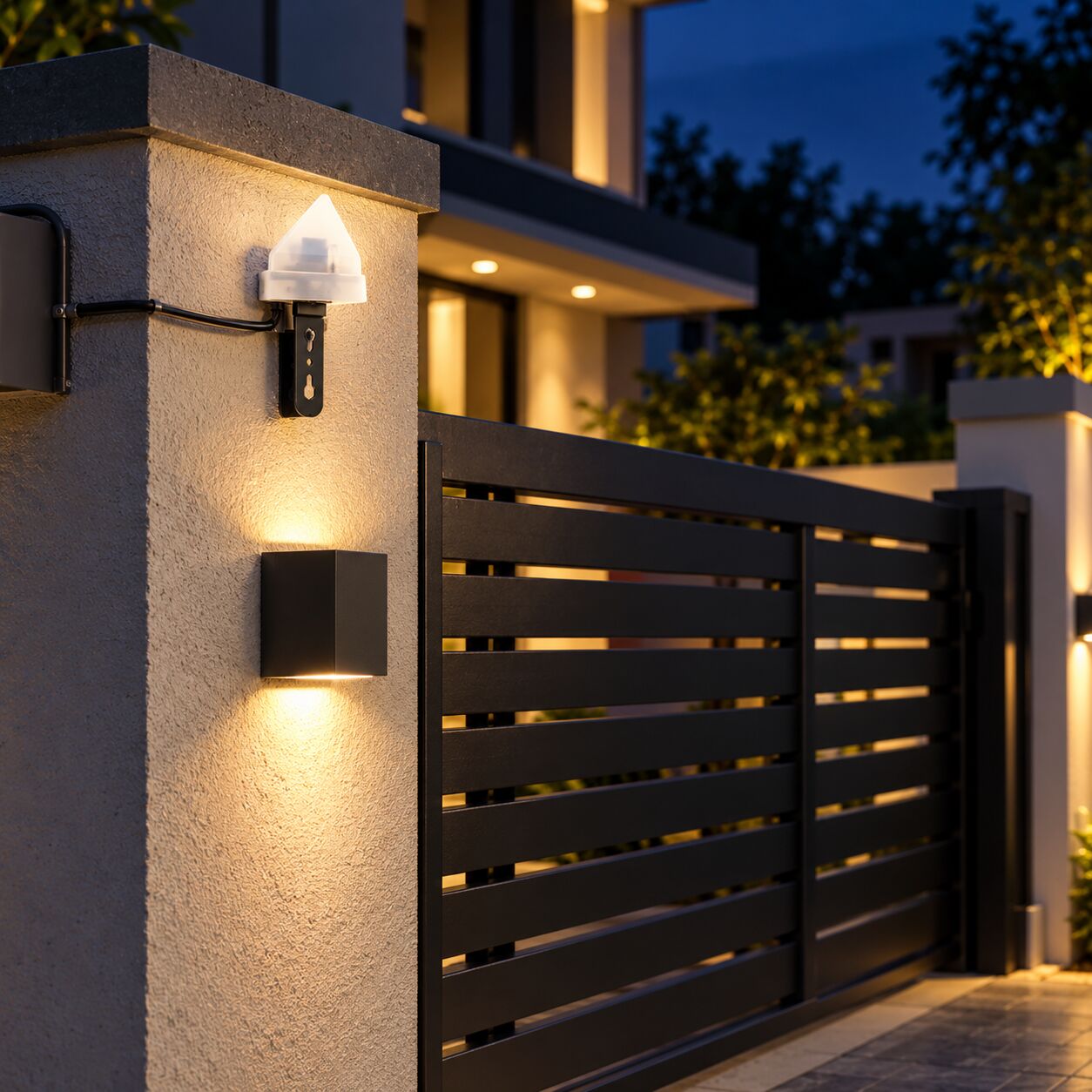
(i) Best for residential street lights, garden lamps & entry gates: Esysense Photocell LDR Sensor — Compact weatherproof dusk-to-dawn controller with a 6A load capacity, operating directly on 110V–270V AC for automated night lighting.
(ii) Best for heavy-duty pole mounting & municipal lighting: Pole-Mount Waterproof Photocell Switches — Rugged IP44/IP65 twist-lock or pole-mountable sensors supporting up to 10A/16A heavy outdoor floodlight loads.
(iii) Best for interior room automation: PIR motion sensors or digital remote switches — Ideal for transient indoor spaces where human movement, rather than outdoor daylight, dictates light activation.
Product Overview
Automating exterior lighting through light-dependent photo-resistors eliminates manual switch operations for perimeter security and public illumination.
(i) What it is: A dusk-to-dawn light control switch, a signal comparator circuit, and an electromagnetic relay within a weatherproof IP44/IP65 housing.
(ii) What it does: Automatically powers connected outdoor LED floodlights, street lamps, and garden lights ON when ambient natural light falls below 30 Lux at dusk, turning them OFF when morning sunlight exceeds 150 Lux at dawn.
(iii) Who it is intended for: Homeowners, estate managers, commercial property operators, municipal lighting contractors, and industrial facility directors seeking hands-free outdoor lighting control.
(iv) Primary features: CdS photo-resistive light detection, adjustable/calibrated Lux thresholds, anti-flicker time delay (prevents false trips from car headlights or lightning), IP44/IP65 weatherproofing, direct AC line switching, and low standby power draw.
(v) Key specifications: Operating Voltage: 110V–270V AC, 50/60Hz; Switching Load Capacity: 6A to 10A (up to 1200W Incandescent / 300W–500W LED load); Ambient Light Sensitivity: ON at < 30 Lux, OFF at > 150 Lux; Operating Temperature: -20°C to +50°C; Standby Consumption: < 0.5W.
(vi) Main use cases: Outdoor street lights, perimeter security floodlights, garden lamp posts, doorway porch lights, parking lot illumination, and billboard advertising lights.
(vii) Important limitations: The sensor probe must be aimed toward natural open sky away from the beam of the light fixture it controls to avoid continuous ON/OFF cycling (flicker feedback loops).
Why This Matters
Forgetting to switch off outdoor gate lamps, garden lights, or perimeter floodlights during the morning hours leads to massive energy waste and shortens LED component lifespans. Conversely, returning home to a pitch-black driveway creates safety hazards and security vulnerabilities. Installing a Esysense Photocell LDR Sensor automates dusk-to-dawn outdoor illumination completely, combining effortless night-time security with energy savings.
How Photocell LDR Sensors Work
A photocell LDR sensor relies on solid-state semiconductor physics and electronic comparison circuits to convert ambient natural light into automated switching:
1. Photo-Resistive Semiconductor Physics
The heart of an LDR light sensor is a wavy track of cadmium sulfide (CdS) semiconductor material deposited on a ceramic substrate. In dark conditions, free valence electrons are bound within the crystal lattice, causing internal electrical resistance to climb as high as 1 to 10 Mega-ohms (1,000,000 Omega). When photons from natural sunlight strike the CdS surface, light energy excites valence electrons into the conduction band, causing internal resistance to drop sharply down to 100 to 500 ohms (Omega).
2. Voltage Comparator & Relay Driver Circuit
The LDR is wired into a voltage divider circuit connected to an operational amplifier (op-amp) comparator:
Daytime (Low LDR Resistance): Low voltage drop across the photo-resistor keeps the comparator output LOW, keeping the internal electromagnetic relay open (Light OFF).
Dusk / Nighttime (High LDR Resistance): High resistance across the LDR increases voltage drop at the comparator input. When ambient light drops below 30 Lux, the comparator trips HIGH, closing the relay contacts to energize connected outdoor fixtures (Light ON).
3. Anti-Flicker Time Delay Protection
To prevent erratic switching caused by transient light flashes—such as passing car headlights, thunderstorm lightning, or temporary cloud shadows—a modern photocell sensor incorporates a 5-to-15-second RC time delay circuit. The ambient light level must remain consistently below or above the Lux threshold for several seconds before the relay changes state.
Main Decision Factors: Choosing a Photocell Sensor
1. Electrical Load Capacity & Fixture Compatibility
What to look for: Match the sensor's current rating (Amperes) to your total connected outdoor lighting wattage.
Why it matters: Inrush current from multiple high-wattage LED drivers can weld low-quality switch contacts together.
Practical recommendation: Choose the Esysense Photocell LDR Sensor with a 6A load capacity for residential gate lamps, garden fixtures, and up to 300W of LED floodlights; select heavy-duty 10A/16A pole-mount sensors for commercial parking lot lights.
2. Mounting Placement & Orienting the Sensor Eye
What to look for: Mount the sensor where it receives clear natural skylight without direct exposure to artificial light.
Why it matters: If the light emitted by the outdoor lamp shines directly onto the sensor's LDR eye, the sensor will mistakenly register "daylight," turn the lamp OFF, detect darkness, turn the lamp ON, and repeat this cycle endlessly (flicker loop).
Practical recommendation: Mount the photocell sensor above or behind the controlled light fixture, pointing the transparent sensing dome toward the northern sky or open horizon.
3. Ingress Protection (IP Rating) & Weatherproofing
What to look for: Ensure the sensor housing carries an IP44, IP65, or higher weather-resistance rating.
Why it matters: Outdoor sensors are exposed to heavy monsoon rains, dust storms, direct UV sunlight, and extreme seasonal temperatures.
Practical recommendation: Look for sealed polycarbonate housings with rubber wire-entry gaskets to prevent water ingress and internal circuit corrosion over years of outdoor exposure.
Technical Specification Comparison
1. Standard Photocell LDR Sensor
Light Sensing Element: Cadmium Sulfide (CdS) Photo-Resistor.
Operating Voltage: 110V–270V AC, 50/60Hz.
Switching Load Rating: 6A