Quick Recommendation
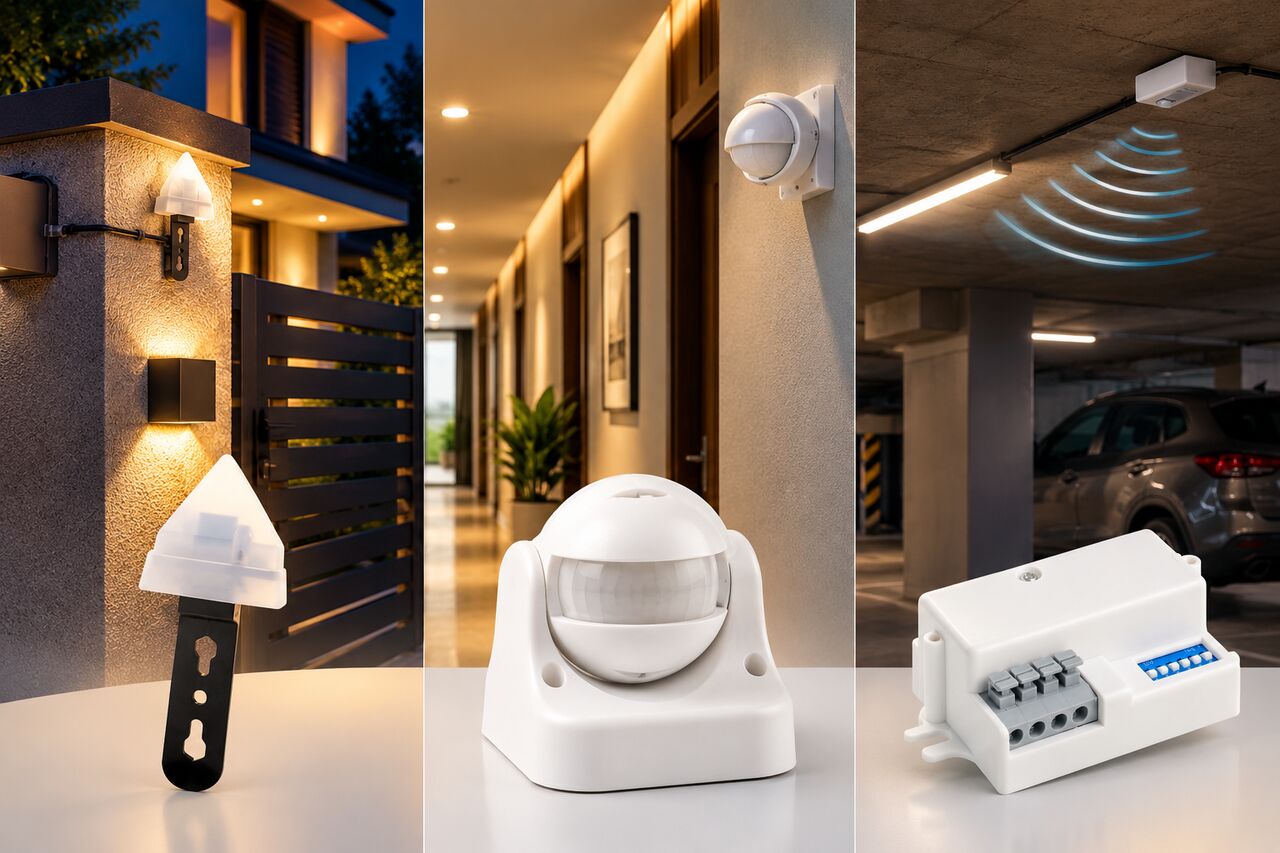
(i) Best for indoor residential rooms, hallways & stairwells: PIR Motion Sensors — Offers precise, line-of-sight body heat detection that prevents false activations from adjacent rooms or outside street traffic.
(ii) Best for commercial open bays, parking lots & glass partition spaces: Radar / Microwave Motion Sensors — High-sensitivity 360° detection penetrates thin partitions and glass doors to detect approaching foot or vehicular traffic instantly. Learn more in our detailed PIR vs. Microwave vs. Radar motion detection technology guide.
(iii) Best for outdoor perimeters, street lamps & gate lights: Photocell LDR Sensors — Automatically measures ambient natural light to deliver hands-free dusk-to-dawn illumination without motion triggers.
(iv) Explore complete smart sensor options: Compare all sensor architectures, load ratings, and mounting styles in the official Esysense Smart Sensors.
Product Overview
Automatic lighting controls utilize specialized physical sensing elements to eliminate manual wall switching and automate energy management across residential, commercial, and industrial facilities.
(i) What it is: A technical comparison of the four primary sensing technologies used in lighting automation: Passive Infrared (PIR), Microwave Radar, Light Dependent Resistor (LDR Photocell), and Dual-Technology hybrid sensors.
(ii) What it does: Detects human presence, moving vehicle heat signatures, high-frequency Doppler wave shifts, or natural sunlight Lux thresholds to automatically control AC lighting circuits.
(iii) Who it is intended for: Homeowners, interior designers, electrical contractors, facility directors, and building engineers evaluating lighting sensor types for new builds or retrofits.
(iv) Primary features: PIR pyroelectric thermal tracking, 5.8GHz Radar/Microwave wave emission, CdS photo-resistive daylight sensing, adjustable Lux thresholds (3 to 2000 Lux), customizable off-delay timers (10 seconds to 15 minutes), and IP20 to IP65 weatherproofing.
(v) Key specifications: Operating Voltage: 110V–270V AC, 50/60Hz; Switching Load Capacity: 300W–500W LED / 1200W–2000W Incandescent; Detection Angles: 110° to 180° (Wall Mount) / 360° (Ceiling Mount); Sensing Range: 2 to 12 meters; Standby Power Draw: < 0.5W.
(vi) Main use cases: Bedrooms, restrooms, staircases, building corridors, underground parking bays, warehouses, outdoor perimeters, and street lamps.
(vii) Important limitations: PIR sensors require an unobstructed optical line-of-sight; Radar/Microwave sensors can trigger falsely through thin partition walls if sensitivity is set too high; LDR photocells react solely to light levels rather than human occupancy.
Why This Matters
Installing a mismatched sensor type leads to persistent operational headaches—such as lights turning off while people are sitting in an office, false activations caused by passing street traffic, or outdoor lights burning uselessly during bright daylight hours. Understanding the functional differences between PIR, Radar, Microwave, and LDR sensors ensures you deploy the best sensor for automatic lighting for your specific architectural layout.
How Each Sensor Type Works
Each core sensing technology operates on a distinct set of physical principles to trigger lighting circuits:
1. Passive Infrared (PIR) Sensors (Thermal Detection)
PIR sensors contain pyroelectric elements positioned behind a curved Fresnel lens array. They do not emit energy; instead, they passively receive far-infrared thermal radiation naturally emitted by human bodies and warm objects. When a person moves across the sensor's optical zones, the shifting heat signature creates a voltage differential that trips the internal relay, switching the lights ON.
2. Radar / Microwave Sensors (Doppler Wave Shift)
Microwave and Radar sensors actively emit low-power high-frequency electromagnetic waves (typically at 5.8GHz) and measure the reflected waves returned to the sensor antenna. Moving objects—such as walking humans, moving vehicles, or opening doors—cause a frequency shift (Doppler Effect) in the reflected signal. The internal microprocessor detects this shift and energizes the connected light fixture instantly. For an in-depth breakdown of wave propagation, read our full PIR vs. Microwave vs. Radar motion detection technology guide.
3. Light Dependent Resistor (LDR) Photocell Sensors (Ambient Lux Measuring)
LDR sensors utilize a cadmium sulfide (CdS) semiconductor element that alters its internal electrical resistance based on natural ambient sunlight. In darkness, internal resistance climbs into the Mega-ohms range, tripping an op-amp comparator to turn outdoor lights ON at dusk. In morning sunlight, resistance drops to a few hundred ohms, opening the circuit to turn lights OFF at dawn.
Main Decision Factors: Choosing the Right Sensor Type
1. Line-of-Sight Requirements vs. Partition Penetration
What to look for: Determine if your installation site contains physical visual obstructions like cubicles, glass walls, or enclosed stalls.
Why it matters: PIR sensors cannot penetrate solid walls, glass doors, or tall office furniture. Radar/Microwave sensors penetrate glass, timber doors, and drywalls easily.
Practical recommendation: Use PIR sensors for enclosed bedrooms, private offices, and clear hallways; choose Radar/Microwave sensors for open-plan offices with cubicles, glass conference rooms, and multi-stall restrooms.
2. Environmental Heat Sensitivity & False Trigger Resistance
What to look for: Assess ambient temperature fluctuations and airflow in the room.
Why it matters: High ambient summer temperatures (above 37°C) reduce PIR sensor sensitivity because human body heat blends into the background room temperature. Conversely, forced hot air from HVAC vents can cause PIR false triggers. Radar sensors are unaffected by temperature or air currents.
Practical recommendation: Install Radar/Microwave sensors in hot boiler rooms, covered outdoor loading docks, and HVAC-heavy commercial spaces; deploy PIR sensors in climate-controlled indoor
living spaces.
3. Occupancy Tracking vs. Time-Based Dusk-to-Dawn Control
What to look for: Decide whether the light should turn on when people walk by or stay illuminated continuously overnight.
Why it matters: Entry gates, perimeter walls, and street lamps requi