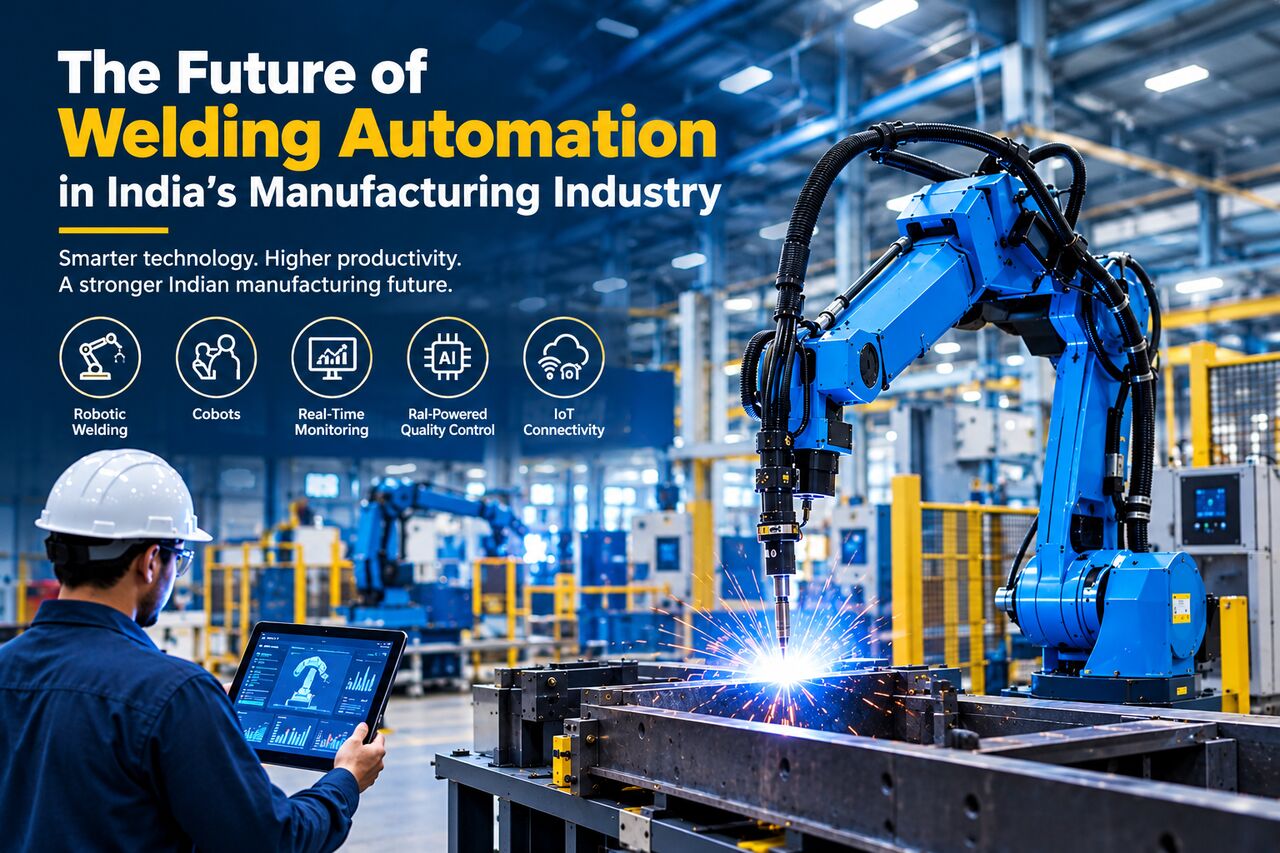
India is gradually moving toward smarter welding processes. Modern welding automation now includes more than basic mechanized movement, with robotic cells, cobots, connected welding manipulators, sensors, and real-time monitoring becoming increasingly important. This transition is closely connected with India’s growing manufacturing activity and the continuing challenge of finding skilled welders.
Why Is Welding Automation Taking Off?
Manufacturers across India are seeing higher demand from infrastructure, automotive, EV, steel, energy, defense, and renewable energy projects.
At the same time, labour costs are increasing and skilled welding resources can be difficult to secure. Automated equipment can help manufacturers maintain consistent production while reducing repetitive manual operations.
What Makes Automation Smart?
Smart automation uses connectivity and data to make welding equipment more informative and responsive.
The growing use of AI, IoT, and robotics between 2026 and 2030 could change how manufacturers monitor welding operations.
Typical capabilities include:
Real-time machine data from sensors.
AI-supported weld inspection using vision systems.
Predictive maintenance based on equipment conditions.
Remote diagnostics for troubleshooting and support.
The Growing Use of Robots and Cobots
Robotic welding is becoming more accessible to manufacturers outside the traditional large automotive sector.
Lower equipment costs and simpler programming can make robotic cells more practical for smaller businesses. Digital connectivity and 3D scanning can also contribute to better monitoring and consistency.
Why Manipulators Are Still Important
Not every manufacturer needs a robot. Welding Column and Boom systems can automate torch positioning and travel while providing a simpler route into mechanized welding.
For businesses looking for a Welding Manipulator Manufacturer in India, manipulators can be particularly useful for increasing SAW or MIG welding productivity.
For round or cylindrical workpieces, a Welding Rotator can provide controlled rotation and help maintain a consistent welding process.
Positioners Improve Welding Orientation
A Welding Positioner helps rotate or orient the workpiece into a better welding position.
For heavy components, a Heavy-Duty Positioner provides higher load-handling capability and controlled movement.
Positioners can also operate with manipulators to create a more efficient production setup.
Manual and Smart Automation: A Comparison
Factor Manual Welding Smart Automated Welding
Consistency Depends on operator Repeatable machine control
Labour dependency High Lower for repetitive tasks
Downtime monitoring Reactive Predictive
Scalability Limited by manpower Supported by equipment
Mistakes Manufacturers Should Avoid
Treating robotics as the only route to automation
Ignoring operator training
Failing to check space and power requirements
Choosing equipment without considering production volume
Practical Steps for Adoption
Begin with suitable mechanized solutions such as manipulators, positioners, and Welding Column and Boom systems.
Train operators and maintenance personnel.
Compare productivity and quality results before and after installation.
Keep future IoT and connectivity requirements in mind.
CARMAC’s Place in the Industry
CARMAC offers welding manipulators, Welding Rotator systems, positioners, and material handling equipment for manufacturers adopting more automated production methods.
These solutions can help companies improve consistency and efficiency while creating a path toward more advanced robotic automation.
Explore CARMAC.co.in for more information.
FAQs
Q.1: Are manual welders becoming unnecessary?
Ans: No. Automation reduces manual work mainly in repetitive and high-volume applications. Skilled welders remain necessary for specialized jobs.
Q.2: What industries are increasing demand for automation?
Ans: Infrastructure, automotive, EV, steel, energy, defense, and renewable energy are among the sectors contributing to demand.
Q.3: Can manufacturers automate without robots?
Ans: Yes. Manipulators, Welding Positioner systems, and Welding Column and Boom equipment can provide effective mechanization for many applications.