Quick Recommendation
(i) Best for standard Indian wall battens & stairwells (B22 Bayonet): B22 Motion Sensor Bulb — Features plug-and-play installation into regular push-and-twist wall sockets, delivering 1000 lumens of bright illumination with integrated photocell daylight suppression.
(ii) Best for imported lamps, sconces & exterior lanterns (E27 Screw Base): E27 Motion Sensor Bulb — Designed for threaded Edison sockets, making it ideal for decorative wall sconces, outdoor entry lanterns, and pendant lights.
(iii) Best for compact bathrooms, pantries & utility closets: E27 Motion Sensor Bulb — Delivers energy-efficient 700-lumen output for small enclosed spaces where lower light intensity is preferred.
(iv) Explore the complete range of smart motion bulbs: Browse specifications, base fittings, and order directly from the official Esysense Motion Sensor Bulb.
Product Overview
Automatic motion sensor LED bulbs combine high-efficiency surface-mounted diodes (SMDs), optical sensors, and micro-relay drivers into a single compact lamp profile.
(i) What it is: A self-contained A60/A65 LED bulb featuring an integrated PIR body-heat sensor or Radar wave module and an ambient Lux photodiode built directly into the bulb dome.
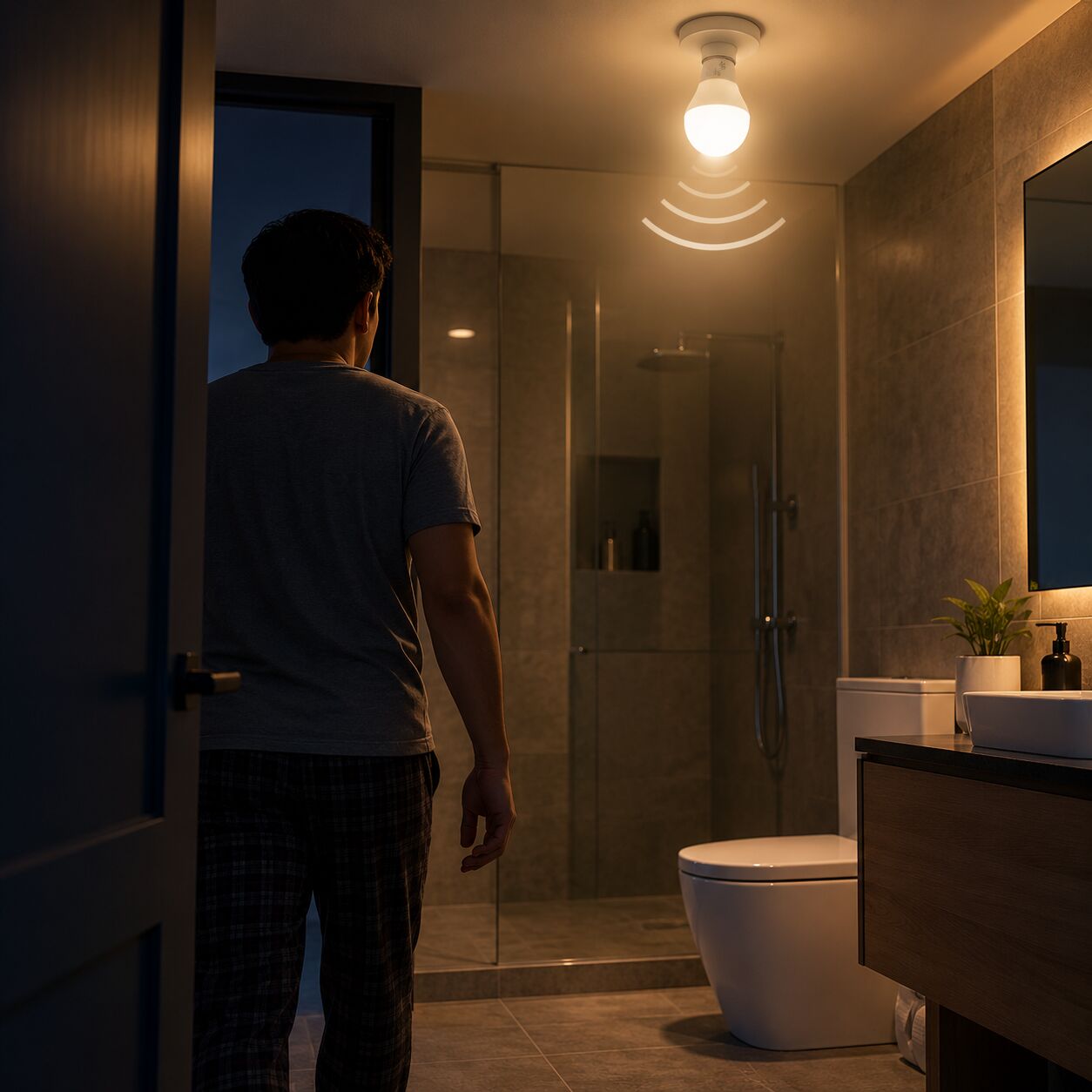
(ii) What it does: Detects human movement within a 9 meter radius in low-light conditions, illuminating automatically and shutting down after 60 seconds of vacancy.
(iii) Who it is intended for: Homeowners, apartment dwellers, senior citizens, and families wanting switch-free hands-free lighting automation without rewiring switchboards.
(iv) Primary features: Integrated PIR or Radar motion detection, daylight photocell (prevents daytime operation), direct plug-and-play B22 pin or E27 screw fitting, 60 second delay countdown, and high-efficiency 100 lm/W LED driver.
(v) Key specifications: Wattage: 7W / 10W; Luminous Output: 700 to 1000 Lumens; Socket Base Options: B22 Bayonet / E27 Screw; Voltage: 110V–270V AC, 50/60Hz; Detection Radius: 9 meters; Color Temperatures: 3000K Warm White / 6500K Cool White; IP Rating: IP20 indoor protection.
(vi) Main use cases: Staircases, building landings, bathrooms, passageways, balconies, pantries, walk-in closets, and entrance porches.
(vii) Important limitations: The wall light switch powering the socket must remain turned ON continuously for the internal sensor circuit to stay armed.
Why This Matters
Bulbs in staircases, hallways, and entry porches are frequently left turned ON all night by accident, causing unnecessarily high utility bills and shortening LED driver longevity. Swapping standard bulbs for an automatic LED light ensures light is delivered only when an occupant is present. This eliminates switch hunting in pitch-black rooms, protects children and elderly family members from trip hazards on stairs, and reduces lighting energy consumption by over 80%.
How Motion Sensor LED Lights Work
An LED motion sensor light coordinates three internal sub-systems within its frosted diffuser dome:
1. Dual-Element Motion Detection (PIR or Radar)
The bulb dome houses an internal sensor module that continuously monitors its surroundings:
PIR Thermal Sensing: A pyroelectric sensor sits behind a miniature Fresnel lens dome, tracking moving infrared thermal radiation (body heat). When a person walks into the room, the shifting heat signature triggers the driver.
Radar Microwave Sensing: High-sensitivity models emit low-power 5.8GHz electromagnetic signals and measure the frequency shift (Doppler effect) of reflected waves, detecting motion through thin glass, plastic, or acrylic shades.
2. Ambient Lux Photocell Suppression
To prevent wasting electricity during bright daylight hours, an integrated light sensor (photocell) measures surrounding light intensity. When ambient light exceeds 10 to 15 Lux, the photocell disables the motion circuit, keeping the bulb turned OFF even if movement is present.
3. Smart Auto-Off Delay Countdown
Once motion is detected in low light, the internal driver energizes the LED array to 100% brightness. An integrated electronic timer maintains full light output as long as movement continues. Once the area becomes vacant, the timer counts down 30 to 60 seconds before safely switching off power to an ultra-low 0.2W standby state.
Main Decision Factors: Comparing Features for Home Use
1. Socket Base Fitting: B22 Bayonet Pin vs. E27 Edison Screw
What to look for: Inspect your existing wall or ceiling holder before purchasing.
Why it matters: Indian homes predominantly use B22 push-and-twist bayonet holders on regular wall battens. However, decorative sconces, pendant lamps, and imported outdoor fixtures require threaded E27 screw bases.
Practical recommendation: Choose a B22 fitting for standard wall battens and staircase holders; select an E27 fitting for threaded sconces and lantern holders from the Esysense Motion Sensor
Bulb.
2. Sensing Technology: PIR Thermal vs. Microwave Radar
What to look for: Match the sensor mechanics to your light fixture housing.
Why it matters: PIR thermal sensors require an unobstructed line-of-sight because solid glass or thick fabric shades block infrared thermal signals. Microwave Radar sensors emit 5.8GHz radio waves that penetrate glass globes, acrylic diffusers, and thin wooden doors.
Practical recommendation: Use PIR sensor bulbs for exposed ceiling battens in bedrooms and bathrooms to prevent false triggers through walls; use Radar sensor bulbs for enclosed glass sconces and covered balcony fixtures.
3. Wattage & Luminance Requirements: 7W vs. 10W
What to look for: Select bulb wattage based on room dimensions and mounting height.
Why it matters: 10W sensor bulbs deliver 1000 lumens of bright light across wide stairwells and entrance porches, whereas 7W sensor bulbs provide 700 lumens suitable for small utility rooms.
Practical recommendation: Select 10W models for main thoroughfares, driveways, and multi-level landings; choose 7W models for compact restrooms, pantries, and wardrobes.
Technical Specification Comparison
1. Esysense 10W B22 Motion Sensor Bulb
Socket Base: B22 Bayonet Cap (Standard Indian Socket).
Power & Lumens: 10W / 1000 Lumens (100 lm/W).
Sensing Technology: Integrated PIR Motion + Lux Photocell.
Detection Radius: Up to 9 meters.
Auto-Off Delay: 60 Seconds.
Best Application: Main staircases, hall corridors, balconies, and entrance doors.
2. Esysense 10W E27 Motion Sensor Bulb
Socket Base: E27 Edison S