Quick Recommendation
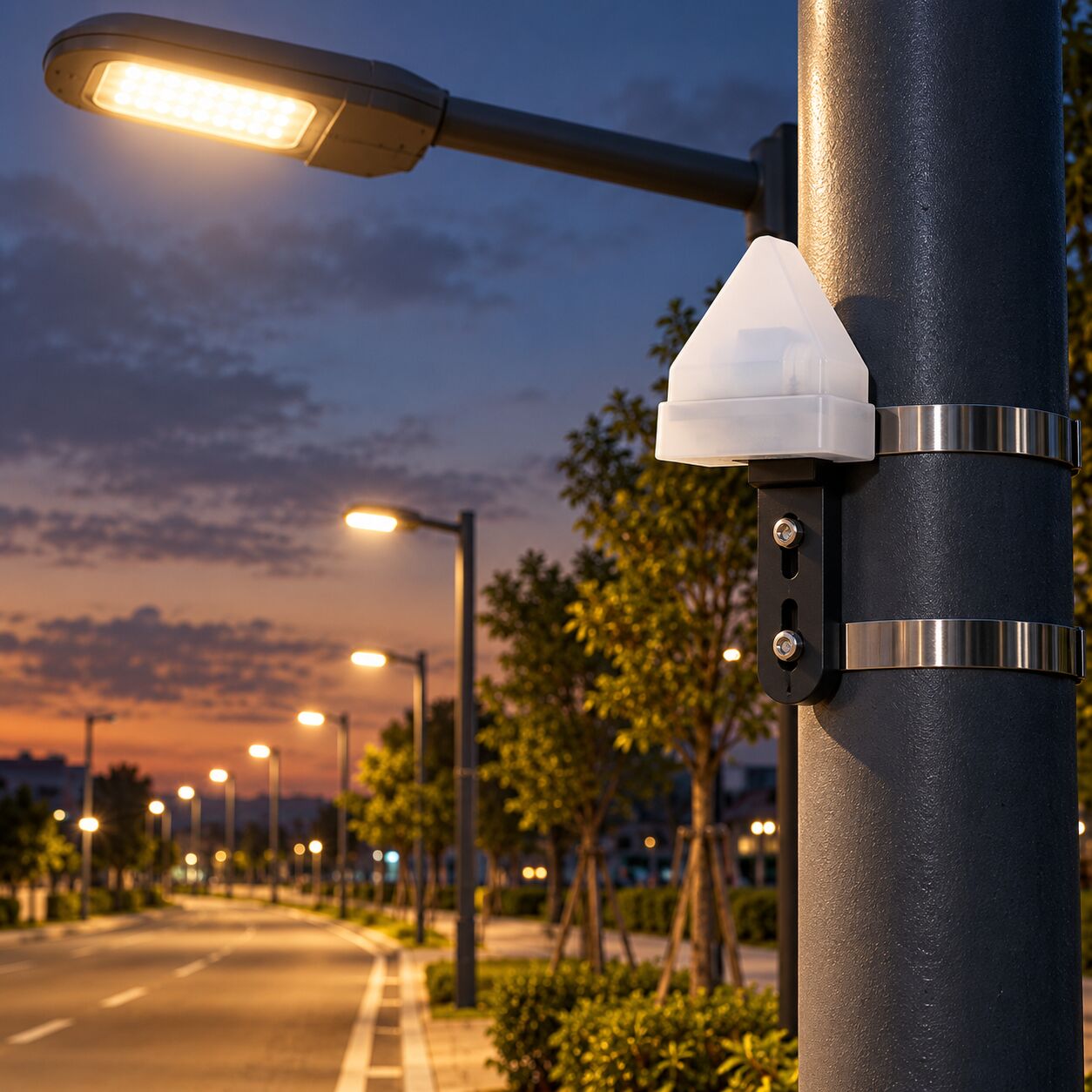
(i) Best for residential gate lamps, garden posts & balcony lights (6A Load): 6A IP44 Pole Mount Photocell Switch — Supports up to 1200W lighting loads in a compact, weatherproof housing for home perimeters.
(ii) Best for housing society street lights & perimeter floodlights (10A–16A Load): 10A / 16A IP65 Weatherproof Photocell Sensor — Features heavy-duty switching capacity and adjustable Lux sensitivity (5 to 50 Lux) for commercial outdoor pole mounting.
(iii) Best for high-capacity industrial estates, parking lots & highway lighting (20A Load): 20A IP65 Heavy-Duty Photocell Sensor — Engineered for multi-fixture commercial circuits handling up to 4000W total connected lighting loads with broad 2–100 Lux adjustment.
(iv) Explore the complete outdoor sensor range: Compare load ratings, IP weatherproof ratings, and order directly from the official Esysense Photocell LDR Sensor Switch.
Product Overview
Automatic photocell daylight switches combine photo-resistive semiconductors, ambient Lux threshold comparators, and heavy-duty mechanical switching relays within compact weatherproof enclosures.
(i) What it is: A comprehensive technical guide explaining the working mechanism, wiring principles, and load selection criteria for cadmium sulfide (CdS) photocell light switches used in outdoor lighting automation.
(ii) What it does: Measures ambient natural daylight levels to automatically energize AC lighting circuits at nightfall and break the circuit at daybreak without human intervention.
(iii) Who it is intended for: Homeowners, electrical contractors, housing society managers, industrial site directors, and municipal lighting engineers.
(iv) Primary features: Cadmium Sulfide (CdS) photo-resistive element, adjustable Lux threshold, IP44 to IP65 weatherproofing, anti-flicker time delay relay, and pole/surface mounting brackets.
(v) Key specifications: Operating Voltage: 110V–270V AC, 50/60Hz; Current Load Ratings: 6A, 10A, 16A, 20A; Switching Threshold: < 10 Lux (ON) / > 40 Lux (OFF); Standby Power Consumption: < 0.5W; Operating Temperature: -10°C to +70°C.
(vi) Main use cases: Street light poles, building perimeter floodlights, boundary gate pillars, residential garden pathways, parking lot lights, and commercial signage.
(vii) Important limitations: Must be installed in an open-sky location facing natural sunlight and positioned away from direct artificial light output produced by the lamps it controls.
Why This Matters
Leaving outdoor floodlights and street lamps burning through the day due to forgotten manual switches wastes massive amounts of electricity and shortens LED driver lifespans. Integrating an automated photocell sensor guarantees hands-free dusk-to-dawn operation, ensuring lights operate strictly when darkness falls.
How Photocell LDR Sensors Work
An LDR light switch relies on photo-resistive semiconductor physics and an electronic comparator circuit:
1. Cadmium Sulfide (CdS) Photo-Resistive Mechanics
The heart of a photocell LDR is a CdS semiconductor cell. In daylight, incoming photon radiation excites electrons into the conduction band, causing internal electrical resistance to drop dramatically (down to a few hundred ohms). In darkness, electron excitation ceases, causing resistance to surge into the Mega-ohms range.
2. Ambient Lux Threshold Comparator & Relay Triggering
An internal operational amplifier (op-amp) continuously measures the voltage drop across the CdS cell. When daylight fades below the set Lux threshold (< 10 Lux), the high resistance trips an internal electromagnetic or solid-state relay, closing the 220V AC circuit to switch connected lights ON.
3. Anti-Flicker Time Delay Protection
High-quality sensors feature an integrated RC time-delay circuit (5 to 15 seconds). This prevents transient light flashes—such as passing car headlights, lightning bolts, or shadows from moving clouds—from causing rapid, damaging relay cycling.
Main Decision Factors: Choosing a Photocell LDR Sensor
1. Amperage & Current Load Capacity (6A, 10A, 16A, 20A)
What to look for: Calculate the total wattage of all connected lamps before choosing a sensor rating.
Why it matters: Standard 6A sensors support up to 1200W resistive loads (ideal for single gate lights or small garden loops). Commercial street light lines require 10A (2000W), 16A (3200W), or 20A (4000W) sensors to handle heavy startup inrush currents without contacts welding together.
Practical recommendation: Use 6A models for home gate pillars and small balconies; select 10A to 20A models for housing colony street light poles and commercial floodlight grids.
2. Ingress Protection (IP44 vs. IP65 Weatherproofing)
What to look for: Inspect the installation environment for direct rain, dust, and jetting water exposure.
Why it matters: IP44 housing protects against splashing water from any direction (suitable for covered porch walls and protected gate posts). IP65 housing offers full dust-tight seals and protection against pressurized water jets (essential for fully exposed street light poles).
Practical recommendation: Choose IP65-rated units for exposed high-pole installations subjected to harsh monsoon conditions.
3. Adjustable Lux Sensitivity vs. Fixed Thresholds
What to look for: Determine if your installation site receives partial shade or dense foliage cover.
Why it matters: Fixed sensors trigger strictly at pre-set light levels (e.g., < 10 Lux). Adjustable Lux models allow precise tuning, preventing premature light activation in tree-shaded residential driveways.
Practical recommendation: Opt for adjustable Lux models when installing sensors under building eaves, near dense trees, or inside shadowed courtyard zones.
Technical Specification Comparison
1. Esysense 6A IP44 Pole Mount Photocell Sensor Switch
Rated Current: 6 Amp (Up to 1200W Load).
Ingress Protection: IP44 Weatherproof.
Lux Sensitivity: Fixed Threshold (< 10 Lux ON / > 40 Lux OFF).
Operating Voltage: 220V–270V AC, 50/60Hz.
Mounting Style: Pole Mount.
Best Application: Residential main gates, boundary wall lamps, small garden posts, and home balconies.
2. Esysense 10A IP65 Pole Mount Photocell Sensor Switch
Rated Current: 10 Amp (Up to 2000W Load).
Ingress Protection: IP65 Water & Dust Tight.
Lux Sensitivity: Adjustable (5 to 50 Lux).
Operating Voltage: 110V–270V AC, 50/60Hz.
Mounting Style: Outdoor Surface Mount.
Best Application: Apartment complex pathways, hotel entrance driveways, and small parking bays.
3. Esysense 16A IP65 Weatherpro