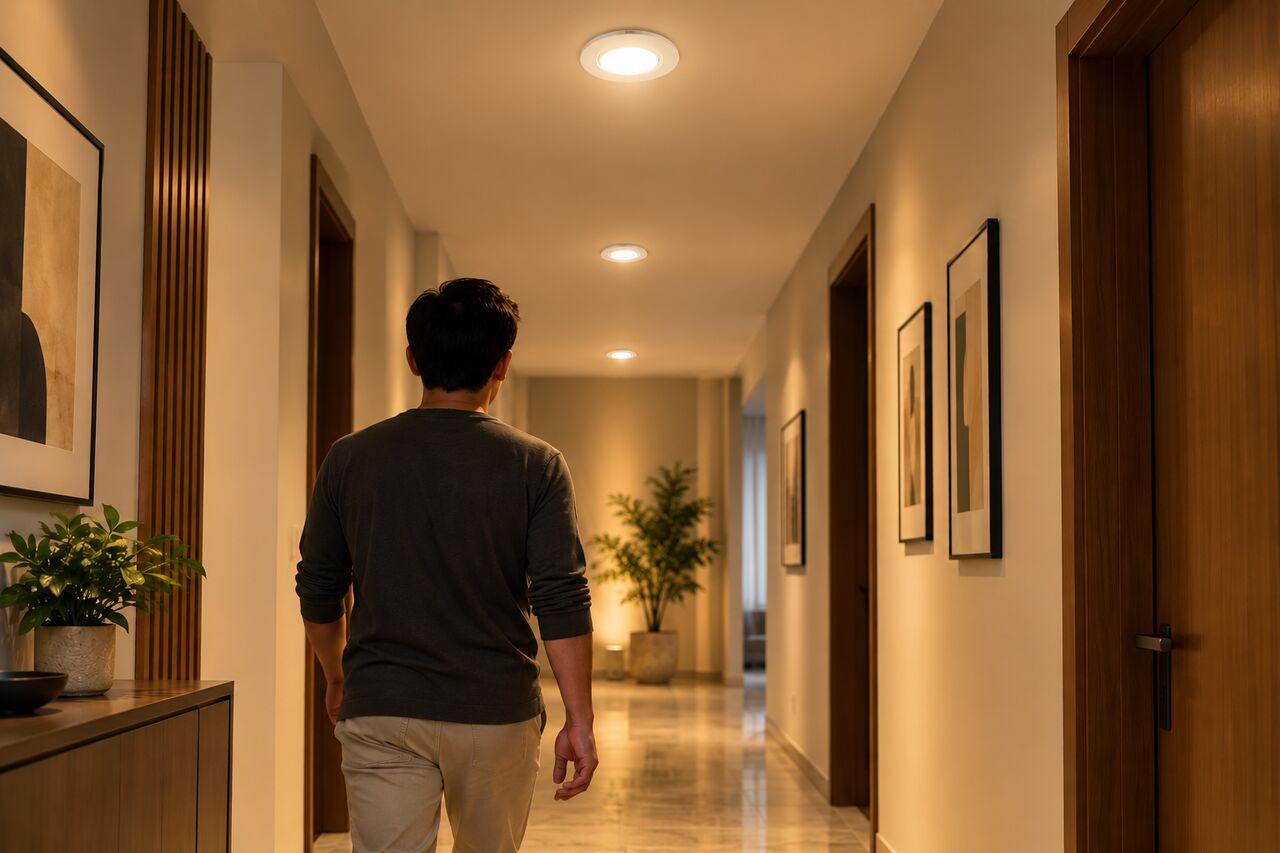
Quick Recommendation
(i) Best for compact hallways, bath spaces & storage areas: 7W Motion Sensor Concealed Downlight — Delivers 700 lumens of glare-free illumination, fitting into standard false ceiling cutouts and junction boxes.
(ii) Best for high-traffic corridors, main entrance foyers & staircases: 10W Motion Sensor Concealed Downlight — Provides 1000 lumens of wide-angle overhead coverage for expansive residential and commercial corridors.
(iii) Best for balconies, outdoor foyers & perimeter entries: 10W Motion & Day/Night Sensor Concealed Downlight — Combines 360° PIR motion sensing with integrated Lux photocells to prevent daylight activation.
(iv) Learn more about layout and advantages: Read the comprehensive guide on the top benefits of installing motion sensor concealed downlights.
Product Overview
Flush-mount motion sensor ceiling downlights integrate optical lenses, PIR thermal sensors, LED arrays, and internal drivers directly into a slim panel housing designed for recessed installation into false ceiling cutouts or junction boxes.
(i) What it is: A recessed ceiling fixture that integrates an LED downlight with motion sensor control inside a flush-mount panel, eliminating external switch box wiring.
(ii) What it does: Automatically powers on overhead LEDs when human movement enters its 360-degree detection zone in low-light conditions, switching off after a preset delay when occupants leave.
(iii) Who it is intended for: Architects, electrical contractors, interior designers, and homeowners seeking seamless architectural lighting automation without bulky wall sensors.
(iv) Primary features: 360° ceiling-mount PIR sensor, integrated Lux photocell (day/night options), 30–60 second off-delay, spring-loaded ceiling retaining clips, and frosted acrylic diffusers.
(v) Key specifications: Wattage: 7W / 10W; Voltage: 220V–270V AC, 50Hz; Detection Angle: 360° Overhead Cone; Detection Range: Up to 9 meters; Delay Time: Up to 60 seconds; IP Rating: IP20; Color Temperatures: Warm White (3000K) / Cool White (6500K).
(vi) Main use cases: False ceiling corridors, stairwell landings, residential bathrooms, entrance foyers, covered balconies, lift lobbies, and commercial storage rooms.
(vii) Important limitations: Designed for indoor recessed false ceilings or junction box installations; requires clear, unobstructed line-of-sight from the ceiling downward.
Why This Matters
Traditional recessed downlights in long corridors, staircases, and guest bath spaces are frequently left burning for hours due to manual switch oversights. A recessed concealed motion sensor light delivers hands-free lighting, maintains clean ceiling aesthetics, and reduces energy bills by operating strictly when spaces are occupied.
How LED Downlights with Motion Sensors Work
An automated sensor downlight combines wide-angle ceiling thermal optics and integrated driver regulation into a single flush fixture:
1. 360-Degree Overhead PIR Optics
The centered frosted sensor dome on the downlight bezel protects a multi-faceted Fresnel lens housing a pyroelectric thermal element:
Overhead Detection Cone: When mounted at standard ceiling heights (2.4 to 3.0 meters), the 360° lens projects a conical motion-detection footprint spanning up to 9 meters in diameter across the floor.
Thermal Contrast Trigger: Detects the heat signature of moving human bodies (37° C) relative to background room temperature, immediately closing the circuit driver.
2. Integrated Day/Night Photocell Suppression
Models equipped with dual sensing feature a daylight photocell that monitors ambient Lux levels. During daylight hours (> 10 to 15 Lux), the light remains dormant even if motion occurs beneath the fixture.
Main Decision Factors: Choosing a Sensor Downlight
1. Wattage & Illumination Output
What to look for: Choose fixture wattage based on ceiling height and space square footage.
Why it matters: A 7W unit (approx. 700 lumens) provides soft, efficient illumination for small residential bathrooms, walk-in closets, and narrow pantries. A 10W unit (approx. 1000 lumens) provides full-coverage illumination for wider entrance foyers, stair landings, and long hallways.
Practical recommendation: Specify 7W fixtures for spaces under 60 sq. ft.; choose 10W fixtures for main residential hallways and commercial corridors.
2. Sensing Mode (Standard Motion vs. Dual Day/Night Photocell)
What to look for: Evaluate ambient natural light exposure in the target room.
Why it matters: Standard auto ON/OFF downlights activate upon motion regardless of daylight, ideal for windowless interior corridors and basements. Day/Night models suppress daytime operation, saving power in sunlit foyers and covered balconies.
Practical recommendation: Select standard motion models for windowless internal corridors; select Day/Night models for entry foyers, balconies, and spaces receiving daylight. Learn how to optimize placement by reading the motion sensor concealed downlights.
3. Ceiling Cutout & Recessed Installation Depth
What to look for: Verify ceiling cavity depth and existing cutout dimensions before cutting false ceiling boards.
Why it matters: Recessed downlights feature spring-loaded side clips that grip gypsum, POP, or grid ceiling boards. Ensuring adequate cavity depth allows heat dissipation and clean flush mounting.
Practical recommendation: Ensure at least 50mm of clearance inside false ceiling cavities for smooth spring-clip installation and cable driver positioning.
Technical Specification Comparison
1. 7W Motion Sensor Concealed Downlight
Wattage & Output: 7W / ~700 Lumens.
Functional Options: Auto ON/OFF + Day/Night Photocell.
Detection Footprint: 360° Overhead Cone / Up to 9 meters range.
Off-Delay Time: 30 to 60 seconds auto shutoff.
Operating Voltage: 220V–270V AC, 50Hz.
Best Application: Residential bathrooms, walk-in closets, utility balconies, and small pantries.
2. 10W Motion Sensor Concealed Downlight
Wattage & Output: 10W / ~1000 Lumens.
Functional Options: Auto ON/OFF + Day/Night Photocell.
Detection Footprint: 360° Overhead Cone / Up to 9 meters range.
Off-Delay Time: 30 to 60 seconds auto shutoff.
Operating Voltage: 220V–270V AC, 50Hz.
Best Application: Entrance foyers, multi-level stairwells, apartment corridors, and commercial reception areas.
Step-by-Step Installation & Wiring Guide
Installing a recessed concealed motion sensor light follows standard false ceiling wiring practices: