Quick Recommendation
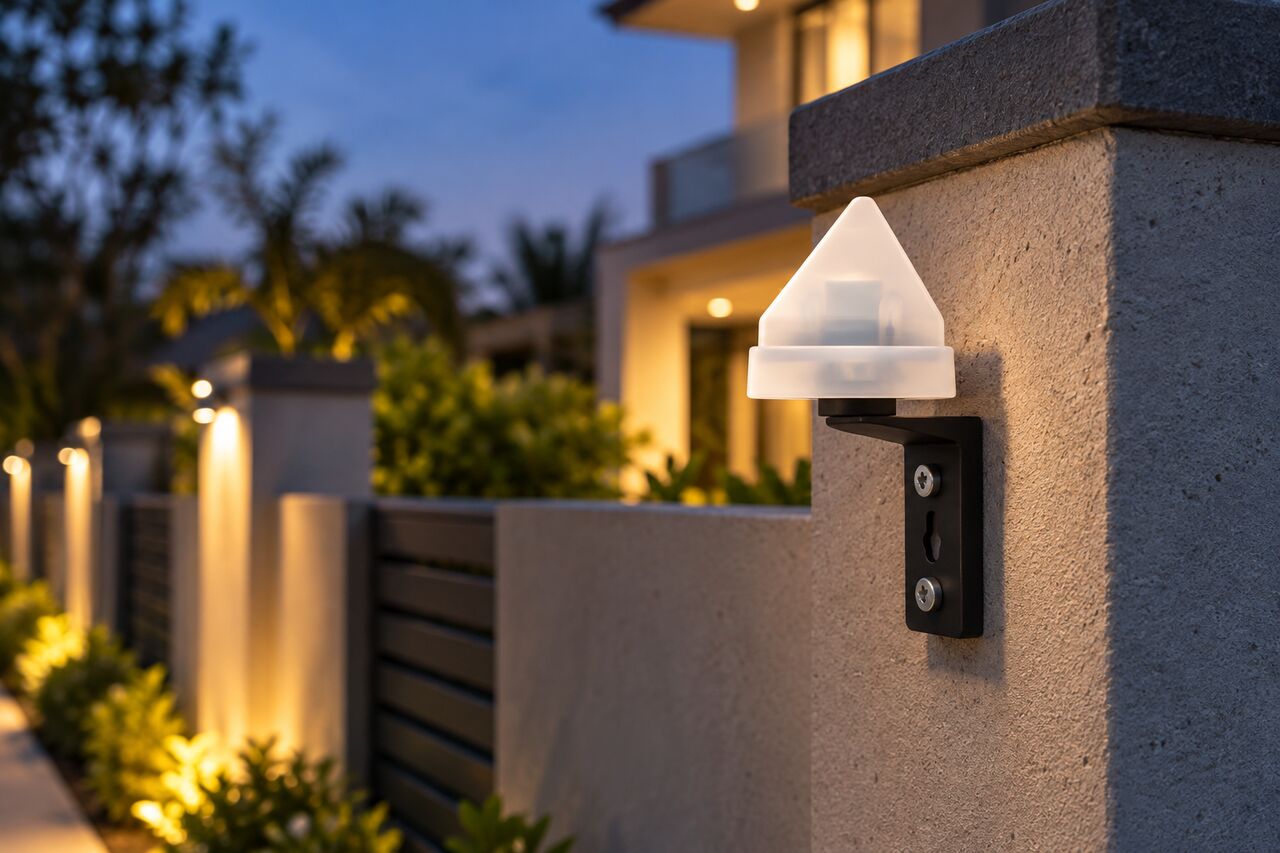
(i) Best for residential gate posts, garden sconces & porch lamps: Compact Pole-Mount Photocell Sensor Switch — Mounts cleanly on wall brackets or lamp posts, delivering reliable 110V–270V AC dusk-to-dawn switching for up to 1000W of LED lighting.
(ii) Best for commercial perimeter floodlights, parking bays & street lamps: 16A IP65 Weatherproof Photocell LDR Sensor — Features a heavy-duty relay capable of controlling large LED driver clusters up to 16A resistive loads under harsh rain and dust exposure.
(iii) Best for industrial parks, high-bay outdoor fixtures & wide Lux tuning: 20A Heavy-Duty IP65 Photocell Sensor — Features an extended 2–100 Lux sensitivity adjustment knob for precision dawn-dusk calibration across large facilities.
(iv) Explore the complete outdoor sensor range: Check technical specifications, load ratings, and order directly from the official Esysense Photocell Sensor.
Product Overview
Automatic outdoor photocell sensors integrate cadmium sulfide (CdS) photoresistors or silicon photodiodes, internal electromagnetic relay switches, hysteresis delay circuits, and IP-rated weatherproof enclosures into a standalone control unit.
(i) What it is: An external light-sensing switch installed inline between 230V AC mains power and outdoor luminaires to enable automatic dusk-to-dawn switching.
(ii) What it does: Continuously measures ambient Lux levels, automatically energizing connected outdoor lights as dusk approaches and disconnecting power at sunrise.
(iii) Who it is intended for: Homeowners, electrical contractors, facility managers, municipal engineers, and commercial property owners.
(iv) Primary features: Light-dependent resistor (LDR) optical element, 5–50 Lux ambient light threshold, built-in time-delay anti-flicker hysteresis, IP44/IP65 ingress protection, and pole/wall mounting brackets.
(v) Key specifications: Operating Voltage: 110V–270V AC, 50/60Hz; Current Load Ratings: 6A, 10A, 16A, 20A (up to 2000W LED load); Ambient Light Threshold: 5–50 Lux (or 2–100 Lux adjustable); Ingress Protection: IP44 to IP65; Operating Temperature: -10°C to +70°C.
(vi) Main use cases: Main entrance gates, perimeter floodlights, garden path lights, street lamps, commercial parking lots, building facades, and signage illumination.
(vii) Important limitations: Must be positioned with clear access to sky daylight while facing away from artificial light sources (like the bulb it controls) to prevent rapid ON/OFF oscillation.
Why This Matters
Outdoor security and landscape lighting are frequently left running 24/7 due to forgotten manual switches or outdated mechanical timers that fail to adapt to seasonal sunrise/sunset shifts. Installing a dedicated photocell sensor for outdoor lights provides precise astronomical lighting control year-round, extending LED fixture life while eliminating daytime energy loss.
How Photocell Sensors for Outdoor Lights Work
An outdoor photocell sensor operates using solid-state photoconductive principles paired with electromagnetic switching:
1. Light-Dependent Resistor (LDR) Photoconductive Mechanics
The core sensing element is a cadmium sulfide (CdS) semiconductor photoresistor:
Daylight State (High Lux): Photons hitting the LDR surface free electrons, reducing internal electrical resistance to a few hundred ohms. Current flows through an internal sensing circuit, keeping the load relay OPEN (OFF).
Dusk/Night State (Low Lux): As ambient sunlight fades below 15 Lux, photo-excitation drops, causing LDR resistance to spike into mega-ohms. This voltage shift signals the internal trigger circuit to close the load relay (ON).
2. Built-In Hysteresis & Anti-Flicker Time Delay
To prevent rapid flickering caused by momentary shadows, passing car headlights, or lightning flashes, modern photocell switches incorporate a thermal or electronic time delay (typically 15 to 30 seconds). The ambient light level must remain consistently below or above the Lux threshold for the delay duration before the relay toggles power.
Main Decision Factors: Choosing a Photocell Sensor for Outdoor Lights
1. Current Load Rating
What to look for: Calculate the total combined wattage of all outdoor LED lights connected to the single sensor switch circuit.
Why it matters: Standard 6A or 10A sensors comfortably handle residential porch lamps, gate lights, and small garden circuits up to 600W–1000W LED. High-capacity 16A or 20A sensors are required for commercial floodlight arrays, street lighting poles, and industrial perimeters drawing up to 2000W LED.
Practical recommendation: Choose a 10A unit for residential perimeter circuits; specify a 16A or 20A unit from the Esysense Photocell Sensor for heavy commercial floodlight banks.
2. Ingress Protection & Weatherproofing
What to look for: Inspect the installation environment for direct rain, dust, and jet water exposure.
Why it matters: IP44-rated sensors suit sheltered porch eaves and covered post boxes. IP65-rated sensors feature silicone gaskets and UV-stabilized polycarbonate caps designed to withstand heavy tropical rainfall, dust storms, and direct sun exposure.
Practical recommendation: Select IP65-rated photocell sensors for all unsheltered outdoor poles, boundary walls, and rooftops.
3. Lux Threshold Sensitivity & Adjustment
What to look for: Determine if your project requires fixed twilight switching (5–50 Lux) or custom Lux calibration (2–100 Lux).
Why it matters: Fixed-threshold sensors trigger reliably at standard twilight. Adjustable models allow facility managers to fine-tune activation so lights turn on earlier during stormy weather or later in brightly lit urban zones.
Practical recommendation: Standard fixed 5–50 Lux units work best for residential homes; choose adjustable Lux models for commercial properties.
Technical Specification Comparison
1. 10A IP65 Pole-Mount Photocell Sensor Switch
Current Capacity: 10A Resistive / Load Capacity up to 1000W LED.
Operating Voltage: 110V–270V AC, 50–60Hz.
Protection Rating: IP65 Water and Dust Resistant.
Sensitivity Threshold: Fixed 5 to 50 Lux.
Mounting Style: Pole-Mount.
Best Application: Residential entry gates, villa garden boundary lights, and street lamp posts.
2. 16A IP65 Weatherproof Photocell LDR Sensor Switch
Current Capacity: 16A Heavy-Duty Relay / Load Capacity up to 1600W LED.
Operating Voltage: 110V&ndash